
Top managed database services in 2026
Managed database services provision, operate, and maintain your database infrastructure so your engineering team does not have to. The right platform depends on which database engines your stack uses, whether you need to run inside your own cloud account, and how much you need beyond the database itself.
- Northflank – Managed PostgreSQL, MySQL, MongoDB, Redis, MinIO, Memcached, and RabbitMQ. Run on Northflank's managed cloud or self-serve BYOC into AWS, GCP, Azure, Oracle, CoreWeave, Civo, on-premises, and bare-metal. Deploy databases alongside your applications, workers, and CI/CD in the same control plane.
- Supabase – Managed PostgreSQL bundled with authentication, real-time subscriptions, and auto-generated APIs. Best for MVPs and SaaS teams that want a full backend layer out of the box.
- PlanetScale – Managed MySQL and PostgreSQL with schema branching and non-blocking migrations via Vitess. Best for teams at extreme MySQL scale or teams that want Git-like schema workflows.
- Neon – Serverless PostgreSQL with scale-to-zero and database branching. Best for variable workloads and branch-per-PR development workflows.
- CockroachDB – Distributed SQL database with PostgreSQL wire compatibility, multi-region survivability, and horizontal scaling. Best for globally distributed applications that require strong consistency across regions.
Most teams running a single database engine start with Supabase, Neon, or PlanetScale depending on their workflow. Teams that need multiple database types, BYOC deployment, or databases running alongside their application stack evaluate Northflank. Teams building globally distributed applications with strict consistency requirements evaluate CockroachDB.
Running a database yourself means handling provisioning, version upgrades, backups, failover, connection pooling, and monitoring. That is significant engineering overhead, especially as your team scales and multiple environments need to stay in sync. Managed database services take that operational surface off your plate entirely.
The tradeoff with most providers is scope. Most managed database services cover one or two database types on their own infrastructure with no path to BYOC. That works until your stack grows, compliance surfaces as a requirement, or you need Redis alongside Postgres without adding a second provider.
These are the dimensions that matter when evaluating managed database platforms for production workloads.
- Database coverage: Does the platform support the full set of engines your stack uses? Postgres and MySQL are table stakes. Redis for caching, MongoDB for documents, RabbitMQ for messaging, and MinIO for object storage are common additions that most providers do not cover.
- Deployment model: Can you deploy inside your own cloud account, or are you locked into the provider's infrastructure? BYOC matters when compliance, data residency, or cost optimization are requirements.
- Backups and restore: Automated backups, point-in-time recovery, and import from external sources are non-negotiable for production workloads.
- Scaling: Can you scale vertically and horizontally without downtime, from the UI, API, and CLI?
- Observability: Real-time logs, performance metrics, and connection monitoring should be built in.
- Stack integration: If your database needs to run alongside services, workers, and pipelines, a platform that handles the full stack in one control plane reduces operational complexity significantly.
- Pricing model: Usage-based, per-second billing with no hidden fees scales more predictably than flat monthly tiers with opaque jumps.
Northflank is a full-stack cloud platform with managed databases as a native first-class feature. You can deploy PostgreSQL, MySQL, MongoDB, Redis, MinIO, Memcached, and RabbitMQ as managed addons alongside your applications, background workers, CI/CD pipelines, and GPU workloads from the same control plane. Databases provision in minutes via UI, API, or CLI. Connection details are injected directly into connected services via secret groups, with no manual environment variable management required.
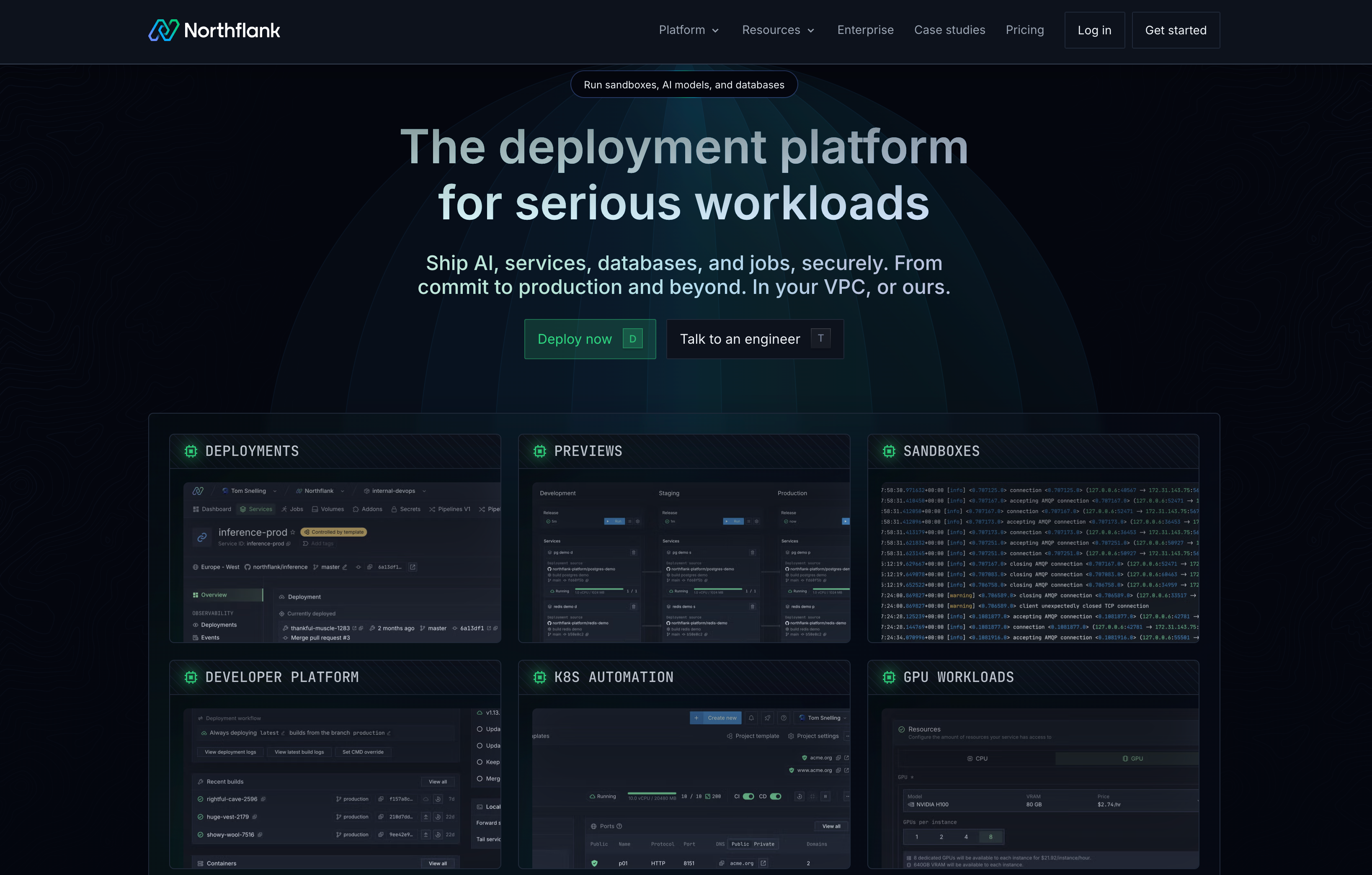
Every addon includes automated backups with restore and fork support, horizontal and vertical scaling, real-time logs and metrics, TLS, and pause/restart for development databases. BYOC is available self-serve into AWS, GCP, Azure, Oracle, CoreWeave, Civo, on-premises, and bare-metal, meaning your databases run inside your own infrastructure with your data never leaving your VPC. Postgres ships with pgvector for AI similarity search, connection poolers for high-connection workloads, and automated failover. Redis supports Sentinel for high availability and configurable eviction policies. Preview environments spin up isolated database instances per pull request and tear them down on merge.
Key features:
- Database catalog: PostgreSQL (pgvector, connection poolers, automated failover), MySQL, MongoDB, Redis (Sentinel, HA), MinIO (S3-compatible), Memcached, and RabbitMQ.
- Automated backups: Create, import, restore, and fork across all addon types. Import from URL, file upload, or connection string.
- Scaling: Horizontal and vertical scaling from the UI, API, or CLI. Adjustable at any time without downtime.
- Secret group injection: Connection details are injected directly into services and jobs.
- Preview environments: Isolated database instances per pull request with automatic teardown on merge.
- Managed cloud or BYOC: Run on Northflank's managed cloud or self-serve BYOC into AWS, GCP, Azure, Oracle, CoreWeave, Civo, on-premises, or bare-metal.
- SOC 2 Type 2 certified: Covers managed cloud and BYOC deployments.
- Access: UI, API, CLI, and GitOps.
Best for: Teams that need multiple database types on a single platform, SaaS and AI teams running databases alongside services and workers, and enterprises with compliance or data residency requirements that need databases running inside their own infrastructure.
Pricing: PostgreSQL from $2.70/month. MySQL from $3.91/month. Redis and RabbitMQ from $2.21/month. All billed usage-based per second with no hidden fees.
Get started on Northflank (self-serve, no demo required). Or book a demo with an engineer to walk through your database requirements.
Supabase is an open-source Firebase alternative built on PostgreSQL. It bundles a managed Postgres database with authentication, real-time subscriptions, auto-generated REST and GraphQL APIs, and edge functions in a single platform. For MVPs and early-stage SaaS products where the built-in auth and API layer reduce setup time, it is a practical starting point. Free tier projects provision instantly with 500MB database storage and 50,000 monthly active users for auth.
Supabase is PostgreSQL-only with no Redis, MongoDB, or messaging layer. The managed offering runs on Supabase's AWS infrastructure with no BYOC option. Free tier projects pause after one week of inactivity. HIPAA compliance requires the Team plan at $599/month plus an add-on.
Best for: MVPs, early-stage SaaS, and teams that want auth, real-time, and APIs bundled with Postgres out of the box.
Pricing: Free with 500MB database. Pro at $25/month. Team at $599/month. Enterprise custom.
PlanetScale is a managed MySQL and PostgreSQL platform built on Vitess, the sharding layer that powers YouTube's database infrastructure. Its core differentiator is the developer workflow: schema branching that lets teams create, review, and merge schema changes like pull requests, with non-blocking migrations that avoid table locks in production. PlanetScale supports BYOC on AWS and GCP for enterprise customers.
MySQL on PlanetScale does not enforce foreign key constraints at the database level due to Vitess's sharding architecture. PlanetScale removed its free tier in 2024. It is the strongest option for teams at extreme MySQL scale or teams that need safe, non-blocking schema migrations as a production primitive.
Best for: Teams at extreme MySQL scale, teams that need non-blocking schema migrations, and Postgres teams that value the schema branching workflow.
Pricing: From $5/month. Enterprise custom. BYOC is available on AWS and GCP for enterprise plans.
Neon offers serverless PostgreSQL with separated storage and compute, enabling scale-to-zero for idle databases and database branching in development workflows. Compute resumes in around 150ms when a connection arrives. The branching feature creates full copy-on-write copies of a database in milliseconds, which integrates cleanly into branch-per-PR preview environment workflows. Neon was acquired by Databricks in 2025.
Neon is PostgreSQL-only with no Redis, MongoDB, or other database types, and managed-only with no BYOC option. Cold starts affect latency-sensitive applications that need consistent response times. For production teams that need multiple databases in one platform or BYOC deployment, the alternatives are more appropriate.
Best for: Serverless-first applications with variable traffic, development workflows that need branch-per-PR databases, and teams minimizing database costs for staging and preview environments.
Pricing: Free plan with 100 projects and 100 compute unit hours per project. Launch from $15/month. Scale from $701/month.
CockroachDB is a distributed SQL database with PostgreSQL wire compatibility designed for globally distributed applications that require strong consistency across regions. It replicates data automatically across nodes, survives node and datacenter failures without manual intervention, and provides ACID transactions across distributed writes. The managed cloud offering runs on AWS, GCP, and Azure with three tiers: Basic, Standard, and Advanced.
CockroachDB is PostgreSQL-compatible but not a drop-in replacement. Some PostgreSQL features behave differently due to the distributed architecture, and teams migrating from standard Postgres should validate compatibility before committing. Multi-region deployments increase cost significantly through additional compute, storage replication, and cross-region data transfer charges. It is managed-only with no BYOC option on standard plans. For teams that need distributed SQL with global survivability and are comfortable with the operational and cost tradeoffs, CockroachDB is the category leader.
Best for: Globally distributed applications that require strong transactional consistency across regions, fintech, and mission-critical workloads that need zero-downtime datacenter failure recovery.
Pricing: Basic free tier available. Standard and Advanced plans are usage-based on compute, storage, and transfer. Enterprise custom.
If you need more than one database type, or databases running alongside your application services in one place, Northflank is the only option here that covers the full stack with self-serve BYOC. Supabase, PlanetScale, Neon, and CockroachDB are each purpose-built for a specific database engine and use case.
If managed infrastructure is acceptable and you need just PostgreSQL, the choice comes down to what you need beyond the database: Supabase for auth and APIs bundled in, PlanetScale for MySQL scale and schema branching, Neon for serverless economics and branch-per-PR workflows, and CockroachDB for globally distributed SQL with multi-region survivability.
| Platform | Databases | BYOC | Free tier | Entry pricing | Billing model |
|---|---|---|---|---|---|
| Northflank | Postgres, MySQL, MongoDB, Redis, MinIO, Memcached, RabbitMQ | Yes, self-serve | Yes, 1 free database | Postgres from $2.70/month | Per second, usage-based |
| Supabase | PostgreSQL | No | Yes (pauses after 1 week) | Pro from $25/month | Tiered + usage overages |
| PlanetScale | MySQL, PostgreSQL | Enterprise (AWS & GCP) | No | From $5/month | Tiered + row-based overages |
| Neon | PostgreSQL | No | Yes (100 projects, 100 CU hours each) | Launch from $15/month | Serverless compute units |
| CockroachDB | Distributed SQL (PostgreSQL-compatible) | No (standard plans) | Yes (Basic tier) | Standard usage-based | Compute, storage, and transfer |
With a managed database, the provider handles provisioning, patching, backups, failover, and scaling. With a self-hosted database, your team owns the full operational stack. Managed databases cost more per unit of compute but reduce engineering overhead significantly, especially as your environment count grows.
Yes. Northflank BYOC lets you deploy managed databases inside your own AWS, GCP, Azure, Oracle, CoreWeave, Civo, on-premises, or bare-metal infrastructure, self-serve. The managed experience is identical to Northflank's managed cloud, but your data never leaves your own infrastructure.
Yes. PostgreSQL and Redis support primary and read replicas with automated failover. Redis Sentinel is available for automated master discovery and failover. Replica counts and compute plans are adjustable from the resources page at any time without downtime.
Northflank and Neon both support branch-per-PR database environments. Northflank spins up isolated addon instances per preview environment across all supported database types. Neon creates lightweight copy-on-write Postgres branches in milliseconds. For teams using multiple database types, Northflank covers the full stack. For Postgres-only teams, Neon's branching is purpose-built for this workflow.
Most managed database decisions come down to one question: do you need a single database engine optimized for a specific workflow, or do you need the full stack?
Supabase, PlanetScale, Neon, and CockroachDB each address a specific use case. Supabase bundles Postgres with auth and APIs. PlanetScale covers MySQL scale and schema branching. Neon provides serverless Postgres economics. CockroachDB handles globally distributed SQL with multi-region survivability.
Northflank is the right call when you need more than one database type, when databases need to run alongside application services in a single platform, or when compliance requires execution inside your own infrastructure.
You can get started for free on Northflank or talk to the team to walk through your database requirements.