
Top managed Kubernetes hosting platforms in 2026
Most enterprises need more than a managed control plane. They need the full deployment lifecycle: CI/CD, preview environments, sandbox isolation for AI-generated code, and BYOC for data residency. Here is how the top platforms compare.
- Northflank – A platform built for the full lifecycle of AI-native software delivery on Kubernetes. Managed Kubernetes underneath, PaaS-quality DX on top. Self-serve BYOC into AWS, GCP, Azure, Oracle, CoreWeave, Civo, on-premises, and bare-metal. Built-in CI/CD, preview environments, sandboxes, GPU workloads, secrets management, RBAC, SSO, and audit logging. Designed to run untrusted AI-generated code at scale, inside your own VPC, with the security guardrails enterprises require.
- AWS EKS – The default for AWS-native production workloads. Best for teams with existing AWS gravity and a platform engineering team that speaks IAM.
- Google GKE – The most polished managed Kubernetes experience from any hyperscaler. Autopilot mode removes node management entirely. Best for teams who want the cleanest K8s experience without AWS lock-in.
- Azure AKS – Free control plane on the no-SLA tier. Best for Microsoft-aligned enterprise shops with existing Entra ID infrastructure.
- DigitalOcean Kubernetes – Free control plane, simple setup, predictable pricing. Best for small teams running standard workloads without compliance requirements.
- Civo – K3s-based managed Kubernetes with fast provisioning and low costs. Best for developers and small teams that want fast cluster spin-up without hyperscaler complexity.
Northflank has been running untrusted code at scale by default since 2021. Every feature other platforms are shipping around sandboxing and AI-native deployment has been in production on Northflank for years. Claude Code and Codex work with Northflank's API and CLI so an agent can build and deploy end to end. Non-developers can use the UI. Enterprises can run everything inside their own VPC. Sign up to get started or book a demo.
Most teams searching for managed Kubernetes in 2026 need more than a managed control plane. They need a platform that runs Kubernetes underneath but exposes developer-friendly abstractions on top. The distinction matters more than ever as AI coding tools push more people across organizations to ship software at 10x to 100x the PR volume existing platforms were built to handle.
The requirements for Kubernetes platforms changed when AI coding tools became mainstream enterprise infrastructure. The platforms listed here are evaluated not just on cluster management but on the full set of requirements that enterprises face when AI agents generate and deploy code at scale.
- Developer experience without YAML. Can your team go from a Git push to a live deployment without writing Kubernetes manifests? The best platforms provide clean UIs, APIs, GitOps support, and automatic CI/CD without requiring infrastructure knowledge.
- Preview environments. Every pull request should deploy an isolated copy of the application for end-to-end testing. At 10x to 100x the PR volume that AI coding tools generate, this must be automated and fast.
- Sandbox isolation for AI-generated code. Any platform running code generated by AI agents needs microVM isolation so each execution runs in its own dedicated kernel. Standard container isolation is not sufficient for untrusted code at scale.
- BYOC and data residency. Enterprises in regulated industries need workloads running inside their own cloud account or on-premises, with their own network controls and audit trails. Self-serve BYOC without an enterprise sales process is the correct standard in 2026.
- Secrets management and RBAC. SOC 2 Type 2, HIPAA, and FedRAMP audits require demonstrable access controls and audit logging. These should be built into the platform, not bolted on.
- GPU workloads. AI coding agents increasingly require GPU inference alongside standard services. A platform that handles both in the same control plane reduces operational complexity.
Northflank is a platform built for the full lifecycle of AI-native software delivery on Kubernetes. It is the answer to the problem most managed Kubernetes platforms do not address: enterprises now have non-engineers shipping software with Claude Code, Lovable, and Bolt. That is untrusted code that needs to run securely at scale. No other platform meets the requirements enterprises are raising: run in their own cloud or multi-cloud, the right primitives for the full deployment lifecycle, CI/CD, preview environments, disaster recovery, sandboxes with strong multi-tenancy, and the governance controls that regulated industries require.
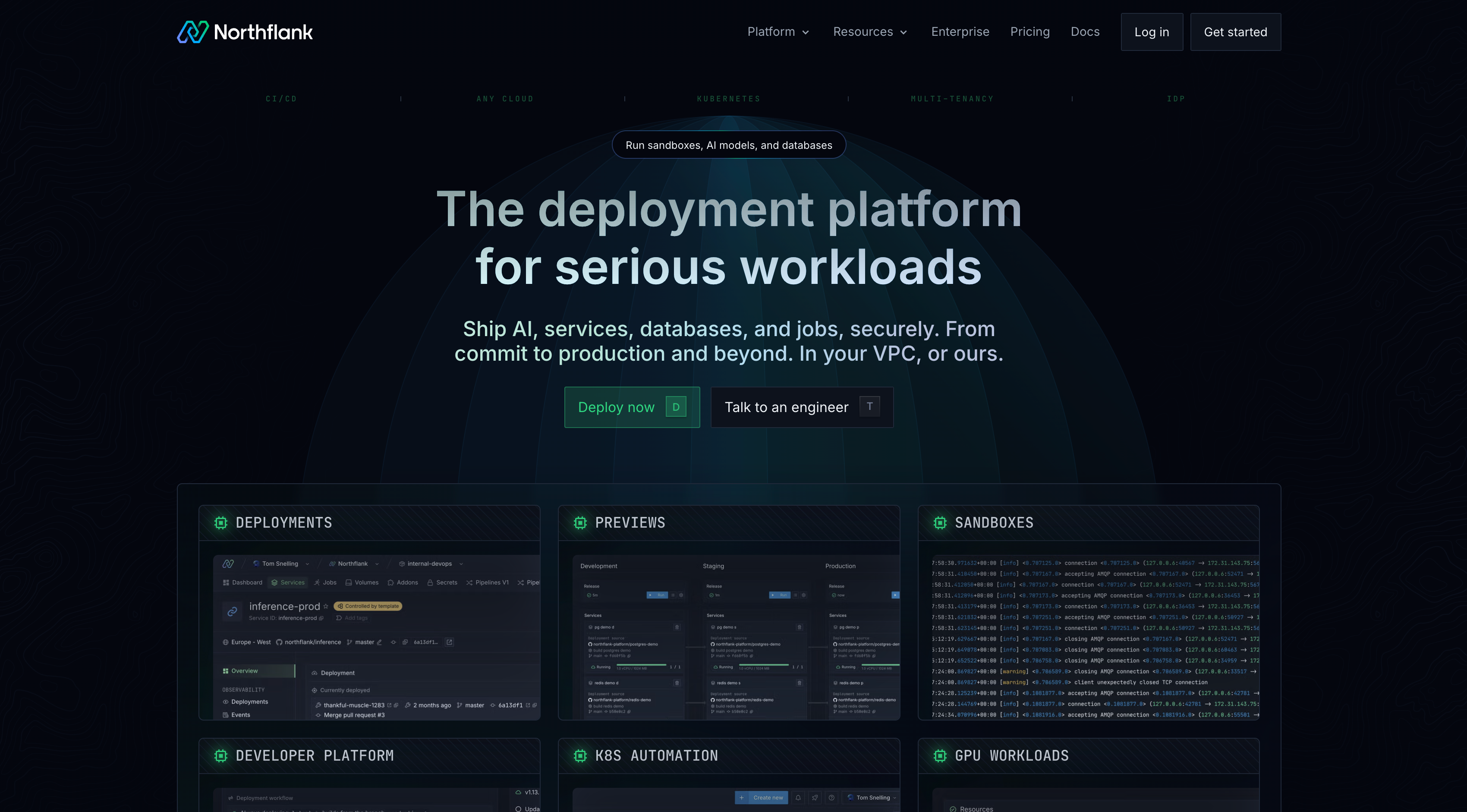
Northflank has been running untrusted code at scale by default since 2021. The platform provides managed Kubernetes underneath with a PaaS-quality developer experience on top: self-service deployment, built-in CI/CD pipelines, preview environments per pull request, managed databases, GPU workloads, and microVM sandbox isolation (Kata Containers, Firecracker, gVisor) for AI-generated code execution. Claude Code and Codex integrate directly with Northflank's API and CLI so coding agents can build and deploy end-to-end. Non-developers interact with the UI. Enterprises deploy inside their own VPC via self-serve BYOC into AWS, GCP, Azure, Oracle, CoreWeave, Civo, on-premises, and bare-metal at no markup on underlying compute.
Key features:
- Self-serve BYOC: AWS, GCP, Azure, Oracle, CoreWeave, Civo, on-premises, bare-metal. No enterprise sales required. Northflank manages orchestration on your infrastructure.
- Sandbox isolation: Kata Containers, Firecracker, and gVisor applied per workload. Every sandbox runs in its own microVM with a dedicated kernel. Built for multi-tenant AI code execution since 2021.
- Preview environments: Isolated app, database, and sandbox instances per pull request. Spun up in seconds, torn down on merge. Run on spot capacity. The only reliable way to validate AI-generated PRs end-to-end.
- CI/CD and GitOps: Build pipelines, release flows, and GitOps sync built in. No external CI/CD tool required.
- Managed databases: PostgreSQL, MySQL, MongoDB, Redis, MinIO, RabbitMQ with scoped credentials injected automatically.
- GPU workloads: H100, H200, A100, L4, L40S, B200, and TPUs with all-inclusive pricing, running alongside services and sandboxes in the same control plane.
- Enterprise controls: RBAC, SAML and OIDC SSO, audit logging exported to SIEM, default-deny network policies, SOC 2 Type 2 certified.
Best for: Enterprises deploying apps built by AI coding agents at scale. Teams that need the full deployment lifecycle, strong multi-tenancy, and data residency inside their own infrastructure. Platform engineering teams that want managed Kubernetes without managing the cluster.
Get started on Northflank (self-serve, no demo required). Or book a demo to walk through your Kubernetes deployment requirements.
AWS EKS is the default for production Kubernetes workloads already running in AWS. Most production Kubernetes in 2026 runs on EKS not because it has the best ergonomics but because the rest of the workload is already in AWS, and the platform team already speaks IAM. EKS earns its position through ecosystem depth: ALB ingress controller, IRSA and EKS Pod Identity, Karpenter for autoscaling, and EKS Anywhere for on-prem.
Standing up EKS the right way is a two-week project for someone who has done it before. For teams without existing AWS gravity or a dedicated platform engineering team, the operational complexity outweighs the benefit.
Best for: AWS-native shops with a platform team that already manages AWS infrastructure.
Google invented Kubernetes, and GKE shows it. The control plane is the most polished of any hyperscaler, and upgrades are the least disruptive. Autopilot mode removes node management entirely: you pay per pod and Google handles provisioning, scaling, and OS patching.
For teams without strong AWS gravity, GKE Autopilot is the strongest managed data plane option from a hyperscaler. Autopilot pricing can be surprising at scale so benchmark it before committing.
Best for: Teams who want the cleanest Kubernetes experience from a hyperscaler without AWS lock-in.
AKS is the natural fit for Microsoft-aligned enterprises. If your identity provider is Entra ID, your compliance posture involves Azure Government, or your developers are already on Visual Studio licenses, AKS reduces the number of vendor integrations you need to manage. The free tier control plane is the most aggressive pricing of any hyperscaler.
AKS upgrades have historically been the most painful of the major three, though they have improved. The no-SLA tier defaults are not appropriate for production without additional configuration.
Best for: Enterprise shops with Microsoft licensing agreements and existing Entra ID infrastructure.
DigitalOcean Managed Kubernetes covers the standard Kubernetes feature set with a free control plane, straightforward setup, and predictable node pricing. For teams that do not want hyperscaler complexity, it is one of the most cost-effective options in the category.
The ceiling is compliance and ecosystem depth. DigitalOcean does not offer the certification breadth of AWS, GCP, or Azure, and BYOC is not available.
Best for: Small to mid-size teams running standard workloads who want predictable pricing without hyperscaler complexity.
Civo provides K3s-based managed Kubernetes with clusters that provision in under 90 seconds, a marketplace of one-click applications, and pricing that undercuts most competitors. The platform is developer-focused with a clean API and CLI.
K3s removes some components to reduce overhead, so Civo is not a drop-in replacement for EKS or GKE for all workloads. For development environments, staging clusters, and lightweight production workloads, it is a strong option.
Best for: Developers and small teams that want fast cluster provisioning and low costs without enterprise compliance requirements.
If you need the full deployment lifecycle for AI-native software delivery, including sandboxes, preview environments at scale, BYOC, and enterprise governance, Northflank is the only platform that covers all of it. If you already live in a specific cloud provider's ecosystem, EKS, GKE, and AKS provide the deepest native integration. EKS for AWS shops. GKE for the cleanest Kubernetes experience. AKS for Microsoft-aligned enterprises. If you need affordable Kubernetes without enterprise requirements, DigitalOcean, Northflank and Civo cover the standard use case at significantly lower cost.
| Platform | Control plane | BYOC | Sandboxes | Preview environments | GPU | Best for |
|---|---|---|---|---|---|---|
| Northflank | Managed | Yes, self-serve | Yes (Kata, Firecracker, gVisor) | Yes, per PR | Yes (H100, A100, and more) | AI-native enterprise delivery |
| AWS EKS | Managed | Native | Manual | Manual | Yes (EC2) | AWS-native shops |
| Google GKE | Managed | No | Manual | Manual | Yes | Clean K8s experience |
| Azure AKS | Managed | No | Manual | Manual | Yes | Microsoft enterprise |
| DigitalOcean | Managed | No | No | No | No | Simple workloads |
| Civo | Managed | No | No | No | No | Fast, low-cost K8s |
EKS, GKE, and AKS are the right choices for teams with existing cloud provider gravity and dedicated platform engineering teams. Northflank is the right choice for enterprises that need the full deployment lifecycle for AI-native software delivery: sandboxes for AI-generated code, preview environments for AI PRs, BYOC for data residency, and governance controls that regulated industries require, all in one platform that has been running untrusted code at scale since 2021.
Sign up for free on Northflank or book a demo to see how Northflank handles managed Kubernetes for your enterprise.
Managed Kubernetes gives you a managed control plane. You still own nodes, ingress, secrets management, observability, RBAC, and the full operational surface of the cluster. A platform like Northflank provides all of that as a managed service, not just the control plane. If you want Kubernetes semantics without operating the cluster, Northflank is the right choice. If you need raw cluster access with full control over every layer, EKS, GKE, or AKS is appropriate.
AI coding tools increase PR volume by 10x to 100x and push code generation to non-engineers across the organization. Every generated change still needs to be tested, validated, deployed, observed, and governed. Preview environments must be fast and automated. Sandbox isolation is required for running untrusted AI-generated code. The platform must handle 100x more developers and 100x more PRs than existing DIY platforms were built for. Northflank was built for this scale from day one.
BYOC (Bring Your Own Cloud) means the platform deploys into your existing AWS, GCP, Azure, or on-premises infrastructure rather than the vendor's managed environment. Your code, data, and workloads run inside your own VPC. For enterprises in regulated industries with data residency requirements, BYOC is often the only compliant option. Northflank BYOC is self-serve with no markup on underlying compute.
Both. Northflank provides Kubernetes-powered container orchestration underneath with PaaS-quality developer experience on top. Teams that need Kubernetes semantics, multi-tenancy, BYOC, and enterprise governance get all of it without operating the cluster directly. It is the platform for teams who have outgrown a pure PaaS but do not want to staff a platform engineering team to operate raw Kubernetes.
OpenShift is a full enterprise Kubernetes platform rather than a managed Kubernetes hosting service. This article focuses on managed Kubernetes and platform-as-a-service options from cloud providers and modern platforms.