
Best tools for deploying internal AI apps in 2026
Internal AI apps are being built faster than ever. Finance teams are generating dashboards from natural language. HR teams are automating workflows with AI agents. Operations teams are deploying code interpreters and internal search tools without waiting on engineering. The next question most teams hit is where these apps actually run in production, and whether the underlying platform handles secrets management, access controls, database connections, and the compliance requirements that enterprise environments need.
This article covers the best tools for deploying internal AI apps in 2026: what each platform provides, where each one stops, and which one gives you the full production stack without infrastructure overhead.
- Northflank – Full-stack deployment platform with managed databases, secrets management, RBAC, audit logging, sandbox isolation for AI-generated code, preview environments, and self-serve BYOC. A strong option for internal AI apps that need production-grade infrastructure and enterprise governance.
- Vercel – Frontend deployment optimized for Next.js. Best for internal AI apps with a web frontend and minimal backend.
- Render – Managed cloud platform with PostgreSQL, Redis, and background workers. Best for straightforward full-stack internal apps.
- Railway – Fast deployment with managed databases and usage-based pricing. Best for teams that want a quick setup with minimal configuration.
- ToolJet – Open-source internal tool builder with self-hosted and air-gapped deployment. Best for regulated industries that need full deployment flexibility.
Northflank provides the deployment infrastructure enterprises need to run internal AI apps securely: secrets management, managed databases, microVM sandbox isolation for AI-generated code execution, RBAC, audit logs, preview environments, and self-serve BYOC into AWS, GCP, Azure, and on-premises. Sign up to get started or book a demo.
Internal AI apps have different requirements from standard web apps. They touch sensitive company data, they may execute AI-generated or user-submitted code at runtime, and they need to be visible to IT and security teams across the organization.
- Secrets management. API keys, database credentials, and environment variables should never appear in source code or logs. The platform should store them securely and inject them at runtime.
- Managed databases. Internal apps that read or write company data need a managed database with automated backups and scoped credentials.
- Sandbox isolation. Any app that executes AI-generated or user-submitted code at runtime needs microVM isolation. Standard container execution shares the host kernel and is not sufficient.
- RBAC and access controls. Internal tools should only be accessible to the intended audience. IT teams need role-based access and audit trails across all deployments.
- Preview environments. Every change should be testable in an isolated environment before it reaches production.
- BYOC. Enterprises with data residency requirements need apps running inside their own VPC or on-premises.
Northflank is a full-stack cloud platform that handles the complete deployment stack for internal AI apps. Connect a Git repository from any AI coding tool, and Northflank builds the app and deploys it with TLS, secrets injection, and health checks configured automatically. Managed databases (PostgreSQL, MySQL, MongoDB, Redis) provision in minutes with scoped credentials injected through secret groups. Credentials never appear in code or logs.
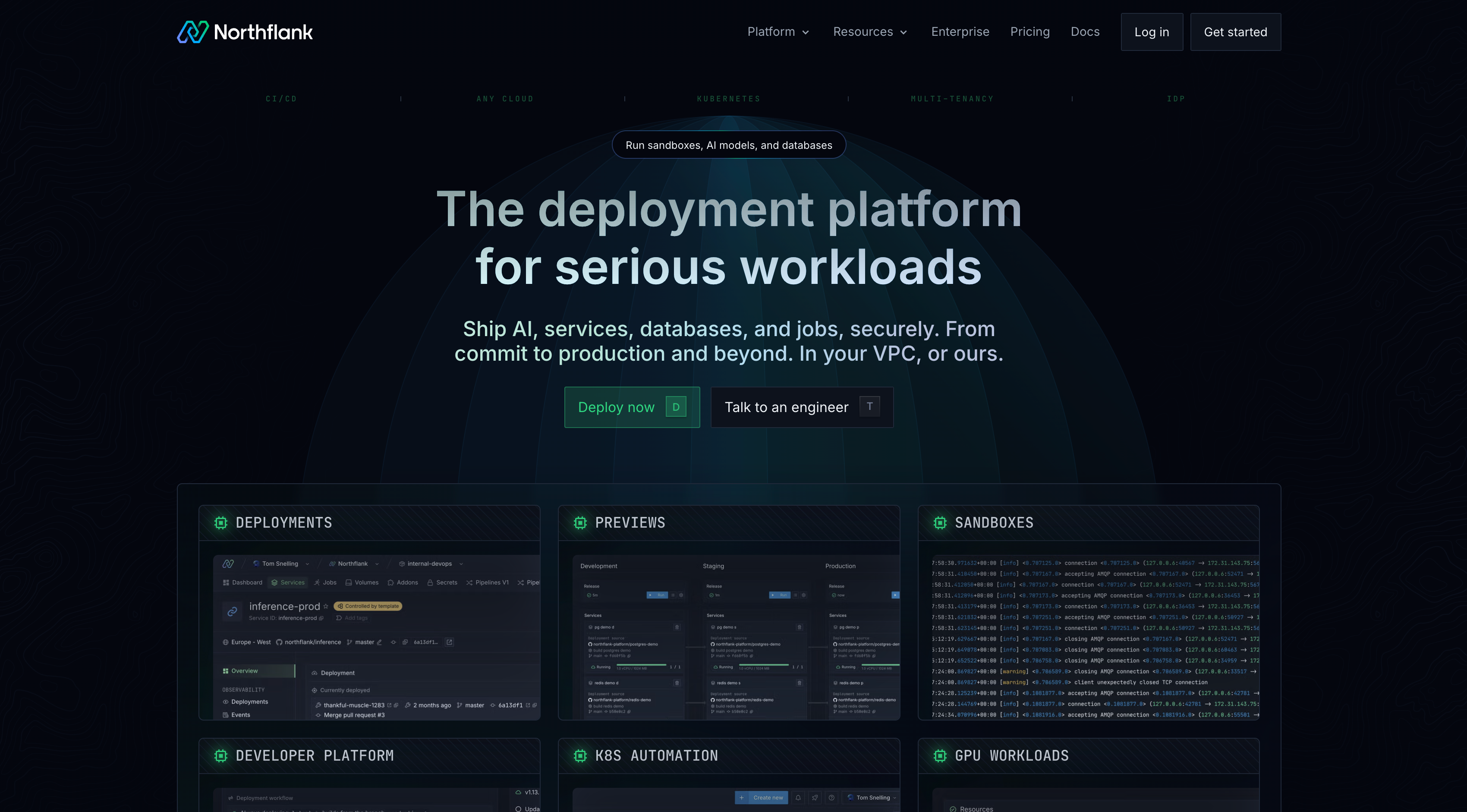
For internal apps that execute AI-generated or user-submitted code at runtime, Northflank's sandbox infrastructure runs microVM-backed execution using Kata Containers, Firecracker, and gVisor. Preview environments spin up per pull request with isolated database instances and tear down on merge. RBAC at the organisation, project, and environment level means every deployment is tied to a user identity, every secret access is logged, and every environment is visible to the IT or security team. SAML and OIDC SSO integrate with Okta, Entra ID, and Google Workspace. For enterprises with data residency requirements, BYOC is self-serve into AWS, GCP, Azure, Oracle, CoreWeave, Civo, on-premises, and bare-metal. SOC 2 Type 2 certified.
Automate deployments from your AI agent. The Northflank Skills package lets Claude Code, Codex, Gemini CLI, and Cursor deploy services, manage databases, and configure environments via Northflank's API and CLI, directly from your agent session.
Best for: Teams of all sizes that need production-grade deployment for internal AI apps without managing infrastructure. Startups that want to move fast without DevOps overhead. Enterprises that need secrets management, sandbox isolation, RBAC, audit logging, and BYOC for data residency.
Pricing: Free tier includes two services, one database, and two cron jobs. Paid compute starts at $2.70/month ($0.0038/hr) for 0.1 shared vCPU and 256MB memory. See full pricing.
Vercel is optimized for Next.js and React frontends with automatic CI/CD, preview deployments per pull request, and global edge delivery. For internal AI apps where the frontend is the primary workload and the backend is handled by external APIs, it provides the cleanest deployment experience in the category. It does not provide managed databases natively, no BYOC option exists, and sandbox isolation for AI-generated code is not available.
Best for: Internal AI apps built as Next.js or React frontends where the backend is minimal or handled by external APIs.
Pricing: Free tier available. Pro from $20/user/month. Enterprise custom.
Render is a managed cloud platform with PostgreSQL, Redis, background workers, and private networking. SOC 2 Type 2 certified. It is managed-only with no BYOC option and no sandbox isolation for AI-generated code.
Best for: Teams building straightforward full-stack internal apps with a service and a database, where managed-only infrastructure is acceptable.
Best for: Teams building straightforward full-stack internal apps with a service and a database, where managed-only infrastructure is acceptable.
Pricing: Pricing starts from $25/month. Enterprise plans available.
Railway provides fast deployment with managed databases (PostgreSQL, MySQL, Redis, MongoDB) and usage-based pricing. SOC 2 Type 2 certified. Managed-only with no BYOC option. RBAC, SSO, and audit logs require enterprise plan commitments.
Best for: Teams that want the fastest path from code to a deployed internal app with a database and minimal configuration.
Pricing: Hobby from $5/month plus usage. Pro from $20/month. Enterprise custom.
If your internal AI app executes code at runtime, handles sensitive data, or needs to run inside your own cloud account, Northflank is the only option here that covers all of those requirements out of the box. Vercel and Render cover simpler deployment needs where managed-only infrastructure and a frontend-first scope are acceptable. Railway provides the fastest setup for straightforward apps.
| Platform | Managed databases | Secrets management | Sandbox isolation | BYOC | RBAC and audit logs |
|---|---|---|---|---|---|
| Northflank | Yes (6+ types) | Yes, built-in | Yes (Kata, Firecracker, gVisor) | Yes, self-serve | Yes, built-in |
| Vercel | Via Marketplace | Environment variables | No | No | Enterprise only |
| Render | Postgres, Redis | Environment variables | No | No | Enterprise only |
| Railway | Postgres, MySQL, Redis, MongoDB | Environment variables | No | No | Enterprise only |
If your internal AI app executes code at runtime, handles sensitive data, or needs to run inside your own cloud account, Northflank is the only option here that covers all of those requirements out of the box. Vercel and Render cover simpler deployment needs where managed-only infrastructure and a frontend-first scope are acceptable. Railway provides the fastest setup for straightforward apps. ToolJet is the right choice when the app-building layer needs air-gapped deployment.
| Platform | Managed databases | Secrets management | Sandbox isolation | BYOC | RBAC and audit logs |
|---|---|---|---|---|---|
| Northflank | Yes (6+ types) | Yes, built-in | Yes (Kata, Firecracker, gVisor) | Yes, self-serve | Yes, built-in |
| Vercel | Via Marketplace | Environment variables | No | No | Enterprise only |
| Render | Postgres, Redis | Environment variables | No | No | Enterprise only |
| Railway | Postgres, MySQL, Redis, MongoDB | Environment variables | No | No | Enterprise only |
| ToolJet | Via connectors | Environment variables | No | Yes (self-hosted) | Yes, paid plans |
The key requirements are secrets management so credentials never appear in source code, managed databases with scoped credentials, RBAC and audit logging for IT visibility, preview environments for safe testing, and sandbox isolation for any app that executes AI-generated or user-submitted code at runtime. For enterprises, BYOC for data residency is often a hard requirement.
Yes, if your app executes code at runtime rather than just running pre-written application logic. This includes apps with AI coding assistant features, code interpreter functionality, agentic workflows, or any feature that runs user-submitted input as code. Without microVM isolation, one bad execution can compromise the host application and other users' data.
Yes, with Northflank BYOC. Connect your AWS, GCP, Azure, or on-premises infrastructure and Northflank deploys apps inside your own VPC. This is required for enterprises with data residency mandates or existing cloud commitments.
Use a deployment platform with RBAC and audit logging built in. Northflank's RBAC means every deployment is tied to a user identity, every secret access is logged, and every environment is visible to the security team. Non-technical employees get self-service access. IT and security teams get oversight without reviewing every deployment manually.
Store database connection strings in a secrets manager and inject them as environment variables at runtime. Never hardcode credentials in application code. Use scoped database users with minimum permissions, not admin accounts. Northflank handles this through secret groups that inject credentials automatically at build and runtime.
Internal AI apps need more than a live URL. They need secrets management, managed databases, access controls, audit trails, and for apps that execute AI-generated code, sandbox isolation. The platform that handles all of this by default is the right choice for production internal app deployment.
Northflank covers the full stack: secrets management, managed databases, microVM sandbox isolation, RBAC, audit logging, preview environments, and BYOC, without writing infrastructure code.
Sign up for free on Northflank or book a demo to deploy your first internal AI app.
- How non-technical employees can build and ship internal apps with AI, securely: The full workflow for AI-generated internal apps, including secrets management, sandbox execution, and enterprise visibility.
- Best deployment platforms for vibe coders in 2026: A comparison of Northflank, Vercel, Render, Railway, and Fly.io for teams shipping AI-generated apps.
- Enterprise vibe coding: how to deploy AI-generated apps safely: Governance, security, and compliance controls for enterprise vibe coding at scale.
- Top internal developer portals in 2026: How platform teams give developers and non-technical employees self-service access to deployment infrastructure.