
Most reliable cloud platforms for app hosting in 2026
Reliability means different things at different scales. For a startup, it means not going down when your first users arrive. For a growing team, it means zero-downtime deployments and autoscaling that actually works. For an enterprise, it means SLAs, data residency, audit trails, and the ability to run inside your own infrastructure, so that a platform outage does not automatically become your outage.
This article covers the most reliable cloud platforms for app hosting in 2026: what reliability actually looks like at each tier, what each platform provides, and which one is right for your team.
Reliability is not just uptime. It covers autoscaling, zero-downtime deployments, data residency, SLAs, and whether the platform gives you enough control to recover when something goes wrong.
- Northflank – Full-stack cloud platform with self-serve BYOC, autoscaling, zero-downtime deployments, managed databases with automated backups, SOC 2 Type 2, and preview environments that keep production clean. One of the most complete reliability stacks without managing Kubernetes.
- AWS – The deepest reliability and compliance catalog available. Best for enterprises that need FedRAMP, global multi-region failover, and the full AWS ecosystem.
- Google Cloud (GCP) – Strong uptime SLAs, global infrastructure, and the best managed Kubernetes experience. Best for teams with GCP gravity or Kubernetes-native workloads.
- Render – SOC 2 Type 2, auto-deploy from Git, managed databases with backups, and private networking. Best for teams that want reliability without infrastructure complexity.
- Railway – SOC 2 Type 2, fast deployments, managed databases, and usage-based pricing. Best for teams that want a reliable path to production with minimal setup.
Northflank operates at 99.99% historical uptime, guaranteed under an SLA with service credits for enterprise agreements. It provides production-grade app hosting with the reliability controls teams actually need: autoscaling, zero-downtime deployments, managed databases with automated backups, self-serve BYOC into your own cloud, SOC 2 Type 2, and preview environments that isolate every change before it reaches production. Sign up to get started or book a demo.
Most platforms advertise 99.9% uptime. Reliability goes deeper than that. The platforms that actually keep production apps running share a specific set of capabilities.
- Zero-downtime deployments: Every deploy should roll out without taking the app offline. This means rolling updates, health check gates before traffic switches, and automatic rollback if a deploy fails.
- Autoscaling: Traffic spikes should not take down the app. The platform should scale services up automatically when load increases and scale down when it drops.
- Managed databases with automated backups: Data loss is the worst kind of outage. Managed databases with point-in-time recovery and automated backups are a reliability baseline, not a premium feature.
- Preview environments: The fastest path to a production incident is pushing untested changes directly to production. Preview environments that isolate every pull request in its own deployment reduce the blast radius of bad code.
- Observability: Real-time logs, metrics, and alerting tell you what is happening before users do. Platforms that bury observability behind external tooling create blind spots.
- BYOC and data residency: BYOC can improve operational control and reduce dependency on a platform vendor, while also helping meet data residency and compliance requirements. Running workloads inside your own cloud account gives teams greater control over networking, security, and recovery processes.
- SLAs: SLAs provide a contractual commitment around availability and are commonly expected for production workloads.
Northflank is a full-stack cloud platform that provides the complete reliability stack for app hosting without requiring teams to manage Kubernetes directly. Northflank operates at 99.99% historical uptime, guaranteed under an SLA with service credits for customers on enterprise agreements. Zero-downtime deployments with health check gates and automatic rollback are the default behavior. Autoscaling adjusts service replicas based on CPU and memory thresholds without manual intervention. Managed databases (PostgreSQL, MySQL, MongoDB, Redis) include automated backups and point-in-time recovery. Real-time logs and metrics are built into the platform without external tooling.
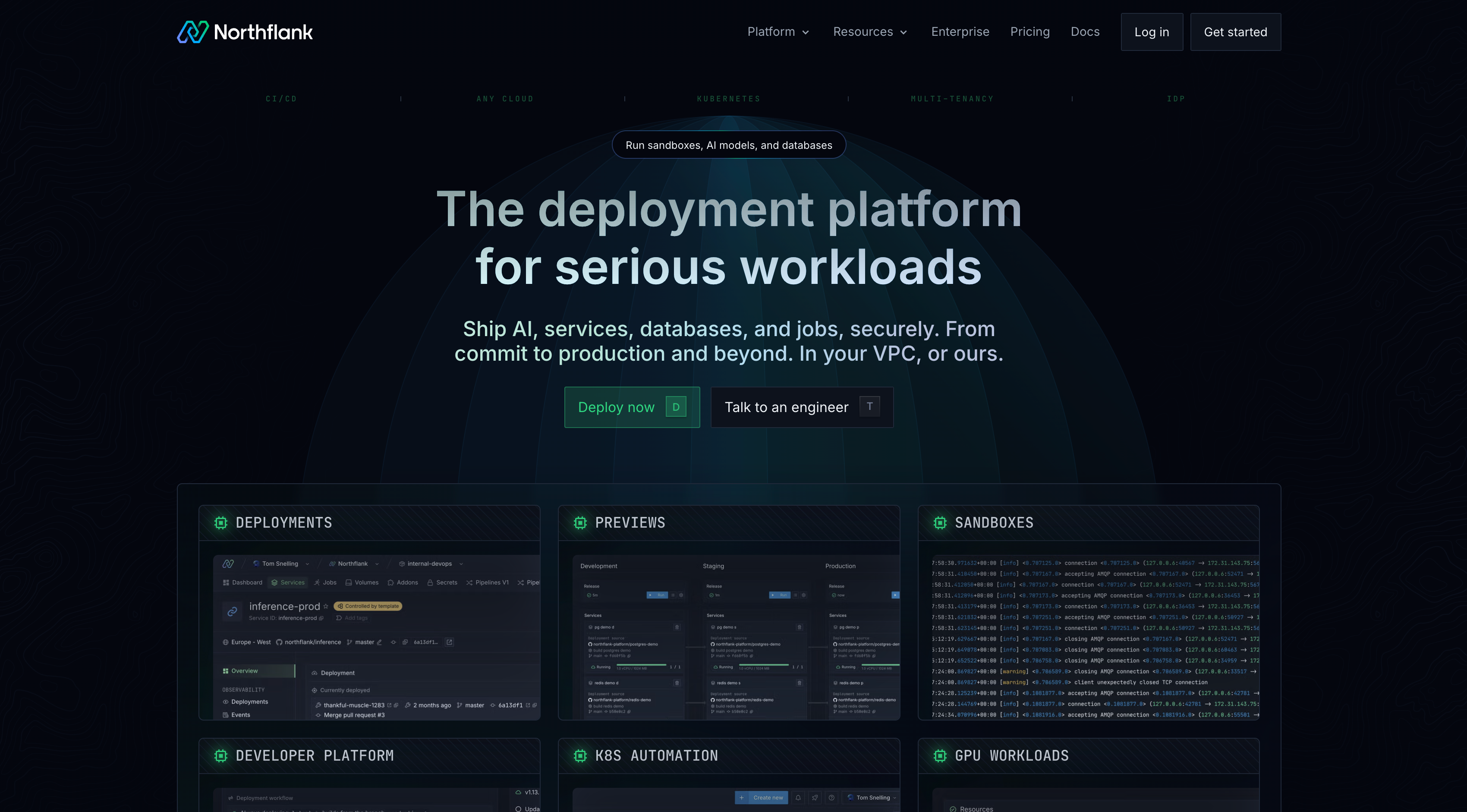
Preview environments spin up per pull request with isolated database instances and tear down on merge, so every change is validated in a production-like environment before it reaches production. For teams with data residency requirements or enterprises that cannot afford a platform dependency on Northflank's managed cloud, BYOC is self-serve into AWS, GCP, Azure, Oracle, CoreWeave, Civo, on-premises, and bare-metal. Northflank manages the platform layer on your infrastructure. SOC 2 Type 2 certified across managed cloud and BYOC deployments.
Best for: Teams of all sizes that need production-grade reliability without managing infrastructure. Startups that want autoscaling and zero-downtime deploys from day one. Enterprises that need data residency, compliance, and full control over their hosting environment.
AWS provides the deepest reliability and compliance catalog of any cloud provider: multi-region failover, Route 53 health-check routing, RDS Multi-AZ, and a compliance portfolio covering SOC 2, HIPAA, FedRAMP, and more. The tradeoff is operational complexity. Achieving high reliability on AWS requires assembling and maintaining load balancers, autoscaling groups, Multi-AZ databases, and CloudWatch alarms without a managed platform layer on top. Teams that want production-grade reliability on AWS without the infrastructure overhead can deploy Northflank on their existing AWS account via BYOC. See how Ultralight ditched AWS ECS for Northflank-managed Kubernetes while keeping all workloads inside their own AWS account.
Best for: Large enterprises with dedicated platform teams that need FedRAMP, multi-region failover, or the full AWS ecosystem.
GCP provides strong global infrastructure, 99.99% SLAs on core services, and the most polished managed Kubernetes experience from any hyperscaler via GKE. For teams without AWS gravity, it offers comparable reliability with a cleaner Kubernetes experience and a simpler IAM model.
Best for: Teams that need enterprise-grade reliability and global infrastructure without AWS lock-in, particularly for Kubernetes-native workloads.
Render provides SOC 2 Type 2, automatic Git-based deployments, managed PostgreSQL and Redis with automated backups, private networking, and zero-downtime deployments. Managed-only with no BYOC option and limited autoscaling compared to Northflank or the hyperscalers.
Best for: Teams building standard full-stack apps that need managed databases and SOC 2 compliance without infrastructure complexity.
Railway provides SOC 2 Type 2, managed databases, automatic Git-based deployments, private networking, and usage-based pricing. Managed-only with no BYOC option. Advanced enterprise features such as RBAC, SSO, and audit logging are available on higher-tier plans.
Best for: Teams that want a reliable, fast deployment path with managed databases and minimal configuration.
The right choice depends on what reliability means for your specific workload and team.
For teams that want production-grade reliability without managing infrastructure, Northflank covers autoscaling, zero-downtime deployments, managed databases, preview environments, and BYOC in one platform. For enterprises that need the deepest compliance catalog and multi-region failover, AWS, Northflank and GCP provide the primitives to build any level of redundancy. For teams with standard workloads that want managed reliability without complexity, Render and Railway cover the baseline well.
| Platform | Autoscaling | Zero-downtime deploys | Managed databases | BYOC | SOC 2 Type 2 |
|---|---|---|---|---|---|
| Northflank | Yes | Yes | Yes (6+ types) | Yes, self-serve | Yes |
| AWS | Yes (manual config) | Yes (manual config) | Yes (RDS, ElastiCache) | Native | Yes |
| GCP | Yes (manual config) | Yes (manual config) | Yes (Cloud SQL, Spanner) | Native | Yes |
| Render | Yes (Professional plan+) | Yes | Yes (Postgres, Redis) | No | Yes |
| Railway | Manual replicas only | Yes | Yes (Postgres, MySQL, Redis, MongoDB) | Enterprise only | Yes |
Reliability depends on your requirements. For the most complete out-of-the-box reliability stack without managing infrastructure, Northflank provides autoscaling, zero-downtime deployments, managed databases with automated backups, preview environments, and BYOC in one platform. For enterprises that need multi-region failover and the deepest compliance catalog, AWS and GCP provide more control at the cost of operational complexity.
Zero-downtime deployment means a new version of an app is rolled out without taking the running version offline. The platform starts new containers with the new version, runs health checks to confirm they are ready, then routes traffic to them before stopping the old containers. If the health checks fail, the deployment is rolled back automatically. Northflank, Render, and Railway all handle this by default.
Not for most teams. Managed cloud platforms provide strong uptime SLAs. BYOC becomes a reliability requirement when you need to eliminate the platform itself as a dependency, when data residency regulations mandate execution inside your own VPC, or when you need to run inside an existing cloud account with existing network and security controls. Northflank BYOC is self-serve into AWS, GCP, Azure, and on-premises.
Northflank provides production-grade reliability with a managed platform on top: autoscaling, zero-downtime deployments, managed databases, and observability are all configured by default without infrastructure setup. AWS provides more granular control and a deeper compliance catalog, but requires assembling and maintaining each reliability component yourself. Northflank is faster to reliable production. AWS is more configurable at scale.
Preview environments spin up an isolated copy of the app per pull request, including isolated database instances, and tear down on merge. Every change is tested in a production-like environment before it reaches production. This reduces the rate of production incidents caused by untested code and makes rollbacks unnecessary more often. Northflank preview environments provision in seconds and run on spot capacity.
Reliability is not a single feature. It is the combination of autoscaling, zero-downtime deployments, managed databases with backups, observability, preview environments, and data residency controls that keeps apps running when traffic spikes, deploys fail, or compliance requirements tighten.
Northflank provides that combination out of the box for teams of all sizes, without requiring infrastructure expertise to configure or maintain. AWS and GCP provide more control for enterprises with dedicated platform teams. Render and Railway cover the reliability baseline for standard workloads with less overhead.
Sign up for free on Northflank or book a demo to see how Northflank handles reliable app hosting for your team.
- Best cloud hosting platforms in 2026: A broader comparison of cloud hosting platforms covering compute, databases, and deployment models.
- Best deployment platforms for vibe coders in 2026: A comparison of Northflank, Vercel, Render, Railway, and Fly.io on databases, secrets management, preview environments, and full-stack scope.
- Top managed Kubernetes hosting platforms in 2026: How managed Kubernetes platforms compare on control plane, BYOC, sandbox isolation, and enterprise controls.
- Best enterprise-safe platforms for running and hosting AI apps in 2026: Platforms covering SOC 2, HIPAA, BYOC, sandbox isolation, and GPU support for enterprise AI app deployment.