
Best enterprise-safe platforms for running and hosting AI apps in 2026
Enterprise-safe deployment for AI apps means more than a live URL. It means compliance certifications that cover your deployment model, execution isolation for AI-generated code, data that never leaves your infrastructure, and audit trails that satisfy security reviews.
Most platforms that host AI apps are built for speed and developer experience. The enterprise requirements, SOC 2 Type 2, HIPAA, BYOC deployment, RBAC, secrets management, and sandbox isolation for AI-generated code, are where most of them fall short.
This article covers the platforms built to meet those requirements and what each one actually provides at the infrastructure layer.
Enterprise AI apps face a different set of deployment requirements than standard web applications. The platform handling your deployment is a third-party data processor under GDPR. Execution of AI-generated code without isolation creates security risk. Shared infrastructure without RBAC creates audit gaps.
- Northflank – Full-stack cloud platform with SOC 2 Type 2, managed cloud or self-serve BYOC into AWS, GCP, Azure, and on-premises, microVM sandbox isolation for AI-generated code, RBAC, audit logs, SSO, managed databases, preview environments, and GPU workloads. HIPAA compliant, meeting the standards required to handle PHI, with BAAs supported under an Enterprise contract. The strongest option for enterprise teams that need the full stack running inside their own infrastructure.
- AWS – Broadest compliance certification set available. Best for enterprises already on AWS that need FedRAMP, HIPAA, and deep MLOps tooling alongside deployment.
- Render – SOC 2 Type 2, HIPAA BAA available on enterprise, private networking, managed databases, and preview environments. Best for teams that need a simpler managed platform with enterprise compliance and do not need BYOC.
- Railway – SOC 2 Type 2, managed databases, Git-based deployment, and preview environments. RBAC, SSO, audit logs, HIPAA BAA, and BYOC are available but require enterprise plan commitments.
- Vercel – SOC 2 Type 2, enterprise SSO, and audit logs on enterprise plans. Best for AI apps with a Next.js frontend where serverless execution is sufficient, and the backend complexity is minimal.
Northflank provides the full enterprise infrastructure stack for AI apps: SOC 2 Type 2, managed cloud or BYOC into your own cloud or on-premises, microVM sandbox isolation (Kata Containers, Firecracker, gVisor), RBAC, audit logs, managed databases, preview environments, and GPU workloads in one control plane. Sign up to get started or book a demo.
These are the dimensions that matter most when deploying AI apps in regulated or security-conscious enterprise environments.
- Compliance certifications: SOC 2 Type 2 is the baseline. Verify that certifications cover the deployment model you plan to use, not just the vendor's managed cloud. HIPAA with a BAA is required for healthcare data. FedRAMP is required for US government.
- BYOC and data residency: Managed platforms send your data to the vendor's infrastructure. Enterprise teams with data residency requirements need execution inside their own VPC, on-premises, or bare-metal. Verify whether BYOC is self-serve or requires an enterprise sales process.
- Sandbox isolation for AI-generated code: AI apps that execute code at runtime need microVM isolation so execution cannot affect the host system or other tenants. Standard container isolation shares the host kernel and is not sufficient for untrusted code execution.
- RBAC and access controls: Granular role-based access controls at the project and environment level determine whether your security team can enforce least-privilege access and satisfy audit requirements.
- Audit logging: SOC 2 Type 2 audits require demonstrable audit trails. Verify what the platform logs, how long logs are retained, and whether they can be exported to your SIEM.
- SSO integration: Enterprise teams require SAML or OIDC-based SSO. Platforms that support only username and password will not pass procurement.
- GPU and AI workload support: Enterprise AI apps often require GPU inference or fine-tuning alongside standard services. A platform that handles both in the same control plane reduces operational complexity.
Northflank is a full-stack cloud platform with enterprise features built in from day one. SOC 2 Type 2 certification covers managed cloud and BYOC deployments. BYOC is self-serve into AWS, GCP, Azure, Oracle, CoreWeave, Civo, on-premises, and bare-metal with no enterprise sales process required. Data stays inside your own infrastructure.
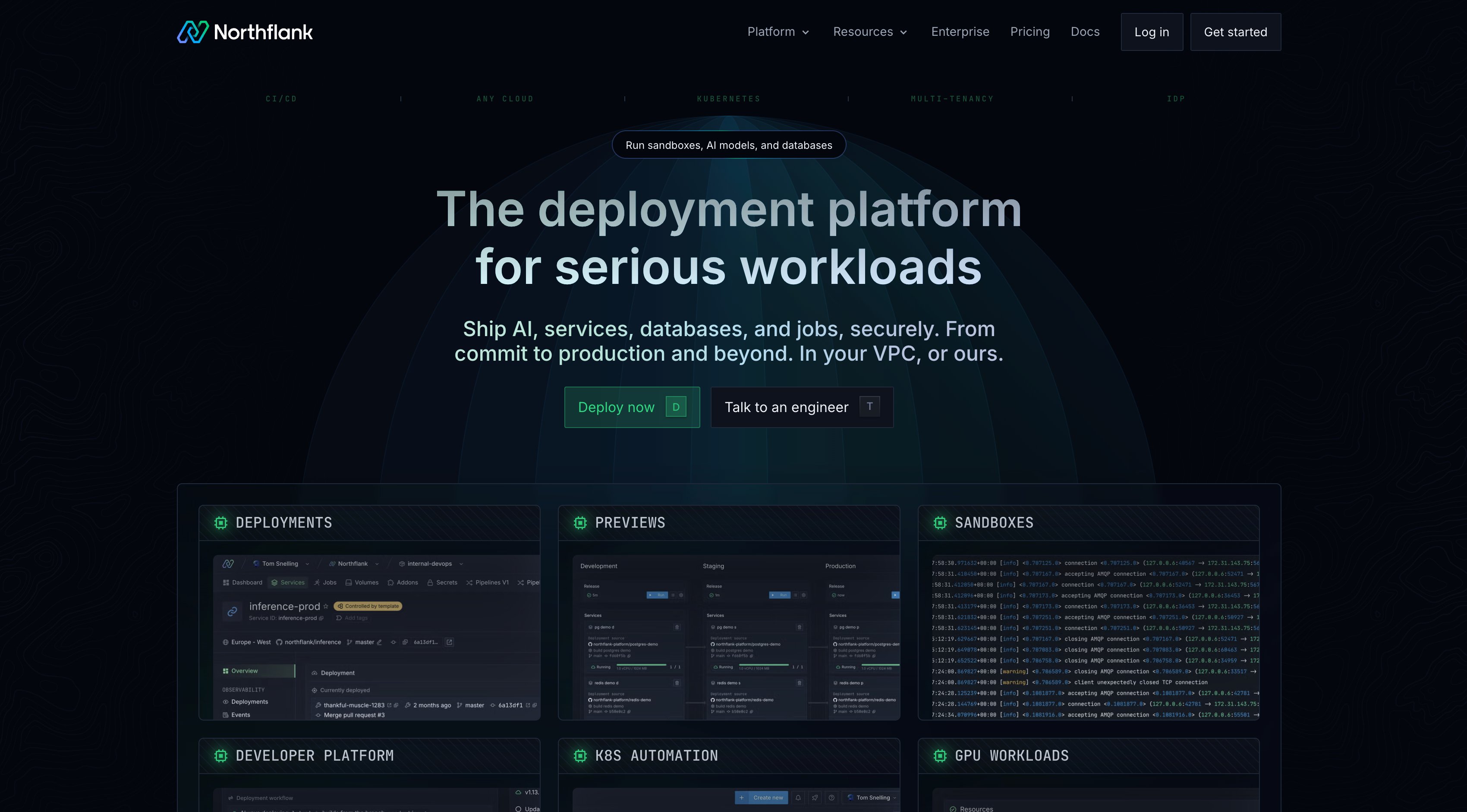
For AI apps that execute code at runtime, Northflank's sandbox infrastructure runs microVM-backed execution using Kata Containers with Cloud Hypervisor, Firecracker, and gVisor per workload. Every sandbox runs in its own microVM with a dedicated kernel. AI-generated code, user-submitted scripts, and LLM tool calls execute inside hardware-enforced isolation that cannot affect the host application or other tenants. GPU workloads (H100, H200, A100, L4, L40S) run alongside services, databases, and sandboxes in the same control plane.
Key features:
- SOC 2 Type 2 certified: Covers managed cloud and BYOC deployments. Trust center at trust.northflank.com.
- HIPAA compliant: Meets the standards required to handle protected health information (PHI). BAAs supported under an Enterprise contract.
- Self-serve BYOC: AWS, GCP, Azure, Oracle, CoreWeave, Civo, on-premises, bare-metal. No enterprise sales required.
- Sandbox isolation: Kata Containers, Firecracker, and gVisor applied per workload. Every sandbox runs in its own microVM.
- RBAC: Role-based access at organisation, project, and environment levels. API roles with scoped permissions. MFA enforcement.
- SSO: SAML and OIDC-based SSO with automatic role assignment from identity provider groups.
- Audit logging: Full audit trail across all platform actions. Exportable for SIEM integration.
- Managed databases: PostgreSQL, MySQL, MongoDB, Redis, MinIO, and RabbitMQ with scoped credentials injected automatically.
- GPU workloads: H100, H200, A100, L4, L40S, B200, and TPUs with all-inclusive pricing.
- Preview environments: Isolated app, database, and sandbox instances per pull request, torn down on merge.
Best for: Enterprise teams building AI apps with code execution, regulated industries where data cannot leave physical infrastructure, and platform engineering teams that need the full stack without a lengthy enterprise sales process.
Pricing: $0.01667/vCPU-hour, $0.00833/GB-hour, H100 GPU at $2.74/hour all-inclusive. BYOC deployments bill against your own cloud account.
Get started on Northflank (self-serve, no demo required). Or book a demo to walk through your enterprise requirements.
AWS provides the broadest compliance certification set on this list: SOC 2, ISO 27001, HIPAA, FedRAMP, PCI-DSS, and more. For enterprise AI apps that need FedRAMP or the full AWS compliance catalog, it is often the only option. SageMaker covers managed MLOps, and Bedrock provides managed foundation model access with private invocation that does not use customer data for training.
The operational overhead is significant. Deploying a complete AI app stack on AWS requires substantial infrastructure engineering expertise across networking, IAM, ECS or EKS, RDS, and secrets management. For teams with existing AWS infrastructure and dedicated platform engineering capacity, AWS provides the deepest compliance posture available.
Best for: Large enterprises that need FedRAMP, HIPAA, or the full AWS compliance catalog and have the engineering capacity to manage the infrastructure layer themselves.
Pricing: Usage-based across all services. Variable and requires careful cost modeling.
Render is a managed cloud platform with SOC 2 Type 2, HIPAA BAA available on the enterprise plan, private networking, managed PostgreSQL and Redis, background workers, and preview environments. AI apps deploy from a Git repository with minimal configuration. Private networking isolates services from public internet exposure by default.
Render is managed-only with no BYOC option. For enterprises with data residency requirements, that is a hard constraint. For teams where managed infrastructure is acceptable and SOC 2 with a simpler operational model than AWS is the priority, Render covers the baseline well.
Best for: Enterprise teams that need SOC 2, private networking, and managed databases without AWS complexity, where managed-only infrastructure is acceptable.
Pricing: Services from $7/month. Managed Postgres from $7/month. Enterprise plans available
Railway provides SOC 2 Type 2, managed databases (PostgreSQL, MySQL, Redis, MongoDB), Git-based deployment, preview environments, and private networking. Deployment is fast with minimal configuration. RBAC, SSO, and 18-month audit log retention are available on enterprise plans. HIPAA BAAs are available from $1,000/month minimum spend. BYOC is available on enterprise plans for teams that need execution inside their own infrastructure.
The enterprise constraints are worth understanding. RBAC, SSO, and extended audit logs require a minimum $2,000/month enterprise commitment. For enterprises with straightforward deployment requirements and SOC 2 as the primary compliance need, Railway provides a fast path to production. For regulated workloads that need HIPAA or BYOC, those features are available but gated behind the enterprise tier.
Best for: Enterprise teams with straightforward deployment requirements where SOC 2 is the primary compliance need.
Pricing: Hobby from $5/month plus usage. Pro from $20/month. Enterprise from $1,000/month minimum spend. BYOC and HIPAA BAA from $1,000/month.
Vercel holds SOC 2 Type 2, ISO 27001, and HIPAA BAA on enterprise plans, and provides enterprise SSO, audit logs, and RBAC on enterprise plans. For AI apps with a Next.js or React frontend, it provides the most optimized deployment experience in the category. The AI SDK integrates with Vercel's edge runtime for streaming LLM responses and preview deployments spin up per pull request.
The constraint is backend scope. Vercel is optimized for serverless functions and static frontends. Long-running AI workloads, background workers, stateful agents, and GPU requirements need external providers. There is no BYOC option.
Best for: Enterprise teams building AI apps with Next.js frontends where serverless execution is sufficient and backend complexity is minimal.
Pricing: Pro from $20/user/month. Enterprise custom.
If your AI app executes code at runtime, processes sensitive data, requires GPU workloads, or must run inside your own VPC, Northflank is the only option here that covers all of those requirements with self-serve BYOC and microVM sandbox isolation. AWS covers the same requirements with significantly more operational overhead. Render and Railway cover SOC 2 and managed infrastructure for teams without data residency mandates. Vercel fits AI apps where the frontend is the primary workload and serverless execution is sufficient.
| Platform | SOC 2 Type 2 | BYOC | Sandbox isolation | GPU support | Managed databases | SSO |
|---|---|---|---|---|---|---|
| Northflank | Yes | Yes, self-serve | Yes (Kata, Firecracker, gVisor) | Yes (H100, A100, and more) | Yes (6+ types) | Yes (SAML, OIDC) |
| AWS | Yes | Native | Manual configuration | Yes (EC2 GPU instances) | Yes (RDS, ElastiCache) | Yes (IAM Identity Center) |
| Render | Yes | No | No | No | Yes (Postgres, Redis) | Yes (enterprise) |
| Railway | Yes | Yes, enterprise only | No | No | Yes (Postgres, MySQL, Redis, MongoDB) | Yes (enterprise) |
| Vercel | Yes | No | No | No | Via Marketplace only | Yes (enterprise) |
SOC 2 Type 2 is the baseline for B2B enterprise deployments. HIPAA with a Business Associate Agreement is required for healthcare data. FedRAMP is required for US government. Verify that certifications cover the deployment model you plan to use, since some vendors hold certifications for managed cloud but not for BYOC or on-premises deployments.
AI apps that execute code at runtime, including code interpreters, agentic workflows, and LLM tool calls, run code that was not written or reviewed by a developer. Without microVM isolation, that code runs with the same privileges as the application and has access to the same network and filesystem. A single bad execution can compromise the host application or expose other tenants' data. Northflank's sandbox infrastructure runs each execution in its own microVM with a dedicated kernel, enforcing a hardware boundary around untrusted code.
Yes. If your AI app processes personal data and execution runs on the vendor's infrastructure, the vendor is a third-party data processor under GDPR. This requires a Data Processing Agreement and can complicate compliance audits. Teams with strict data residency requirements need execution inside their own infrastructure via BYOC or on-premises deployment.
Managed hosting runs your app on the vendor's infrastructure. The vendor controls the physical hardware and network. BYOC deploys the vendor's platform into your own cloud account, on-premises, or bare-metal. Your data stays inside your own infrastructure. For regulated industries with data residency requirements, BYOC is often the only compliant option.
On Northflank, yes. Services, managed databases, GPU workloads, and microVM sandboxes all run in the same control plane. For the other platforms on this list, GPU workloads require a separate provider or significant additional configuration.
Enterprise-safe hosting for AI apps requires more than a SOC 2 badge. It requires execution isolation for AI-generated code, data that stays inside your own infrastructure when compliance demands it, RBAC and audit logging that satisfy security reviews, and a platform that covers GPU workloads, managed databases, and sandboxes in the same control plane.
Northflank covers all of it with self-serve BYOC and microVM isolation built in from day one. AWS covers it with more operational complexity. Render and Railway cover the baseline for teams where managed infrastructure is acceptable. Vercel fits AI apps where the frontend is the primary workload and serverless execution is sufficient.
Sign up for free on Northflank or book a demo to walk through your enterprise requirements.
- Best enterprise AI sandbox platforms in 2026: A comparison of sandbox platforms covering SOC 2, HIPAA, BYOC, and microVM isolation for enterprise code execution workloads.
- How non-technical employees can build and ship internal apps with AI, securely: Covers the full deployment workflow for AI-generated apps, including secrets management, sandbox execution, and enterprise visibility.
- Best platforms for untrusted code execution in 2026: Isolation model selection, multi-tenant design, and network controls for platforms running AI-generated or user-submitted code.
- Best BYOC sandbox platforms in 2026: Platforms that support running execution inside your own cloud account for teams with data residency requirements.