
Best enterprise AI sandbox platforms in 2026
Enterprise AI sandbox platforms give AI agents isolated environments to execute code, with the deployment options and access controls enterprise teams need.
- Northflank: Best for enterprise AI agent sandboxes at scale. A fit for teams that want secure sandbox environments for AI-generated code, with fast startup, thousands of concurrent sessions, custom images, and CPU or GPU execution. Supports self-serve bring your own cloud (BYOC), enterprise identity controls, and HIPAA compliance with Business Associate Agreements (BAAs).
- E2B: Best for SDK-driven agent execution. A fit for teams building agent workflows around Firecracker sandboxes, with managed cloud and enterprise customer-cloud deployment options.
- Modal: Best for GPU-intensive agent workloads. A fit for teams that want programmatic sandbox execution on managed infrastructure, with enterprise SSO, audit logs, and HIPAA support.
- Fly.io Sprites: Best for persistent coding environments. A fit for teams whose agents need durable files between tasks and managed Firecracker isolation.
For isolated AI agent code execution on managed infrastructure or in your own environment, explore Northflank Sandboxes.
Enterprise sandboxes need to run the code your agents produce: scripts, repository builds, generated APIs, and workloads that need GPUs. They also need to handle concurrent users, retain files when tasks continue, and isolate each workload from other customers and production systems.
Security reviews add practical questions: where does execution happen, which data reaches the provider, who can access the environment, and what activity can you audit? A managed service may process personal data on your behalf, so contractual terms and data flows matter alongside runtime isolation. Requirements depend on the data and deployment; choosing your own infrastructure does not automatically settle every compliance obligation.
Compare sandbox execution capabilities alongside the controls your security team requires.
- Compliance evidence: Review the SOC 2 Type II report and its scope. For workloads involving protected health information (PHI), check applicable HIPAA requirements, BAA availability, and which services the agreement covers.
- Data residency controls: Check the locations of execution, storage, backups, logs, and control-plane metadata. Selecting a compute region does not necessarily place every type of data there.
- Bring your own cloud (BYOC) and deployment model: Determine whether you need managed infrastructure, execution in your virtual private cloud (VPC), or a fully private deployment. Check who operates the runtime and control plane.
- RBAC and access controls: Look for role-based access control (RBAC), scoped API credentials, and permissions that separate teams, projects, and administrative actions.
- Audit logging: Check which events are recorded, retention periods, and export options for your security information and event management (SIEM) system.
- SSO integration: Check single sign-on (SSO), identity-provider compatibility, and how users receive and lose access.
- Multi-tenant isolation and scale: Evaluate runtime isolation, network policies, concurrency, and session limits against the code your agents execute. Test representative workloads before sizing production capacity.
Northflank provides secure, isolated sandbox environments for AI agents and code execution. Run coding agents, scripts, generated APIs, repository builds, and GPU tasks in custom environments, with support for thousands of concurrent sessions and no fixed session time limit.
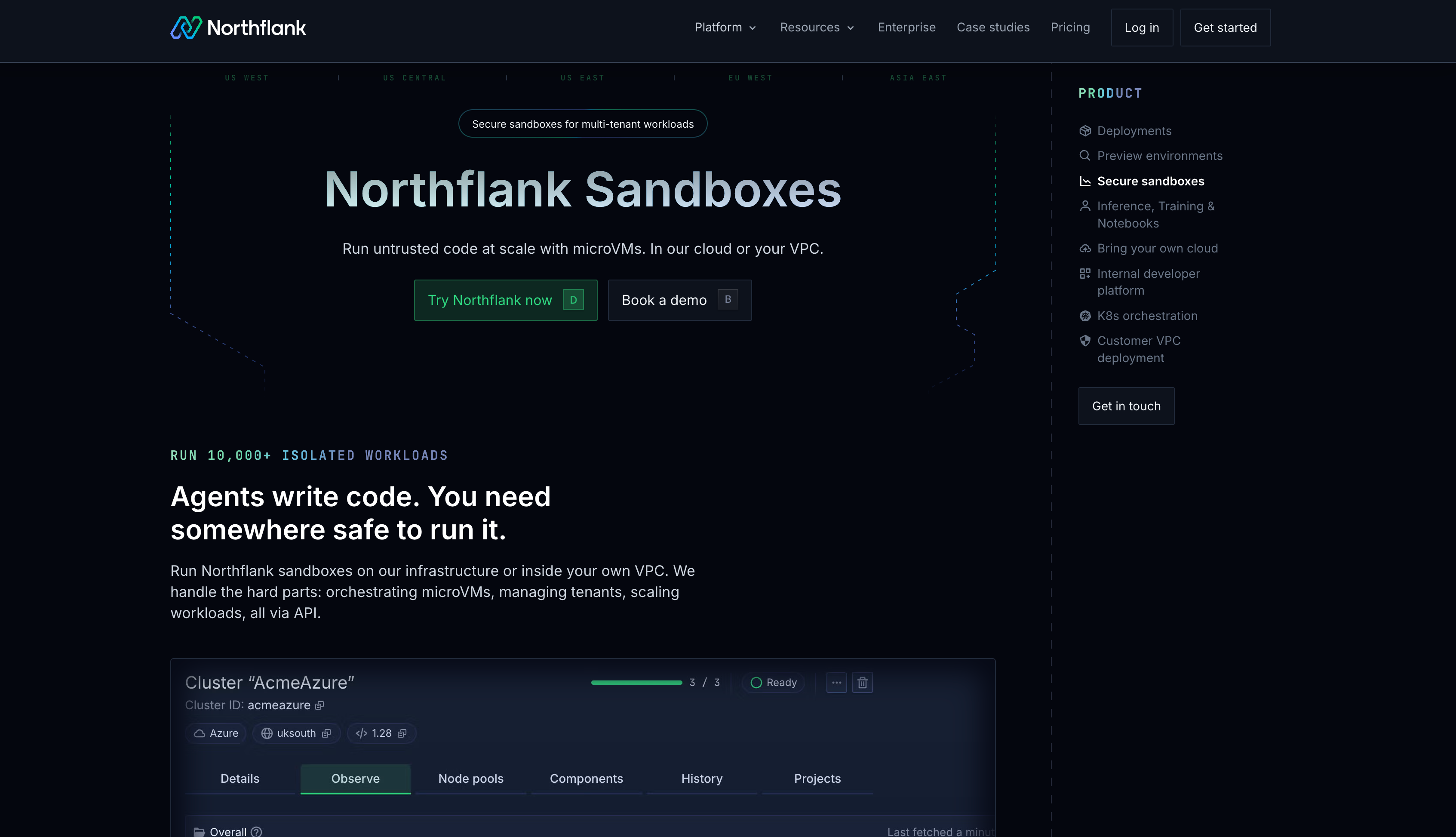
Sandboxes can run on Northflank Cloud or your own infrastructure. With bring your own cloud (BYOC), Northflank acts as the control plane to run coding agents and their sandboxes in your virtual private cloud (VPC). Workload execution stays in your environment; standard deployments still use Northflank-hosted orchestration metadata. Enterprise deployments can also place the control plane inside your infrastructure.
Key features:
- Fast sandbox startup: Sub-second sandbox boot times on Northflank Cloud, with custom container images for your agent's tools and dependencies.
- Concurrent and persistent execution: Run parallel agent tasks, use short-lived environments, or keep sandboxes running without a fixed session cutoff. Attached volumes retain files across restarts.
- Workload isolation: Northflank Cloud uses microVM isolation for CPU sandboxes and gVisor for GPU sandboxes. Customer-cloud deployments support isolation runtimes according to the infrastructure and configuration.
- SOC 2 Type II and HIPAA: Northflank is SOC 2 Type II compliant and supports HIPAA-compliant workloads with BAAs under an Enterprise contract. Review the relevant evidence in its trust center.
- Self-serve bring your own cloud (BYOC): Run sandboxes on supported cloud providers, including AWS, GCP, Azure, Oracle, CoreWeave, and Civo, or on-premises and bare-metal infrastructure.
- RBAC: Organisation, team, and project permissions, scoped API roles, and multi-factor authentication enforcement.
- SSO: SAML and OIDC integration with role assignment through identity-provider groups.
- Audit logging: Enterprise audit logs for platform authentication and infrastructure events.
- Air-gapped deployment: The Enterprise forward-deployed control plane runs inside your infrastructure, supporting environments without a dependency on Northflank's managed cloud.
- Programmatic access: Manage sandbox workloads through the UI, API, CLI, and infrastructure automation.
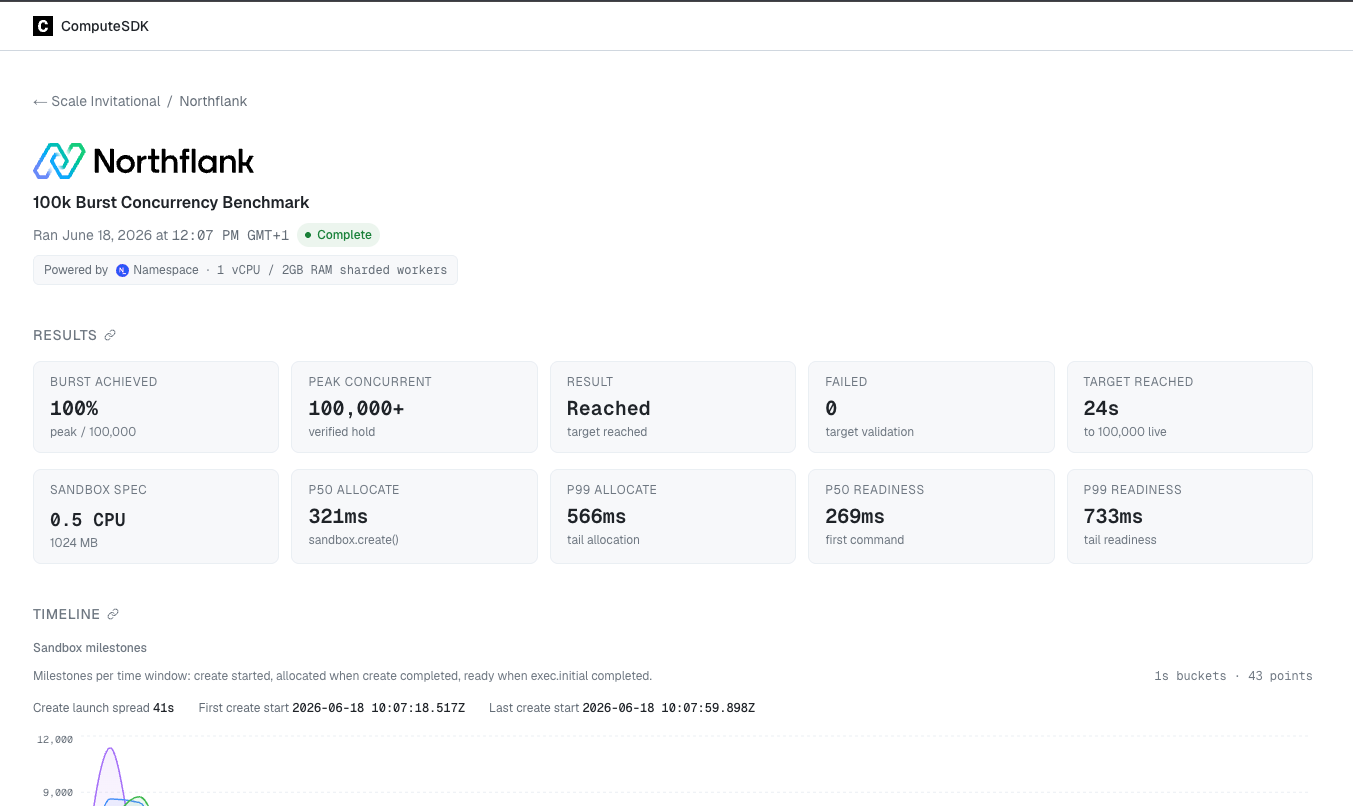
Northflank at 100,000 concurrent sandboxes. In the ComputeSDK 2026 Scale Invitational, Northflank reached 100,000 concurrent live sandboxes in 24 seconds using a 1-vCPU configuration. This provides a concrete scale result to consider alongside tests of your own images, regions, and workload sizes. See the benchmark results.
Best for: Enterprise teams running AI agent sandboxes at scale, multi-tenant code execution, and workloads requiring private deployment, identity controls, or long-running sessions.
Pricing: $0.01667/vCPU-hour and $0.00833/GB-hour, with H100 GPU plans at $2.74/hour all-inclusive (CPU and RAM included). The free developer Sandbox tier offers always-on compute with no sleeping, two free services, one database, and two cron jobs for development and testing. Pay-as-you-go supports CPU and GPU workloads with per-second billing. Enterprise plans provide custom pricing, 24/7 support, service-level agreements (SLAs), and enterprise access controls. See the full pricing details for additional GPU options and plans.
Get started on Northflank or book a demo with an engineer to discuss your sandbox workloads and enterprise requirements.
E2B provides Firecracker sandboxes for agent execution through Python and TypeScript SDKs. Its enterprise offering includes SOC 2 Type II evidence and a HIPAA BAA on request.
Bring your own cloud (BYOC) is available on AWS, GCP, and Azure, with E2B provisioning and operating the cluster. This differs from E2B Embed, its self-hosted single-node package. Private-cloud deployment is listed as in development. Enterprise identity requirements also need attention: E2B currently lists SSO, SCIM, and RBAC as planned. E2B's enterprise overview describes these deployment and security options.
Best for: Enterprise teams integrating agent execution through SDKs that want Firecracker isolation and a managed deployment in a supported cloud account.
Pricing: Enterprise pricing is custom. Hobby includes a $100 one-time usage credit. Pro starts at $150/month plus usage, with 100 concurrent sandboxes and sessions up to 24 hours; higher concurrency costs extra.
Modal provides programmatic sandboxes for code execution and GPU workloads on managed infrastructure. It supports custom container images and gVisor isolation, with a CPU-only virtual-machine isolation option in beta. Its Enterprise plan includes Okta SSO, audit logs, and HIPAA support, and Modal holds a SOC 2 Type II report.
Modal does not offer bring your own cloud (BYOC). For PHI workloads, its BAA also has service-specific exclusions, including memory snapshots and Volumes v1; Volumes v2 are covered. Check the security documentation when choosing how an agent stores and resumes its work.
Best for: Enterprise AI and ML teams running GPU-intensive sandbox workloads where managed infrastructure is acceptable.
Pricing: Enterprise pricing is custom. Team costs $250/month plus compute and includes $100/month in compute credits. Sandbox CPU costs $0.1419/physical-core-hour and memory costs $0.0240/GiB-hour.
Sprites provides persistent Firecracker environments for coding agents, with a 100GB filesystem backed by durable object storage and local storage caching. Files survive idle periods. A warm pause retains memory and processes; a later cold transition discards them. Checkpoints preserve filesystem state.
Fly.io holds SOC 2 Type II attestation and offers BAAs and data processing agreements. Those company-level offerings do not, by themselves, establish the scope of coverage for a particular Sprites deployment. Confirm that Sprites and the intended workflow are covered before using PHI. Fly's security information provides the starting point for that review. Sprites does not offer bring your own cloud (BYOC) or on-premises deployment.
Best for: Enterprise development teams that need persistent coding environments on managed infrastructure and can meet their requirements within the applicable service and contract scope.
Pricing: $0.03825/CPU-hour and $0.021875/GB-hour, effective October 1, 2026. Idle compute is free; retained cold storage is billed.
Northflank is a strong fit for teams that need fast, concurrent AI agent sandbox execution, private deployment, and enterprise access controls. Its self-serve bring your own cloud (BYOC) option supports multiple clouds and on-premises infrastructure; a fully private control plane is an Enterprise option.
E2B offers managed customer-cloud deployment through Enterprise. Modal fits GPU-heavy agent workloads on managed infrastructure. Sprites fits persistent coding environments where the service's controls and contractual coverage meet your requirements.
| Platform | SOC 2 Type II evidence | Bring your own cloud (BYOC) | Deployment |
|---|---|---|---|
| Northflank | Available through trust center | Yes, self-serve | Managed cloud, customer infrastructure, or Enterprise private control plane |
| E2B | Available through trust center | AWS, GCP, and Azure; Enterprise | Managed cloud or E2B-operated customer-cloud deployment |
| Modal | Report available | No | Managed only |
| Fly.io Sprites | Fly.io attestation; confirm service scope | No | Managed only |
Rates checked October 1, 2026. The table shows resource charges; Enterprise contracts and plan subscriptions may add separate commitments. E2B Pro starts at $150/month plus usage, while Modal Team costs $250/month and includes $100 in compute credits.
| Platform | CPU | Memory | Storage | GPU | Billing model |
|---|---|---|---|---|---|
| Northflank | $0.01667/vCPU-hr | $0.00833/GB-hr | $0.15/GB-month | L4: $0.80/hr, A100 40GB: $1.42/hr, A100 80GB: $1.76/hr, H100: $2.74/hr | Per second |
| E2B | $0.0504/vCPU-hr | $0.0162/GiB-hr | 10 GiB on Hobby; 20 GiB on Pro included | No GPU compute | Per second |
| Fly.io Sprites | $0.03825/CPU-hr | $0.021875/GB-hr | Hot: $0.000683/GB-hr; cold: $0.000027/GB-hr | No GPU compute | Actual usage; no idle compute charge |
| Modal Sandboxes | $0.1419/physical-core-hr (2 vCPU) | $0.0240/GiB-hr | Volumes: $0.09/GiB-month; 1 TiB/month included | L4: $0.80/hr, A100 40GB: $2.10/hr, A100 80GB: $2.50/hr, H100: $3.95/hr, H200: $4.54/hr | Per second |
Modal charges per physical core, equivalent to two vCPUs. Its hourly CPU and memory figures are rounded conversions of per-second rates.
The table below compares supported infrastructure, access, and billing for bring your own cloud (BYOC) deployments.
| Platform | Bring your own cloud (BYOC) available | Clouds supported | Access model | Pricing model |
|---|---|---|---|---|
| Northflank | Yes, self-serve | AWS, GCP, Azure, Oracle, CoreWeave, Civo, supported on-premises and bare-metal infrastructure | Self-serve; Enterprise for additional requirements | Cloud infrastructure bill plus Northflank fees; Enterprise terms vary |
| E2B | Yes, Enterprise | AWS, GCP, Azure | Contact sales | Custom Enterprise pricing plus cloud infrastructure costs |
| Modal | No | Managed only | — | — |
| Fly.io Sprites | No | Managed only | — | — |
Start with your organisation's requirements and the data your agents handle. A SOC 2 Type II report helps assess operating controls; ISO 27001 may also be relevant. For HIPAA-regulated PHI workloads, check BAA availability and covered services. Review the scope of the evidence against your deployment rather than relying on a badge alone.
It can. If the provider processes personal data on your behalf, it may act as a processor under GDPR, with appropriate contractual obligations. Review execution, logs, storage, and metadata flows. Bring your own cloud (BYOC) can change where processing happens, but does not automatically remove the provider's role or your obligations.
Northflank supports SAML and OIDC-based SSO with role assignment from identity-provider groups. Modal offers Okta SSO on Enterprise. E2B currently lists SSO, SCIM, and RBAC as planned.
A Type 1 report assesses the design of controls at a point in time. A Type 2 report also assesses their operating effectiveness over a period. Review the report's scope, examination period, and findings when evaluating a sandbox provider.
Yes, if the deployment supports a private control plane and the workload's dependencies can operate without internet access. Northflank's Enterprise forward-deployed control plane supports air-gapped environments. This is distinct from standard bring your own cloud (BYOC), which uses Northflank's hosted control plane.
Ask for the SOC 2 report, applicable BAA or data processing agreement, and the services each covers. Confirm execution and metadata locations, operator access, audit-log retention and export, incident response, and breach notification terms. Test concurrency, startup, persistence, and isolation with representative agent workloads.
An enterprise AI sandbox needs to execute agent code reliably while meeting your requirements for isolation, access, auditability, and deployment. Compare those controls alongside concurrency, session duration, and the state your agents need between tasks.
Northflank is a strong choice for enterprise AI agent sandbox execution with custom environments, CPU and GPU support, no fixed session time limit, and flexible private deployment. E2B offers SDK-driven execution and managed customer-cloud clusters. Modal and Sprites serve teams whose requirements can be met on managed infrastructure.
You can get started for free on Northflank or talk to the team to walk through your enterprise sandbox requirements.
If you want to go deeper on the topics covered in this guide, these articles are a good next step.
- Best BYOC sandbox platforms in 2026: Covers the platforms that support running sandbox execution inside your own cloud account, with a focus on deployment model and operational responsibility.
- Best on-premises AI sandbox platforms in 2026: Covers platforms that support execution on hardware you own, with specific attention to air-gapped deployments and who manages orchestration on your hardware.
- Self-hosted AI sandboxes: guide to secure code execution: Covers how DIY, self-hosted, and BYOC sandbox approaches differ operationally, and what full self-hosting actually involves.
- Best platforms for untrusted code execution in 2026: Covers isolation model selection, multi-tenant design, and network controls for teams running code they do not control.