
Top Runloop alternatives for AI agent sandbox infrastructure in 2026
Runloop provides Devbox environments for AI coding agents with two layers of isolation (VM and container), Snapshots for suspend and resume, Blueprints for reusable templates, and built-in benchmarks and evals.
If you are evaluating Runloop alternatives for reasons such as needing Bring Your Own Cloud (BYOC) support, persistent environments with no forced runtime limits, a full workload runtime beyond sandbox execution, or on-demand GPU support, here is a breakdown of the top options.
- Northflank: fullstack workload platform that allows you to run sandboxes alongside APIs, workers, databases, and GPU workloads in one place, with microVM isolation, self-serve BYOC, both ephemeral and persistent environments with no forced time limits, and SOC 2 Type 2 compliance
- E2B: API-driven sandbox platform with Python and JavaScript SDKs, pause and resume with full state preservation, and AutoResume
- Modal: serverless compute platform with gVisor-based sandbox isolation, dynamically defined environments at runtime, and GPU support
- Fly.io Sprites: persistent, hardware-isolated Linux environments using Firecracker microVMs with automatic idle behaviour and checkpoint and restore
- Vercel Sandbox: Firecracker microVM-based sandbox for running untrusted code, integrated with Vercel's deployment infrastructure
Worth noting: Northflank provides production-grade sandbox infrastructure backed by Firecracker, Kata Containers, and gVisor, with both ephemeral and persistent environments and no forced time limits, self-serve BYOC across AWS, GCP, Azure, Oracle, CoreWeave, Civo, bare-metal, and on-premises infrastructure, SOC 2 Type 2 compliance, on-demand GPU support, and a full workload runtime for APIs, workers, databases, and jobs alongside sandboxes. Northflank has been running this class of workload in production since 2021 across startups, public companies, and government deployments.
Runloop alternatives span a range of approaches, from sandbox-only platforms to full workload runtimes. The right choice depends on what you need beyond the sandbox itself.
This article compares the top alternatives across isolation model, persistence, BYOC support, GPU access, and platform scope.
Before comparing platforms, clarify your requirements across these dimensions.
- Isolation model: What layer does the platform isolate at? Container namespacing, gVisor syscall interception, and microVMs (Firecracker, Kata Containers) offer meaningfully different security guarantees for untrusted code.
- Ephemeral vs persistent environments: Some platforms are designed for short-lived execution sessions. Others support persistent state that survives across sessions without manual snapshot logic. Clarify whether your workload needs state to persist and for how long.
- BYOC availability: If your workloads cannot leave your own infrastructure, check whether BYOC is available self-serve or only on an enterprise plan requiring a sales process.
- Platform scope: A sandbox API is not the same as a full workload platform. If you need databases, background workers, GPU inference, and production services alongside sandbox execution, look for platforms that cover the full stack.
- Compliance: SOC 2, HIPAA, and GDPR coverage varies across platforms. Verify what each provider is certified for before evaluating.
- GPU support: Not all sandbox platforms include GPU access. If your agent workloads require GPU compute, confirm it is available within the same platform.
Each platform below takes a different approach to sandbox infrastructure. Here is what they provide and where they fit.
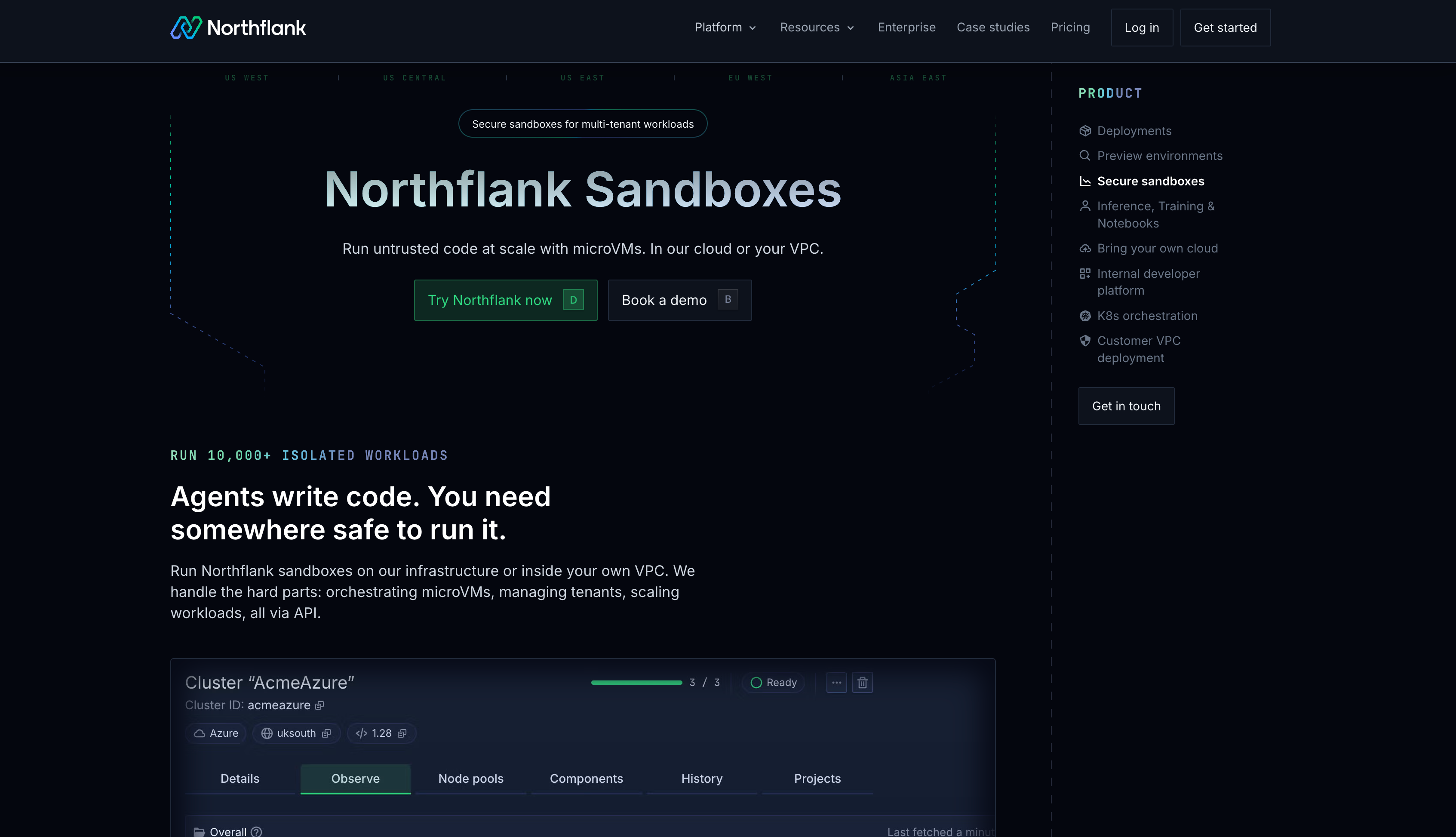
Northflank provides production-grade sandbox infrastructure backed by Firecracker, Kata Containers, and gVisor, with orchestration, multi-tenant isolation, autoscaling, and bin-packing handled at the infrastructure level. It is the only platform in this list that covers sandboxed code execution alongside production deployments, databases, and GPU workloads in one control plane.
Key capabilities:
- MicroVM isolation (Firecracker, Kata Containers, and gVisor) applied depending on the workload
- Both ephemeral and persistent environments with no forced time limits
- End-to-end sandbox creation at 1-2 seconds, covering the full stack
- Self-serve BYOC across AWS EKS, GKE, AKS, Oracle Kubernetes, CoreWeave, Civo, bare-metal, and on-premises distributions, including OpenShift and RKE2, or run on Northflank's managed cloud
- On-demand GPU access (NVIDIA H100, A100, L4, and others) with no quota requests
- Full workload runtime: APIs, workers, databases, and background jobs run alongside sandboxes in the same control plane
- API, CLI, and SSH access
- Multi-tenant architecture
- SOC 2 Type 2 certified, in production since 2021 across startups, public companies, and government deployments
- CPU at $0.01667/vCPU-hour, memory at $0.00833/GB-hour. See full GPU and compute pricing
Northflank is the right choice when you need isolation guarantees beyond containers, want to avoid managing separate infrastructure for execution and production, or require workloads to stay within your own cloud under compliance constraints.
To make the pricing difference concrete, here is what 200 sandboxes costs across providers under the same conditions.
Based on 200 sandboxes, plan: nf-compute-100-4, infra node: m7i.2xlarge
| Model | Provider | Cloud | Sandbox vendor | Total |
|---|---|---|---|---|
| PaaS | Northflank | — | $7,200.00 | $7,200.00 |
| PaaS | E2B | — | $16,819.20 | $16,819.20 |
| PaaS | Modal | — | $24,491.50 | $24,491.50 |
| PaaS | Fly Sprites | — | $35,770.00 | $35,770.00 |
| PaaS | Vercel Sandbox | — | $31,068.80 | $31,068.80 |
| BYOC (0.2 overcommit)* | Northflank | $1,500.00 | $560.00 | $2,060.00 |
| BYOC | E2B | $1,500.00 | $10,000.00 | $11,500.00 |
*Through Northflank's plans on BYOC, there's a default overcommit which allows a customer to spawn more services and sandboxes on the same amount of compute. A request modifier of 0.2 means each sandbox only requests 20% of its plan's resources as a guaranteed minimum, but can burst up to the full plan limit if there's available capacity on the node. So instead of fitting 8 sandboxes per node, you could fit 40 on the same hardware, reducing both infrastructure cost and the Northflank management fee.
Next steps:
E2B provides isolated sandbox environments for AI agents and code execution, with Python and JavaScript SDKs.
Key capabilities:
- Isolated Linux VMs created on demand via API
- Pause and resume with full state preserved (filesystem and memory)
- Paused sandboxes are retained indefinitely with no automatic deletion
- Continuous runtime limit of 24 hours (Pro) or 1 hour (Base) per session, reset on pause and resume
- AutoResume for automatic sandbox resumption on network reconnection
- Snapshots for saving and restoring sandbox state
- SSH access, interactive terminal, proxy tunneling, and custom domain support
- Git integration and cloud storage bucket connectivity
- MCP gateway
- BYOC available on Enterprise for AWS and GCP only (requires contacting sales)
Modal is a serverless compute platform with a sandbox interface for executing untrusted or dynamically defined code.
Key capabilities:
- gVisor-based sandbox isolation
- Sandbox environments defined and spawned at runtime with custom container images
- Sandbox timeouts configurable up to 24 hours, with Filesystem Snapshots for longer workflows
- GPU access configurable per sandbox
- Tunnels for direct external connections and granular egress network policies
- Filesystem snapshots for state preservation and restoration
- Python SDK (primary), JavaScript and Go SDKs
Sprites are persistent, hardware-isolated Linux environments built on Fly.io's infrastructure.
Key capabilities:
- Firecracker microVM isolation per Sprite
- Persistent ext4 filesystem backed by NVMe hot storage during execution and durable object storage at rest
- Automatic idle behaviour: compute charges stop when idle, filesystem is preserved
- Warm and cold states: warm Sprites resume quickly from hibernation
- Checkpoints with copy-on-write (approximately 300ms, non-disruptive to the running environment)
- Unique HTTPS URL per Sprite for exposing services or APIs
- CLI, JavaScript, and Go SDKs
- No BYOC
Vercel Sandbox provides on-demand, isolated microVM environments for running untrusted code, tightly integrated with Vercel's deployment infrastructure.
Key capabilities:
- Firecracker microVM isolation
- Node.js 22 and Python 3.13 runtimes, running on Amazon Linux 2023
- Session limits: 5 minutes default, up to 45 minutes on Hobby, up to 5 hours on Pro and Enterprise
- Up to 8 vCPUs and 2GB RAM per vCPU
- Snapshotting for saving and restoring sandbox state
- Active CPU billing only (billed when code is actively running)
- TypeScript and Python SDKs, CLI
- Runs on Vercel's infrastructure only, no BYOC
The right platform depends on your primary requirement. Use the table below to narrow down your options.
| If you need... | Consider... |
|---|---|
| MicroVM isolation (Firecracker, Kata Containers, or gVisor) with self-serve BYOC | Northflank |
| Both ephemeral and persistent environments with no forced time limits | Northflank |
| Full workload runtime alongside sandboxes (databases, APIs, workers, GPU) | Northflank |
| On-demand GPU support within the same platform as sandboxes | Northflank |
| SOC 2 Type 2 compliance with BYOC deployment | Northflank |
| MicroVM isolation with pause and resume, SDK-first integration | E2B |
| gVisor-based isolation with runtime-defined environments and GPU access | Modal |
| Persistent Linux environments with automatic idle behaviour and checkpointing | Fly.io Sprites |
| Short-lived Firecracker microVM execution within the Vercel ecosystem | Vercel Sandbox |
The questions below cover what engineering teams most commonly ask when comparing Runloop alternatives.
Runloop provides Devbox environments for AI coding agents, with two layers of isolation (VM and container), Blueprints for reusable templates, Snapshots for suspend and resume, Repo Connect for automatic environment inference from git repositories, and built-in benchmark and eval tooling. VPC deployment is available on the Enterprise plan.
Runloop uses two layers of isolation: a VM layer and a container layer. The specific VM technology is described on their site as a micro-VM.
Northflank supports BYOC self-serve across AWS EKS, GKE, AKS, Oracle Kubernetes, CoreWeave, Civo, bare-metal, and on-premises infrastructure. E2B BYOC is available on Enterprise for AWS and GCP only, and requires contacting their team. Modal and Vercel Sandbox do not offer BYOC. Fly.io Sprites run on Fly.io's infrastructure only.
Northflank supports both ephemeral and persistent environments with no forced time limits. Fly.io Sprites are persistent with automatic idle behaviour. E2B supports persistent state via pause and resume, with continuous runtime limits of 24 hours (Pro) or 1 hour (Base) per session, reset on pause. Modal sandbox timeouts are configurable up to 24 hours. Vercel Sandbox sessions run up to 5 hours on Pro and Enterprise.
Northflank supports on-demand GPU workloads (NVIDIA H100, A100, L4, and others) within the same platform as sandboxes. Modal also provides GPU access configurable per sandbox.
The articles below go deeper on sandbox infrastructure, isolation technologies, and deployment models relevant to this comparison.
- Top AI sandbox platforms for code execution: A full ranked comparison of AI sandbox platforms with pricing, isolation, and session lifecycle breakdowns.
- Best code execution sandbox for AI agents: Covers how to evaluate sandbox platforms for AI agent workflows, including isolation, latency, and SDK requirements.
- Top BYOC AI sandboxes: A comparison of sandbox providers that support deployment inside your own cloud infrastructure.
- Self-hosted AI sandboxes: Covers the three deployment models for running sandbox infrastructure in your own infrastructure.
- Top Fly.io Sprites alternatives for secure AI code execution: A direct comparison for teams evaluating Sprites against other persistent, isolated environment options.
- Ephemeral sandbox environments: Explains the tradeoffs between ephemeral and persistent sandbox models and when each fits the workload.