
Where should you deploy your AI-built apps?
- Deploying AI-built apps to production typically requires microVM sandbox isolation, CI/CD with preview environments per PR, secrets management, RBAC, and the option to run workloads in your own cloud account, among other infrastructure controls depending on your use case.
- Consumer PaaS platforms (Vercel, Render, Railway) cover the basics, but while some have introduced standalone sandboxing primitives (like Vercel Sandbox or Railway's ephemeral Sandboxes beta), they do not isolate your core persistent production application inside a microVM runtime by default. They also do not offer BYOC into your own cloud, or native support for GPU-accelerated workloads.
- Apps generated by tools like Claude Code, Lovable, Bolt.new, Cursor, and Replit Agent are untrusted code by default. They need a deployment platform that handles isolation, secrets, and access controls, not just a place to run a container.
- Northflank is a full-stack cloud platform that supports deploying AI-built apps on managed cloud or in your own cloud account (BYOC), with microVM sandboxing, preview environments per PR, managed databases, GPU workloads, and security controls included by default. Northflank provides enterprise-grade infrastructure with a DX that makes it accessible to startups and teams of any size, both technical and non-technical, with little to no infrastructure or DevOps expertise required.
If you are looking for where to deploy your AI-built apps and using any of these tools, these hands-on guides below cover deploying from Claude Code, Lovable, Bolt.new, Cursor, and Replit Agent to production step by step:
- How to deploy vibe-coded Claude Code apps to production
- How to deploy vibe-coded Lovable apps to production
- How to deploy vibe-coded Bolt.new apps to production
- How to deploy vibe-coded Cursor apps to production
- How to deploy vibe-coded Replit Agent apps to production
Start deploying your AI-built apps by following the Introduction to Northflank guide, see enterprise vibe coding: how to deploy AI-generated apps safely if you are deploying at enterprise scale, or see how non-technical teams can build and ship internal apps with AI securely if you are deploying without a dedicated engineering team.
AI-built apps are shipping to production faster than most deployment platforms were designed to handle. The tools generating them are moving quickly; the infrastructure underneath them often is not.
This article covers where you can deploy your AI-built apps, what to look for in a deployment platform, and why the infrastructure requirements differ from standard application deployment.
Apps generated by AI coding tools are functionally complete but come with deployment characteristics that differ from code written with full engineering oversight.
The code generated by AI coding tools is untrusted by default. AI tools generate packages, dependencies, and runtime behaviour that may not have been reviewed by a human. Running that code in a standard container on shared infrastructure, with access to a production database and no isolation boundary, is a meaningful risk. This is not unique to AI-generated code, but the volume and speed at which it is being shipped makes the risk profile different.
There is also the authorship question. AI coding tools like Claude Code, Lovable, Bolt.new, and Cursor are being used by engineers and non-engineers alike. For instance, a product manager building an internal reporting tool or a founder prototyping a customer-facing feature may have little visibility into what the generated code is doing at the infrastructure level. As a result, the deployment platform carries more of the security burden.
See also: How to deploy vibe-coded apps for a general walkthrough, and Enterprise vibe coding: how to deploy AI-generated apps safely for the enterprise-specific risk picture.
Most deployment options fall into one of four categories. Each makes different tradeoffs on isolation, control, and operational overhead.
| Platform | Sandbox isolation | BYOC (Bring Your Own Cloud) | Full-stack (DBs, workers, jobs) | Security controls |
|---|---|---|---|---|
| Northflank | Yes (microVM: Kata Containers, Firecracker) + gVisor | Yes (AWS, GCP, Azure, Oracle, Civo, CoreWeave, on-premises) | Yes (databases, background jobs, workers, message queues) | Yes (RBAC, SSO, secrets management, audit logs) |
| Consumer PaaS (Vercel, Render, Railway) | No | No | Varies (Yes on Render/Railway; No on Vercel) | Limited |
| AI tool native deploy (Lovable, Bolt.new) | No | No | No | No |
| Raw Kubernetes (EKS, GKE, AKS) | Yes (requires separate tooling) | Natively (fully self-managed) | Yes (requires separate tooling) | Yes (requires separate tooling) |
Northflank provides microVM-backed sandbox isolation, managed databases, secrets management, RBAC, preview environments, GPU workloads, and BYOC on a single control plane. It runs on managed cloud or in your own cloud account, making it the most complete option for deploying AI-built apps without managing the underlying infrastructure yourself.
Consumer PaaS platforms like Vercel, Render, and Railway are quick to get started with and handle the basics well: build, deploy, custom domains. They do not support BYOC, and have limited support for full-stack workloads with managed databases and background jobs at scale. See Best PaaS platforms for AI-generated and vibe-coded apps for a more detailed comparison.
AI tool native deploy options (Lovable's built-in deploy, Bolt.new's export) are optimised for the tool's own environment. They are useful for prototyping but do not provide production infrastructure: no isolation, no persistent databases, no secrets management, no access controls.
Raw Kubernetes (EKS, GKE, AKS) gives you full control and workload portability, but sandbox isolation, secrets management, CI/CD, and preview environments are all self-managed, requiring separate tooling and dedicated platform engineering capacity to build and maintain.
See also: Best deployment platforms for vibe coders
For teams deploying AI-built apps and looking for a platform that handles sandboxing, secrets, databases, and preview environments without managing the underlying infrastructure, Northflank provisions and manages all of it on managed cloud or in your own cloud account. Get started (self-serve) or book a demo to walk through your specific setup.
See the following guides to get started deploying your AI-built apps:
- Introduction to Northflank
- How to deploy vibe-coded Claude Code apps to production
- How to deploy vibe-coded Lovable apps to production
- How to deploy vibe-coded Bolt.new apps to production
- How to deploy vibe-coded Cursor apps to production
- How to deploy vibe-coded Replit Agent apps to production
- Enterprise vibe coding: how to deploy AI-generated apps safely
- How non-technical employees can build and ship internal apps with AI, securely
The right platform depends on your team's size and infrastructure requirements, but there are a few capabilities that matter specifically for AI-built apps regardless of context.
- Does the platform sandbox untrusted code by default? Standard container isolation shares the host kernel, so if an AI-generated app behaves unexpectedly at runtime, that shared kernel is an attack surface. microVM isolation gives each workload its own kernel instance. See: What is a sandbox environment, Sandboxes on Northflank
- Does the platform support BYOC and multi-cloud? For teams with data residency requirements, existing cloud commitments, or startup credits, BYOC means workloads run inside your own VPC rather than a shared vendor environment. See: Why smart enterprises are insisting on BYOC for AI tools
- Does the platform cover the full deployment lifecycle? AI-assisted development produces many small PRs in rapid succession, and a shared staging environment becomes a bottleneck quickly. Preview environments that spin up a full-stack isolated deployment per PR and tear down on merge let teams test on production-like infrastructure without blocking each other. See: Ephemeral preview environments for vibe-coded apps
- Does the platform include security controls out of the box? AI-generated code regularly includes hardcoded credentials and defaults to broad database permissions, so secrets management, scoped credentials, RBAC, SSO, and audit logs need to be platform defaults, not optional configuration. See: How to vibe code securely
- Does the platform support GPU workloads and scale? Some AI-built apps require GPU access for inference or agent execution, and platforms built for lower volumes tend to show strain through slow build queues and pricing that scales poorly with concurrency. See: Top GPU hosting platforms for AI, Best platforms for high concurrency sandbox environments
Northflank provides a single control plane for the full set of infrastructure an AI-built app needs in production.
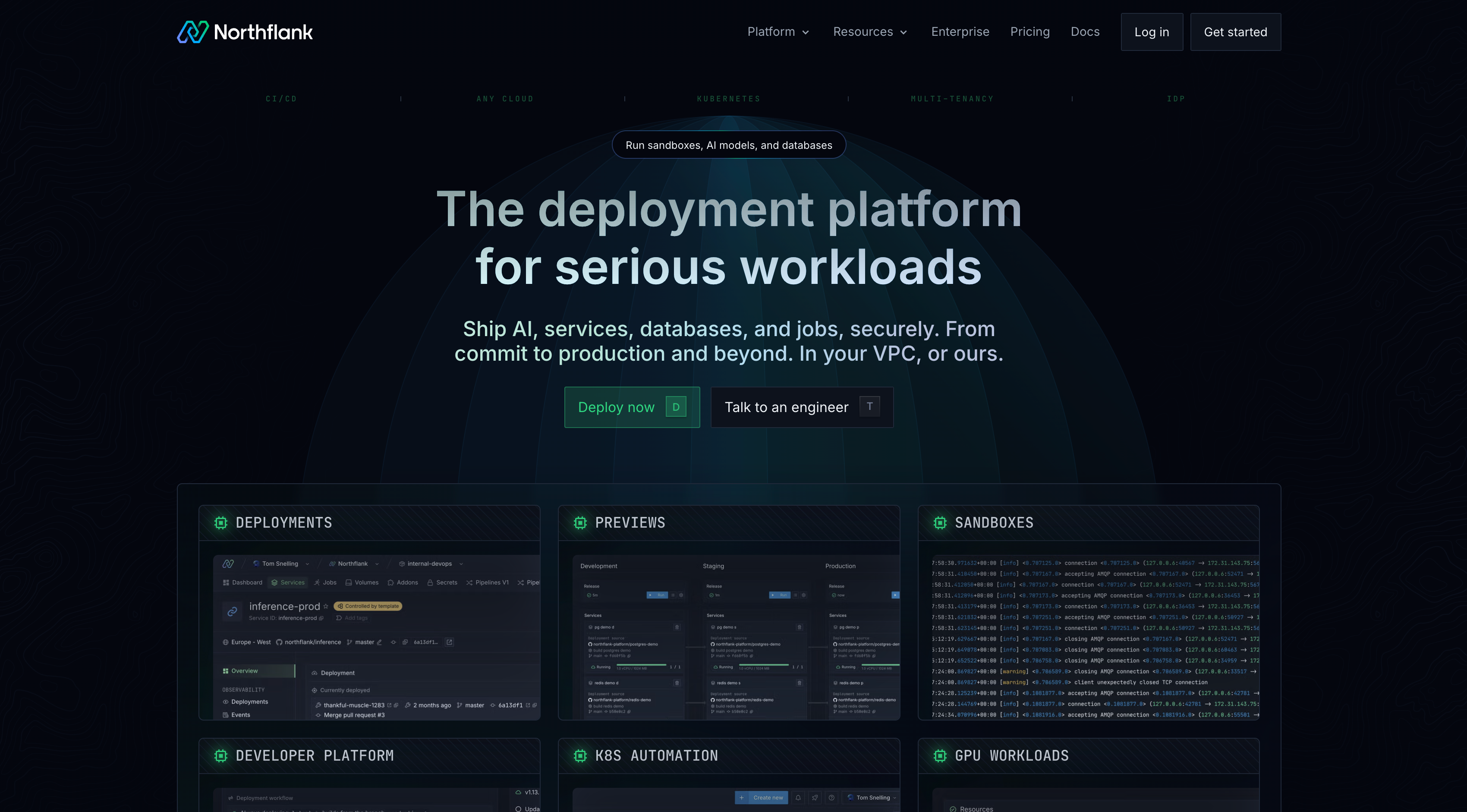
Sandbox isolation is on by default. Every workload runs inside an isolated container using Kata Containers or Firecracker microVMs, or gVisor syscall interception, providing VM-level isolation without the overhead of managing virtual machines directly.
AI coding agents including Claude Code and Codex work end-to-end via the Northflank API and CLI, so the build and deploy steps do not require manual intervention.
Automate deployments from your AI agent. The Northflank Skills package lets Claude Code, Codex, Gemini CLI, and Cursor deploy services, manage databases, and configure environments via Northflank's API and CLI, directly from your agent session.
Northflank runs on managed cloud or, via BYOC (Bring Your Own Cloud), inside your own AWS, GCP, Azure, Oracle, Civo, CoreWeave, or on-premises environment.
Managed databases (PostgreSQL, MySQL, MongoDB, Redis), secrets management, RBAC, SSO, audit logs, preview environments per PR, and GPU workloads are all available on the same platform.
Northflank is SOC 2 Type 2 certified and provides enterprise-grade infrastructure across managed cloud and BYOC, with a DX that makes it accessible to both technical and non-technical teams building and deploying apps with AI coding tools, with little to no infrastructure or DevOps expertise required.
Get started deploying your AI-built apps on Northflank
See how Versaia migrated their full AI agent orchestration stack to Northflank, reducing compute costs by 60% and increasing voice engine throughput from 4-5 to 15 concurrent calls per node.
The following guides and resources will get you started:
- Introduction to Northflank
- Enterprise vibe coding: how to deploy AI-generated apps safely
- How non-technical employees can build and ship internal apps with AI, securely
- Sandboxes on Northflank
- GPUs on Northflank
- How to deploy vibe-coded Claude Code apps to production
- How to deploy vibe-coded Lovable apps to production
- How to deploy vibe-coded Bolt.new apps to production
- How to deploy vibe-coded Cursor apps to production
- How to deploy vibe-coded Replit Agent apps to production
Get started (self-serve), or book a demo if you want to walk through your specific deployment setup with the team.
The deployment process is the same, but the risk profile differs. AI-generated code has not been fully reviewed, may include hardcoded credentials, and often defaults to broad database permissions, so the deployment platform carries more of the security burden.
Not every AI-built app requires microVM isolation. A static frontend or a simple API with no runtime code execution does not carry the same risk as an app that runs AI-generated or user-submitted code dynamically, where standard container isolation sharing the host kernel is not sufficient.
Claude Code outputs to a Git repository, which you can deploy to any platform that supports Git-based deployments. For production workloads that need secrets management, databases, isolation, and access controls, you will typically need a separate deployment platform rather than the tool's native deploy option. Northflank supports both workflows: see how to deploy vibe-coded Claude Code apps to production and how to deploy vibe-coded Lovable apps to production for step-by-step walkthroughs on Northflank.
BYOC (Bring Your Own Cloud) means your workloads run inside your own cloud account rather than a shared vendor environment. For teams with data residency requirements, compliance obligations, or existing cloud credits, BYOC means AI-built apps run on managed deployment tooling without data leaving your own VPC.
A preview environment is a full-stack isolated deployment created when a pull request is opened and torn down on merge. On Northflank, a single preview can include the frontend, backend, databases, and background jobs as isolated instances, giving reviewers a shareable URL to test against real infrastructure before anything reaches production.
Claude Code outputs to a Git repository. Northflank connects to that repository, builds the container, and deploys it with sandbox isolation, secrets management, managed databases, RBAC, and preview environments. The Northflank API and CLI also support agent-driven deployments so the deploy step can be triggered programmatically. See how to deploy vibe-coded Claude Code apps to production for a step-by-step walkthrough.
The following articles cover the topics in this guide in more depth.
- How to deploy vibe-coded apps: step-by-step walkthrough for taking an AI-built app from a Git repository to a live HTTPS URL on Northflank.
- Best PaaS platforms for AI-generated and vibe-coded apps: comparison of PaaS platforms on databases, secrets management, and preview environments for AI-built apps.
- What is a sandbox environment: a primer on sandbox isolation models and the difference between container and microVM isolation.
- Best deployment platforms for vibe coders: broader comparison of deployment platforms for teams shipping AI-built apps.
- Enterprise AI coding agent deployment: deployment infrastructure for teams running AI coding agents at scale.
- Top GPU hosting platforms for AI: comparison of GPU hosting options for AI workloads including inference and agent execution.