
How to deploy vibe-coded Cursor apps to production in minutes
You built an app with Cursor. It runs locally. Now you need it on a real URL, with HTTPS, automatic redeployments when you push changes, and infrastructure that does not break when real users hit it.
This article covers how to deploy a Cursor app to production on Northflank: getting your code into GitHub, configuring the build, and getting a live HTTPS URL with automatic redeployments on every push. Cursor can build anything, from a static frontend to a full-stack API to a Python backend, so some steps will depend on what your app actually is.
Cursor builds the app. Northflank runs it in production.
- Ask Cursor Agent to create a Dockerfile for your project. This is the most reliable way to deploy any vibe-coded Cursor app, regardless of framework or language.
- Push your code to GitHub. Cursor projects live on your local machine, so this is a standard Git push.
- Connect the repository to Northflank. Northflank builds from the Dockerfile and deploys the app with TLS in under two minutes.
- Every push to GitHub triggers an automatic redeployment on Northflank.
What is Northflank? Northflank is a full-stack cloud platform that deploys Cursor apps with production-grade infrastructure: managed databases, secrets management, TLS, CI/CD pipelines, preview environments per pull request, and BYOC into your own cloud. No infrastructure code. No DevOps background required. Sign up to get started or book a demo.
Cursor outputs code directly to your local machine. Northflank takes that code and runs it with managed databases, secrets management, autoscaling, preview environments, CI/CD pipelines, and BYOC support when your app grows. You keep iterating with Cursor. Northflank handles everything underneath.
Before pushing to GitHub, ask the agent to generate a Dockerfile for your project. A Dockerfile is the most reliable way to deploy any Cursor app on an external platform, regardless of the framework or language. Open the Cursor chat and ask the agent:
Add a Dockerfile to this project so I can deploy it anywhere with Docker.
The agent will generate a Dockerfile specific to your project. For a Node.js app, it will install dependencies, build, and start the server. For a Python app, it will install requirements and start the ASGI or WSGI server. For a Next.js app, it will run the build and start the Next.js server.
Once the agent is done, check two things before moving on:
- The Dockerfile is visible in your project file tree
- Ask the agent: "What port does my app run on in the Dockerfile?" Write this down. You will need it in Step 4.
Confirm both look correct before continuing.
Now you need to put your code on GitHub so Northflank can deploy it. If you do not have a GitHub account, create one for free at github.com before continuing.
Create a GitHub repository:
- Go to github.com/new
- Give the repository a name
- Leave everything else as the defaults
- Click Create repository
Do not add a README or .gitignore. You just need an empty repository. GitHub will show you the repository URL once it is created. Copy it. It will look like https://github.com/your-username/your-app-name.git.
Push your code:
Open the Cursor chat and paste this prompt, replacing the URL with the one you copied:
Initialize a Git repository in this project if one does not already exist, then push everything to GitHub. The repository URL is https://github.com/your-username/your-app-name.git
Cursor will initialize the repository if needed, commit all the files, and push to GitHub. Every push to GitHub from this point will trigger an automatic redeployment on Northflank once connected.
Sign up for Northflank. The free tier includes two services, one database, and two cron jobs with always-on compute.
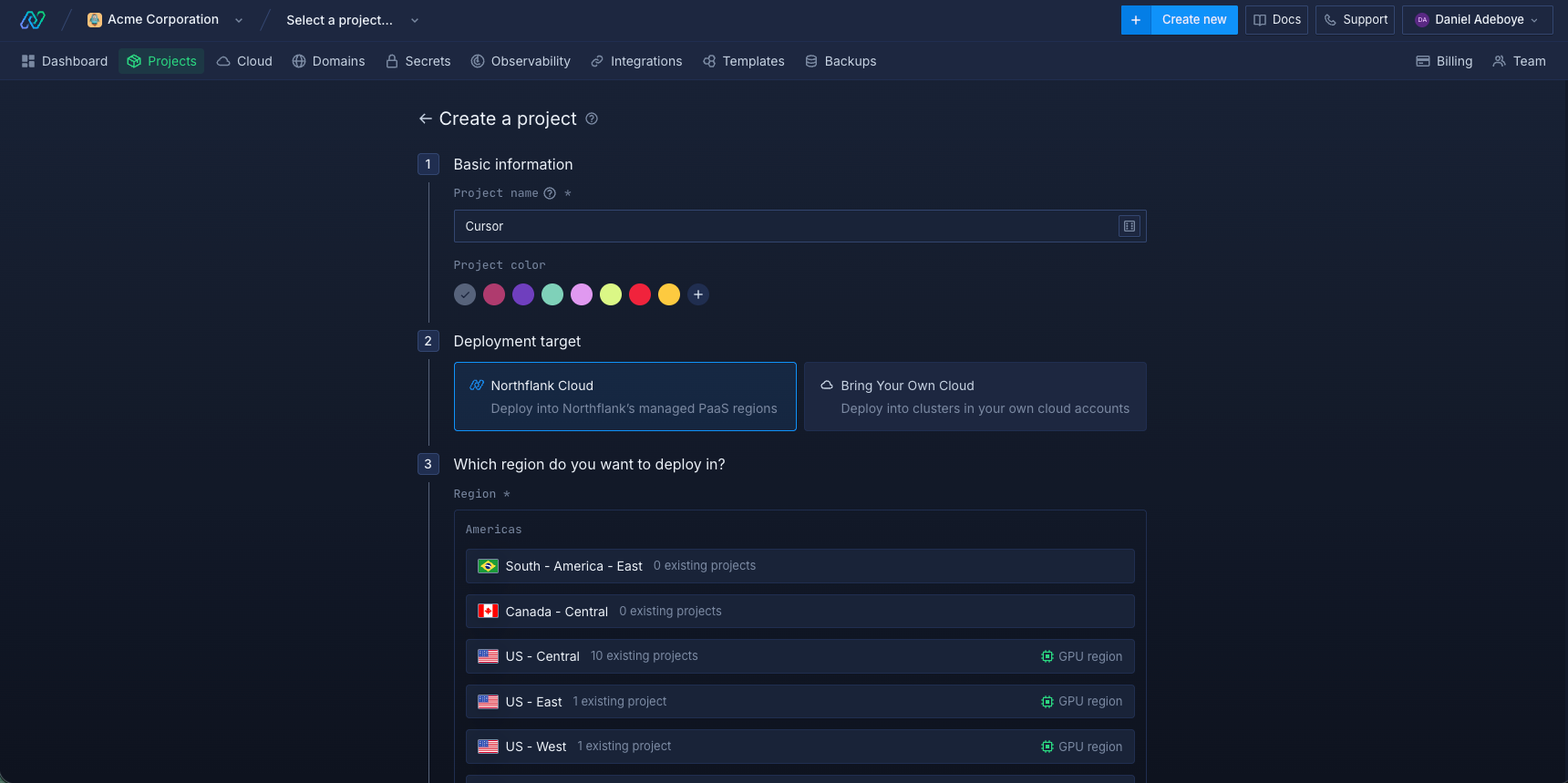
Once you are in the dashboard, link your git account and create a new project. A project is a container for all the resources that belong to your app: services, databases, secrets, and pipelines.
- Click Create project from the dashboard
- Give it a name matching your Cursor app
- Choose a deployment target (Northflank Cloud)
- Select a region closest to your users
- Click Create project
Tip: If you are using Claude Code, Codex, Gemini CLI, or Cursor, you can install the Northflank skill to deploy and manage your app directly from your agent workflow without switching to the Northflank dashboard.
- Open your project dashboard and go to the Services tab. Click Create service
- Select Combined service and enter a name, for example
cursor-app - Select your repository from the dropdown and choose the branch to deploy from
- Under Build options, select Dockerfile. Northflank automatically detects the Dockerfile if it is in the root of the repository. If Cursor placed it in a subdirectory, ask it for the exact path and enter it in the Dockerfile location field, for example,
/app/Dockerfile - Under Networking, add a public port using the port number Cursor told you in Step 1. Northflank provisions a public HTTPS URL on this port automatically
- Under Environment variables, add any credentials or configuration your app needs. There are two types: build arguments are injected during the build process, and runtime variables are injected when the app is running. If you are unsure which to use, ask Cursor: "Do my environment variables need to be available at build time or runtime?" and add them in the correct section based on the answer
- Leave resources at the default values. You can enable autoscaling from the resources panel at any time
- Click Create service
Tip: If your app has multiple services or you want to manage credentials in one place, secret groups are a better option than adding variables directly to each service.
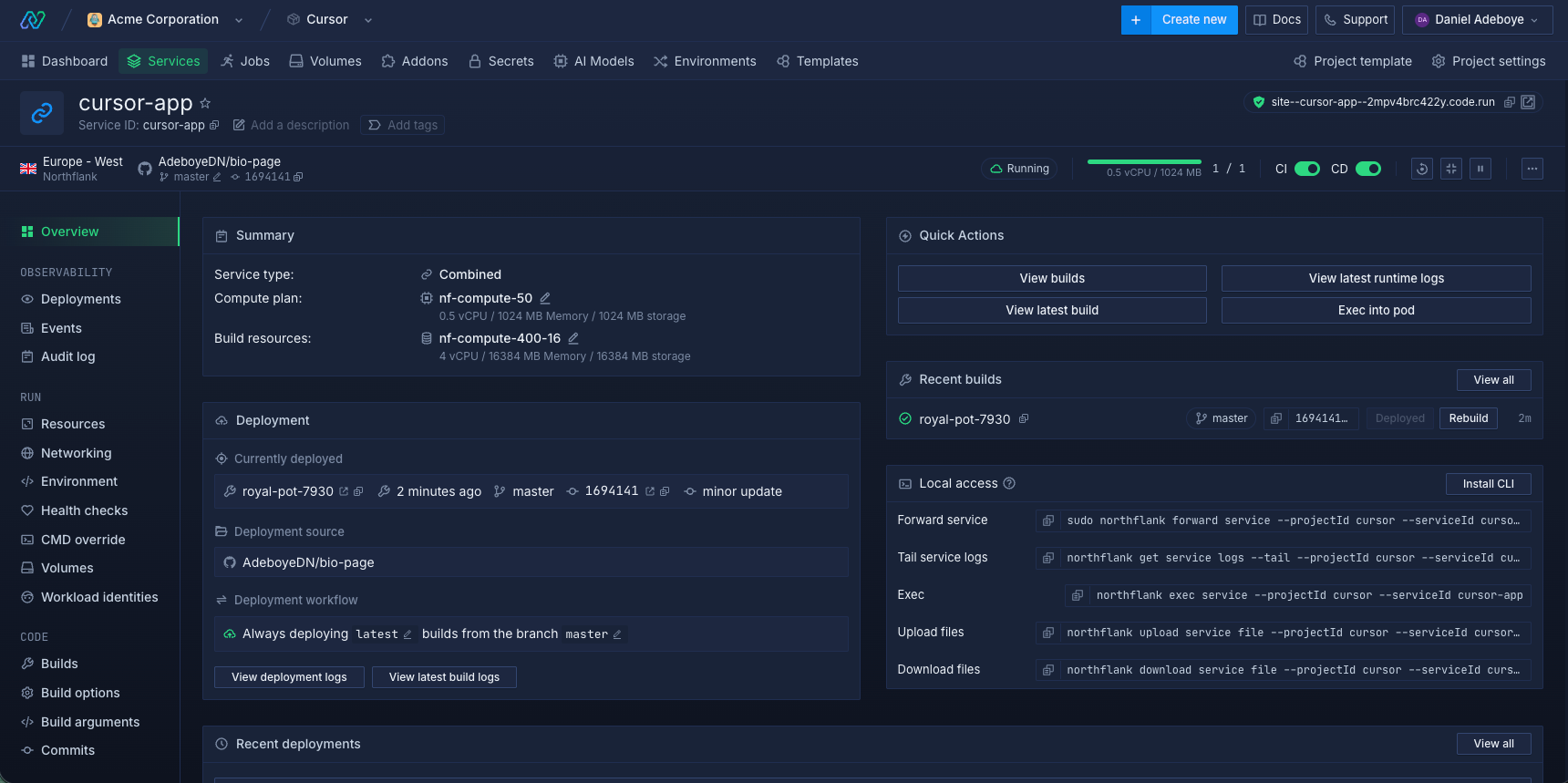
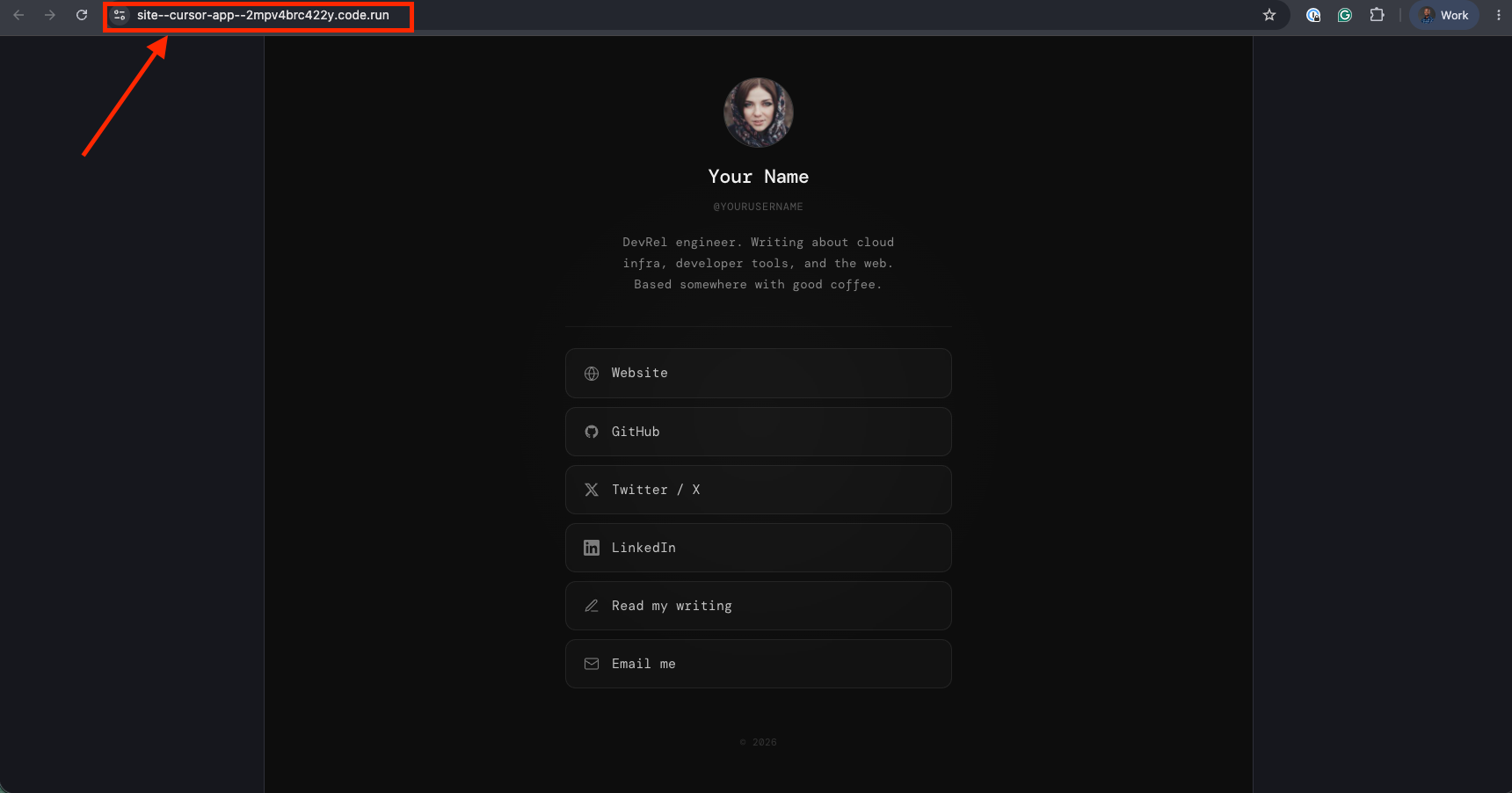
Northflank builds the app and deploys it. TLS is provisioned automatically. Your Cursor app is live on a *.code.run URL in under two minutes.
To use your own domain, first verify it in your Northflank account settings by adding a TXT record to your DNS provider. Once verified, add a subdomain and point it to your service port using the CNAME record Northflank provides. Northflank provisions a TLS certificate automatically.
For the full walkthrough, see Add and verify a domain in the Northflank docs.
By the end of this guide, your Cursor app has:
- A live HTTPS URL on a
.code.runsubdomain or your own domain - Automatic redeployment on every push to GitHub
- Environment variables injected at runtime with no credentials in the source code
- Always-on compute on the free tier
When your app grows and needs a managed database, background workers, preview environments per pull request, or the ability to run inside your own cloud account, Northflank covers all of it from the same control plane.
No. You keep iterating with Cursor locally. Every time you push to GitHub, Northflank picks up the new commit and redeploys automatically. Your development workflow stays the same. The production infrastructure runs on Northflank.
It is the most reliable approach for Cursor apps since they can be any framework or language. Northflank also supports buildpacks for standard runtimes. If your app is a straightforward Node.js or Python project, you can try buildpacks first and fall back to a Dockerfile if the build fails.
Copy the error from the Northflank build logs and paste it into the Cursor chat. Cursor can diagnose most build failures and update the Dockerfile to fix them.
Make your changes with Cursor, commit, and push to GitHub. Northflank detects the new commit and triggers a new build and deploy automatically. No manual steps required after the initial setup.
Yes. Northflank provides managed PostgreSQL, MySQL, MongoDB, Redis, MinIO, and RabbitMQ as first-class addons. Provision one from the project dashboard and Northflank injects the connection string automatically via secret groups.
Yes. Northflank preview environments spin up an isolated copy of the app per pull request and tear down automatically on merge. For a full walkthrough, see How to auto-create preview environments on every PR.
Cursor builds the app. Northflank keeps it running in production. Ask Cursor for a Dockerfile, push to GitHub, connect to Northflank, and your app is live with TLS and automatic redeployments on every push.
Sign up for free and deploy your Cursor app in minutes. Or book a demo if you want to walk through your specific setup with an engineer.
- How to deploy vibe-coded apps to production: The general guide for deploying any vibe-coded app on Northflank, with a step-by-step walkthrough.
- How to auto-create preview environments on every PR: Step-by-step guide to setting up automatic preview environments so every pull request gets its own isolated deployment.