
Is BYOC the future of software deployment?
BYOC is emerging as a preferred deployment model for many enterprise infrastructure, data, and AI software where compliance, data residency, committed cloud spend, or GPU hardware are hard requirements. It will not replace SaaS for most software. The three structural drivers accelerating adoption are compliance enforcement with real financial penalties, multi-year cloud commitments that make shared SaaS economically inefficient, and GPU hardware reservations that require the platform to come to the hardware rather than the reverse.
Northflank has been operating BYOC since 2019, longer than most platforms have offered it at all. Self-serve into AWS, GCP, Azure, Oracle, CoreWeave, Civo, on-premises, and bare-metal. No enterprise sales process. No markup on underlying compute. Full feature parity with managed cloud on every plan including free. Get started (self-serve) or book a demo.
BYOC adoption is accelerating across enterprise software, driven by compliance enforcement, committed cloud spend optimization, and GPU hardware reservations for AI workloads. This article covers the structural drivers behind that shift, which categories of software are moving toward BYOC, and what the model looks like in practice.
BYOC (Bring Your Own Cloud) is a deployment model where a vendor's platform runs inside the customer's own cloud account rather than the vendor's shared infrastructure. The vendor manages the control plane. The customer owns the VPC, the compute, and the data. In real BYOC, user traffic enters your VPC directly and the vendor's control plane is not in the request path.
Three structural forces are accelerating BYOC adoption across enterprise software categories.
GDPR enforcement reached record levels in 2025, the highest total since enforcement began. China's Network Data Security Management rules took effect in January 2025. Brazil's LGPD, India's PDPB, and the UAE's PDPL all have active enforcement. Standard SaaS creates a compliance chain that auditors increasingly challenge. A DPA (Data Processing Agreement) covers the contractual relationship, but auditors now ask for architectural evidence that data stays in a specific region. BYOC provides that evidence: the data plane is in your cloud account, in your region, under your network controls.
Multi-year committed use agreements are standard practice for mid-market and enterprise organizations. Paying a SaaS vendor for compute when committed cloud spend sits underutilized is a procurement problem that CFOs and infrastructure teams are now actively resolving. BYOC moves the compute cost to the customer's own cloud account against committed spend. The vendor charges a platform fee. The infrastructure cost goes toward spend the organization has already committed.
H100 and B200 GPU clusters are three-year infrastructure commitments. Teams running serious AI workloads at production scale cannot rely on spot pricing or on-demand rates. The hardware is reserved, paid for, and located in a specific region in a specific cloud account. A platform that cannot deploy its control plane to target that existing cluster is not useful for those workloads. BYOC is often the most practical deployment model when GPU infrastructure is a fixed, customer-owned asset.
The Broadcom acquisition of VMware in 2023 eliminated perpetual licensing and increased renewal costs by 2x to 10x across enterprise customers. Organizations are doing expensive, disruptive multi-year migrations rather than absorbing the price increases.
The lesson applies to every enterprise SaaS procurement team: any vendor-managed deployment creates a dependency that can reduce a customer's leverage during renewals. One response is increasing ownership of the infrastructure the software runs on. BYOC is one way to achieve that while retaining a managed platform experience. This risk calculus now appears on enterprise procurement evaluations for any platform with significant lock-in potential.
Northflank BYOC is designed specifically for this scenario. Your workloads run on infrastructure you own. Northflank manages the platform layer. If you ever move on, your data and compute stay with you. See how it works.
No. Most software does not need BYOC and will not need it. Consumer software, SMB SaaS, and developer tools below the enterprise threshold will remain on shared managed infrastructure. The drivers that make BYOC compelling are specific to certain categories.
The categories where BYOC is becoming the standard model:
| Software category | Primary BYOC driver |
|---|---|
| Enterprise infrastructure and developer platforms | IP protection, compliance, committed spend |
| Data and analytics platforms | Data residency, regulatory requirements |
| AI and ML infrastructure | GPU hardware reservations, model IP |
| Security and identity platforms | Routing security data through a third party's network |
| Observability platforms | Telemetry data residency, regulated industries |
These three models are often confused. The distinction is who manages the platform and where the data runs.
| Deployment model | Where workloads run | Who manages the platform | Data in your VPC |
|---|---|---|---|
| Shared SaaS | Vendor's cloud | Vendor | No |
| Single-tenant SaaS | Vendor's cloud (dedicated) | Vendor | No |
| BYOC | Your cloud | Vendor | Yes |
| Self-hosted | Your cloud | You | Yes |
BYOC is the model where the vendor manages the platform on your infrastructure. Self-hosted gives you more control at the cost of full operational burden. Single-tenant SaaS provides tenant isolation, but the data still runs in the vendor's network.
Northflank BYOC is self-serve. Connect a cloud account, and the platform deploys the data plane into your infrastructure in minutes. No enterprise sales process required. BYOC is available on all plans, including the free tier.
Northflank manages the control plane. Your workloads run on your own compute, in your own VPC, under your own network controls. User traffic enters your VPC directly. Infrastructure costs bill to your cloud account at list price with no markup. For teams with committed AWS, GCP, or Azure spend, BYOC workloads consume that committed spend. For teams with GPU reservations, Northflank's control plane targets existing GPU clusters.
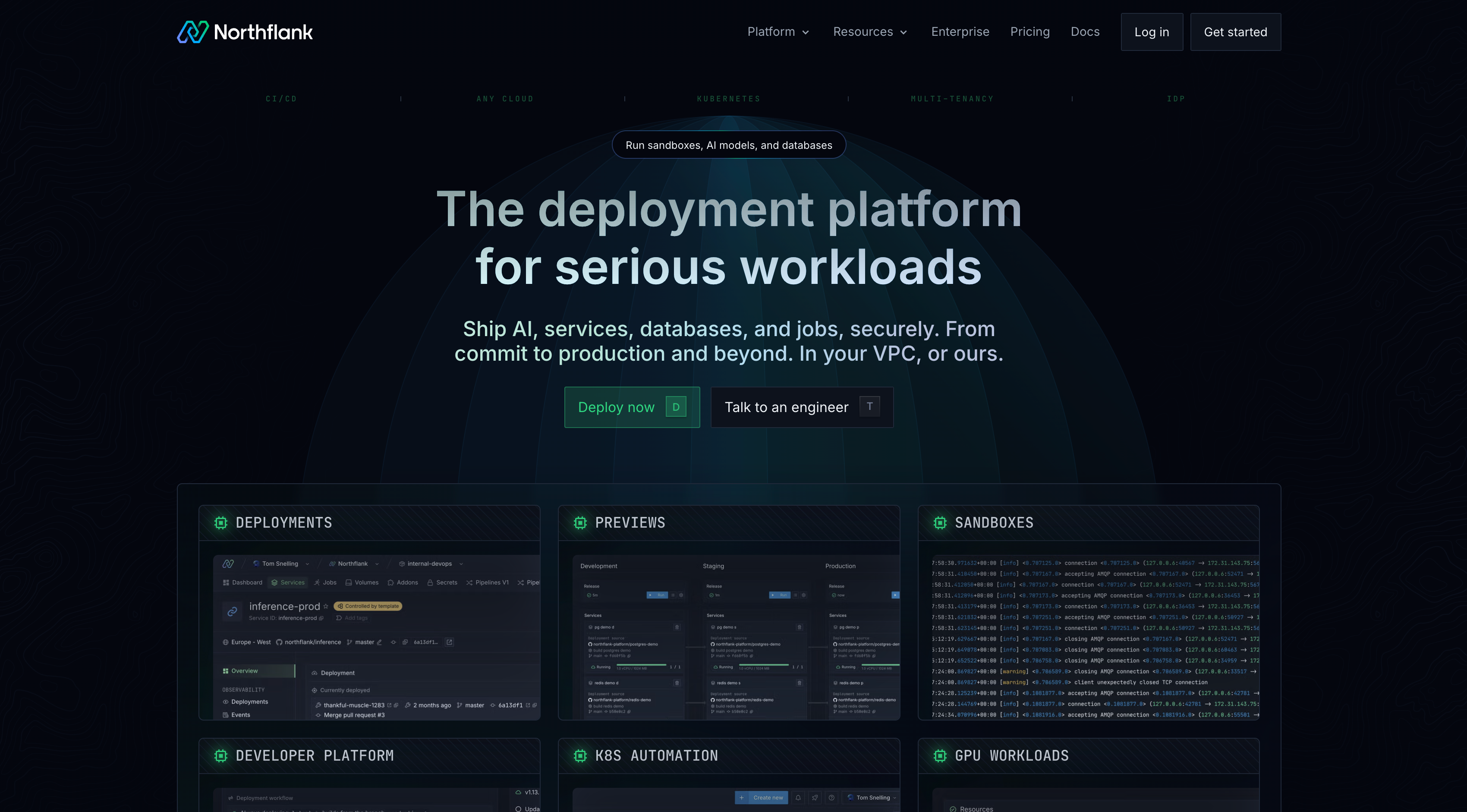
Every capability available on Northflank's managed cloud is available on BYOC: CI/CD pipelines, managed databases, preview environments per pull request, microVM sandbox isolation, GPU workloads, RBAC, SAML and OIDC SSO, and audit logging. SOC 2 Type 2 certified across managed cloud and BYOC, HIPAA compliant, and Northflank signs BAAs for customers handling PHI on either deployment model.
| Feature | Northflank managed cloud | Northflank BYOC |
|---|---|---|
| CI/CD pipelines | Yes | Yes |
| Managed databases | Yes | Yes |
| Preview environments | Yes | Yes |
| GPU workloads | Yes | Yes |
| Sandbox isolation | Yes | Yes |
| RBAC and SSO | Yes | Yes |
| Audit logging | Yes | Yes |
| Data in your VPC | No | Yes |
| Infrastructure cost markup | Platform fee only | No markup |
| Committed spend consumption | No | Yes |
BYOC is not the future of all software. It is the future of enterprise software categories where compliance enforcement, committed cloud spend, GPU hardware commitments, and vendor pricing risk are all increasing interest in deployment models that give customers more infrastructure ownership and control. The drivers behind that shift are structural, and all three are accelerating in 2026.
Northflank has been building for this shift since 2019. Self-serve BYOC, full feature parity with managed cloud, and no markup on underlying compute.
Get started with Northflank BYOC or book a demo to see how it works.
Three structural drivers are converging: compliance enforcement with real financial penalties (GDPR exceeded €3 billion in fines in H1 2025), committed cloud spend optimization as enterprises look to consume multi-year cloud commitments, and GPU hardware reservations for AI workloads that require the platform to come to the hardware.
No. SaaS remains the right model for most software, particularly below the enterprise threshold. BYOC is likely to become increasingly common across enterprise infrastructure, data, AI, and security platforms where compliance, residency, spend, or hardware requirements are significant factors.
The Broadcom acquisition demonstrated that vendor-managed deployments create a pricing dependency that can be exploited at renewal. Enterprises undergoing painful VMware migrations are now applying that lesson to every enterprise SaaS renewal. BYOC can reduce infrastructure lock-in because the workloads run in infrastructure controlled by the customer. While it does not eliminate vendor dependence entirely, it can improve negotiating leverage and make migrations less disruptive.
Northflank BYOC is available on all plans, including the free tier with self-serve setup. Early-stage teams with compliance requirements, GPU hardware, or committed cloud spend can benefit from BYOC today without a professional services engagement or an enterprise sales process.
At a small scale, shared SaaS is typically cheaper. At production scale with committed cloud spend, BYOC usually reduces total cost because infrastructure bills against existing cloud commitments rather than the vendor's shared infrastructure margin.
- What is BYOC in cloud computing?: How the BYOC deployment model works, who needs it, who does not, and the test for genuine BYOC.
- Best BYOC platforms in 2026: A comparison of Northflank, Aiven, Qovery, and Porter on cloud coverage, self-serve setup, and full-stack scope.
- OpenShift vs VMware: key differences and how to choose in 2026: How the Broadcom acquisition is driving enterprises to evaluate BYOC-based alternatives.
- Top managed Kubernetes hosting platforms in 2026: How managed Kubernetes platforms compare on BYOC, sandbox isolation, and enterprise controls.