
Top Blaxel alternatives for AI sandbox and agent infrastructure in 2026
Blaxel is a managed AI agent infrastructure platform with fast sandbox resume times and serverless agent hosting. It works well for teams that just want sandboxes, but it falls short when you need BYOC, compliance, GPUs, or a full stack (databases, pipelines, and observability in your own VPC). Northflank is the strongest alternative built for it.
- Northflank – Full-stack AI infrastructure platform with managed cloud and BYOC deployment into AWS, GCP, Azure, or bare-metal. Production-grade microVM sandboxes with Kata Containers, Firecracker, and gVisor isolation, unlimited sessions, databases, GPUs, CI/CD, and observability all in one place.
- E2B – Developer-friendly AI sandbox with polished SDKs and Firecracker microVMs, best for teams that need quick integration
- CodeSandbox – Browser-based sandboxing with snapshot and forking support, now backed by Together AI
- Modal – Serverless compute platform purpose-built for Python/ML workloads with massive autoscaling
- Daytona – Pivoted from dev environments to AI code execution in 2025, and went closed-source in June 2026
- Fly.io Sprites – Stateful sandbox environments built on Firecracker microVMs, designed for AI coding agents
Blaxel came out of YC's Spring 2025 batch with a clear thesis: the cloud wasn't built for AI agents. Its perpetual sandbox platform keeps environments on standby indefinitely, resumes in under 25ms, and co-locates agent APIs alongside sandboxes to cut latency. For teams that just need sandboxes, that's a solid pitch. But costs can escalate quickly at scale, and once compliance, BYOC, GPUs, or a full infrastructure stack enter the picture, the alternatives start to look a lot more interesting. Here are the top alternatives worth your time.
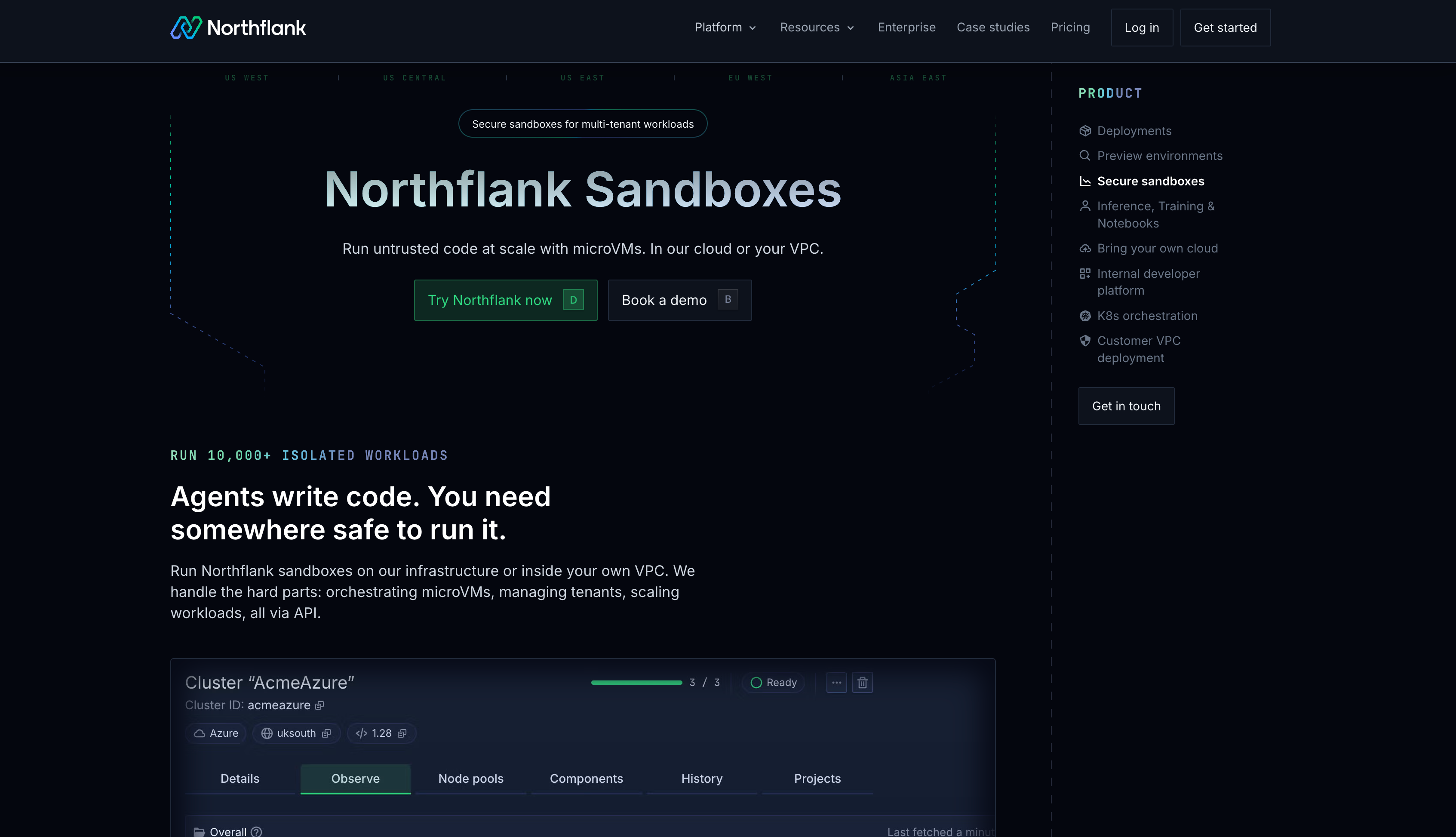
Northflank is the most complete platform on this list. While Blaxel focuses on agent hosting and code execution, Northflank provides the full infrastructure stack: microVM sandboxes, databases, APIs, CI/CD pipelines, GPU workloads, and observability, all running either in your own cloud account or in Northflank's managed cloud.
The biggest differentiator is production-grade BYOC support. You can deploy into AWS, GCP, Azure, Oracle, CoreWeave, Civo, or bare-metal, and Northflank handles the orchestration while your data never leaves your VPC. For teams in fintech, healthcare, or any regulated industry, that distinction often determines whether a platform even makes it past a security review.
On sandboxes specifically, Northflank supports both Kata Containers with Cloud Hypervisor and gVisor, giving you flexibility based on your threat model. Sessions run indefinitely with no artificial caps, which matters more than most teams realize until they're debugging why a production agent died mid-task.
Northflank also accepts any OCI-compliant image from any registry without modifications, which means your existing Docker workflows port over without a rewrite. GPU pricing is all-inclusive covering CPU and RAM, which works out roughly 62% cheaper than sandbox products billing GPU, CPU, and RAM separately.
Best for: Teams that need full infrastructure control, compliance-sensitive workloads, long-running stateful agents, or anyone who wants one platform instead of stitching together five point solutions.
Pricing: Transparent usage-based pricing with no mandatory minimums. CPU at $0.01667/vCPU-hour, RAM at $0.00833/GB-hour, and H100 GPU at $2.74/hour all-inclusive (CPU and RAM included). BYOC deployments run on your own cloud billing.
E2B has clean Python and TypeScript SDKs and Firecracker microVM isolation, making it one of the fastest ways to add sandboxed code execution to an AI agent. Boot times sit around 150ms and it integrates well with LangChain, OpenAI, and Anthropic tooling. The ceiling is session duration: 24 hours on Pro, with no production-ready self-hosting option if you need data to stay in your own infrastructure.
Best for: Developers building AI coding agents, data analysis tools, or Code Interpreter-style experiences who don't need sessions longer than 24 hours.
Pricing: Free tier with $100 one-time credit. Pro at $150/month with 24-hour sessions and configurable CPU and RAM.
Now backed by Together AI, CodeSandbox brings snapshot and forking to AI agent infrastructure. You can branch environments from the same base state, run agents in parallel, and restore VMs in under two seconds. It uses Dev Container images rather than arbitrary Docker images, so there is some convention to work within, but the SDK is solid and the pricing is competitive.
Best for: Teams already on CodeSandbox, web-focused coding agents, educational platforms, or use cases where snapshot and forking are central to the product.
Pricing: The community plan is free. Production workloads are usage-based at $0.0446 per vCPU per hour plus $0.0149 per GB-RAM per hour.
Modal is a Python-first serverless compute platform where sandboxes are one feature within a broader ML-focused fabric. It scales to 20,000 concurrent containers with sub-second cold starts, and teams like Lovable and Quora run millions of executions through it. The constraints are significant though: you must define environments through Modal's Python SDK, there is no BYOC option, and GPU, CPU, and RAM are billed separately.
Best for: Python-centric ML teams running batch jobs, model inference, and data pipelines who want sandboxing integrated with their existing Modal setup.
Pricing: Usage-based per second. CPU from around $0.047/vCPU-hour. GPU billed separately from CPU and RAM.
Daytona pivoted to AI agent infrastructure in early 2025 and leads on cold-start speed, with sub-90ms provisioning and some configurations hitting 27ms. It also supports full Linux, Windows, and macOS virtual desktops for computer-use agents. The tradeoff is isolation: Docker containers by default, with Kata Containers available but not the out-of-the-box experience. Daytona does offer a BYOC option, though it is limited compared to more mature offerings like Northflank. It also went closed-source in June 2026: the original open-source repository is now archived and unmaintained.
Best for: Teams where raw cold-start speed is the priority, computer-use agent workloads, or cases where Docker-level isolation is acceptable.
Pricing: Usage-based with $200 in free compute credits. Around $0.067/hour for a 1 vCPU, 1 GiB RAM sandbox while running.
Sprites launched in January 2026 as Fly.io's purpose-built sandbox for AI coding agents. It runs on Firecracker microVMs with a 100GB persistent NVMe filesystem, checkpoint/restore in around 300ms, and automatic idle billing. It is a good fit if you are already on Fly.io. If you are not, sandbox creation times of one to twelve seconds and the absence of BYOC make it harder to justify outside that ecosystem.
Best for: Individual developers building coding agents, teams already on Fly.io, and Claude Code-style persistent environment use cases.
Pricing: Pay-per-use based on CPU, memory, and storage.
Most of the platforms here solve one problem well. Northflank solves the whole thing. It is the only option on this list that gives you production-grade microVM sandboxes, BYOC deployment into your own cloud account, unlimited session lengths, GPU support, databases, CI/CD, and observability under one roof. If you are building something that needs to scale, stay compliant, and not fall apart when you outgrow a point solution, Northflank is where teams end up.
| Platform | Best for | BYOC | Session limit | Isolation |
|---|---|---|---|---|
| Northflank | Production AI infra, compliance, full stack | Yes (AWS, GCP, Azure, bare-metal) | Unlimited | microVMs (Kata Containers), gVisor |
| E2B | Quick integration, AI agent prototypes | Experimental only | 24 hours | Firecracker |
| CodeSandbox | Forking, parallel agents, web tooling | No | None | microVM |
| Modal | Python ML, inference, batch jobs | No | None | gVisor |
| Daytona | Speed-first, computer-use agents | Limited | None | Docker (default) |
| Fly.io Sprites | Fly.io users, persistent dev environments | No | None | Firecracker |
Blaxel keeps sandboxes on standby indefinitely and resumes them in under 25ms, with agent APIs co-located in the same network to cut round-trip latency. Most competitors either expire sessions or require full cold starts.
Blaxel has SOC2 and HIPAA compliance and supports data residency policies by region. That said, it is managed-only, so enterprises that need workloads running inside their own cloud accounts will need a BYOC platform like Northflank instead.
Daytona leads with sub-90ms provisioning and some configurations hitting 27ms. Blaxel resumes from standby in 25ms. E2B cold boots in around 150ms. Northflank is competitive for production workloads across both Kata Containers and gVisor.
Northflank is the most production-ready BYOC option, deploying into your AWS, GCP, Azure, or bare-metal infrastructure while managing the control plane for you. E2B is open source, but self-hosting at scale means running their control plane yourself. Daytona went closed-source in June 2026, so fully self-hosting it is no longer possible. Modal, Blaxel, and Fly.io Sprites are managed-only.
Modal has deep GPU support for ML workloads. Northflank supports NVIDIA H100 A100, and more, with all-inclusive pricing that runs roughly 62% cheaper than other products billing GPU, CPU, and RAM separately. The other platforms on this list do not currently prioritize GPU workloads.
Ephemeral sandboxes execute code and disappear. Persistent sandboxes hold state across sessions so agents can pick up where they left off. Northflank supports unlimited persistent sessions. E2B caps at 24 hours. Daytona and Fly.io Sprites also support persistence.
Blaxel is well-built for teams that want fast sandboxes without the infrastructure overhead. But managed-only means your data leaves your VPC, the platform stops at agent execution, and when you need databases, CI/CD, compliance controls, or GPUs alongside your sandboxes, you are back to stitching tools together.
If you are building something that needs to last and scale inside your own cloud account, Northflank is the platform worth evaluating. The rest of the options here each do one thing well. Northflank is the one built to do it all.
If Northflank sounds like the right fit, you can get started for free or talk to the team to see how it fits your stack.