
E2B vs Sprites dev: comparing AI code execution sandboxes in 2026
Both platforms provide microVM-based isolation for running untrusted code, but they're optimized for different problems.
- E2B is built for AI agent code execution. Sandboxes are session-scoped, defined by custom templates, and managed via a Python or JS/TS SDK.
- Sprites (by Fly.io) are persistent Linux microVMs that hibernate when idle and resume on demand. Their filesystem persists indefinitely, backed by object storage.
Northflank provides secure sandboxes for running untrusted code at scale with microVM isolation (Kata Containers, Firecracker, gVisor), supporting both ephemeral and persistent environments in managed cloud or your own VPC. It also removes the ceiling: if you need GPUs, workers, APIs, or databases running alongside your sandboxes, they're in the same platform.
E2B provides isolated Linux microVM sandboxes for AI agents to execute code safely. You define an environment via a custom template, and your agent provisions sandboxes on demand via a Python or JavaScript/TypeScript SDK. Each sandbox has a defined lifecycle: created, used, then torn down.
The platform exposes SSH access, an interactive terminal (PTY), lifecycle webhooks, and the ability to connect to running sandboxes. Common use cases include coding agents, computer use agents, and CI/CD pipelines.
Sprites, built by Fly.io, are persistent, hardware-isolated Linux microVM environments. Unlike short-lived sandboxes, Sprites maintain their full filesystem state between executions. When idle, a Sprite hibernates automatically. When you need it, it wakes up. Warm Sprites resume near-instantly; cold Sprites take a bit longer.
What makes them architecturally distinct is how storage works. Sprites back their 100GB durable filesystem with object storage rather than host-attached NVMe. NVMe acts as a read-through cache.
Here's how the three platforms stack up across the dimensions that typically drive the decision.
| E2B | Sprites | Northflank | |
|---|---|---|---|
| Primary use case | AI agent code execution | Persistent stateful compute environments | Secure microVM sandboxes at scale, with full workload runtime |
| Isolation | MicroVM (Firecracker) | MicroVM (Firecracker via Fly Machines) | MicroVM (Kata Containers, Firecracker, gVisor) |
| Persistence model | Session-scoped (up to 24h) | Indefinite, persists between runs | Both ephemeral and persistent, same platform |
| Filesystem | Ephemeral within session, bucket storage available | Full ext4, 100GB durable, backed by object storage | Persistent volumes (4GB to 64TB), S3-compatible object storage, ephemeral by default |
| Hibernation | Auto-pause available in beta | Core feature: auto-sleep when idle | Ephemeral pools or long-running stateful services |
| SDK / access | Python, JS/TS SDK; CLI and SSH also available | CLI, REST API, JS/Go | API, CLI, SSH |
| HTTP access | Via proxy tunneling; custom domains via self-managed proxy setup | Every Sprite gets a unique public URL | Built-in routing and load balancing |
| Self-hosted / BYOC | BYOC on AWS only; enterprise customers only | Managed service (Fly.io infrastructure) | Self-serve BYOC; deploy in your own infrastructure on AWS, GCP, Azure, Oracle, Civo, CoreWeave or on-premises |
| GPU support | CPU-focused | CPU-focused | Both CPU and GPU workloads supported; on-demand GPUs, no quota requests |
| Full runtime (APIs, DBs, workers) | Sandboxes only | Sandboxes only | Yes, full platform |
| Templates | SDK-defined custom templates | Standardized Linux environment | Reusable templates, any language or framework |
The table above captures the what. Here's the why behind the four differences that drive decisions.
| E2B | Sprites | |
|---|---|---|
| State survives between runs | Ephemeral by default; pause/resume available in beta | Yes (filesystem persists indefinitely) |
| Auto-hibernation | Not the primary model | Yes, auto-sleep when idle |
| Use case fit | Fresh environment per agent run | Stateful environments you return to repeatedly |
If your agent needs a clean slate for every execution, E2B's session model fits. If you need state that accumulates between runs, a long-running service that sleeps when idle, or a persistent dev environment, Sprites are designed for that.
Both platforms use Firecracker-based microVM isolation, providing hardware-level separation appropriate for running untrusted or AI-generated code. This is meaningfully stronger than container-based isolation.
Sprites add an inner container layer within the VM, separating user code from the root namespace where orchestration services run. This means the platform can restart the inner environment without rebooting the full VM, including on checkpoint restores. E2B provides VM-level isolation with a secured access mode and proxy tunneling for controlled network access.
The meaningful practical difference: E2B offers a BYOC option on AWS only and for only enterprise customers. Sprites run on Fly.io's managed infrastructure only.
Note: Northflank supports BYOC (Bring Your Own Cloud) self-serve across AWS, GCP, Azure, Oracle, Civo, CoreWeave and on-premises. (or use Northflank's managed cloud if you'd rather not manage your own infrastructure.)
| E2B | Sprites | |
|---|---|---|
| Primary interface | SDK-first (Python, JS/TS) | CLI-first |
| Environment definition | SDK-defined custom templates, versioned and cached | Standardized Linux base; configure inside the running Sprite |
| Reproducibility | High: same template, same environment every time | Lower: environment is configured manually, state persists |
| Integrations | Claude Code, Codex, OpenCode, agent frameworks | Claude, Gemini, Codex pre-installed |
| Best for | Agent pipelines provisioning sandboxes programmatically | Interactive or persistent environments you set up once |
E2B fits when you need a code-defined, reproducible execution environment per agent run. Use it when:
- Your agents generate code that needs a fresh, isolated Linux environment each time
- You want SDK-driven sandbox creation embedded directly in an agent framework
- You need custom-based templates for consistent, versioned environments
- Each task is stateless or self-contained within a session
- You want lifecycle webhooks and metrics for sandbox observability
Sprites fit when the persistence of the environment is itself the feature. Use them when:
- You want a development environment that retains state between sessions
- Your environment accumulates configuration, dependencies, or data over time
- You want instant HTTP access to services running inside via a unique URL
- You're already working within Fly.io's infrastructure and ecosystem
Northflank's Secure Sandboxes provide microVM-based isolation for running untrusted code safely, with both ephemeral and persistent environments, in managed cloud or your own infrastructure.
Where it goes further is in what surrounds the sandboxes: the same platform also runs agents, APIs, workers, databases, and both CPU and GPU workloads, so teams don't need a separate system as their requirements grow.
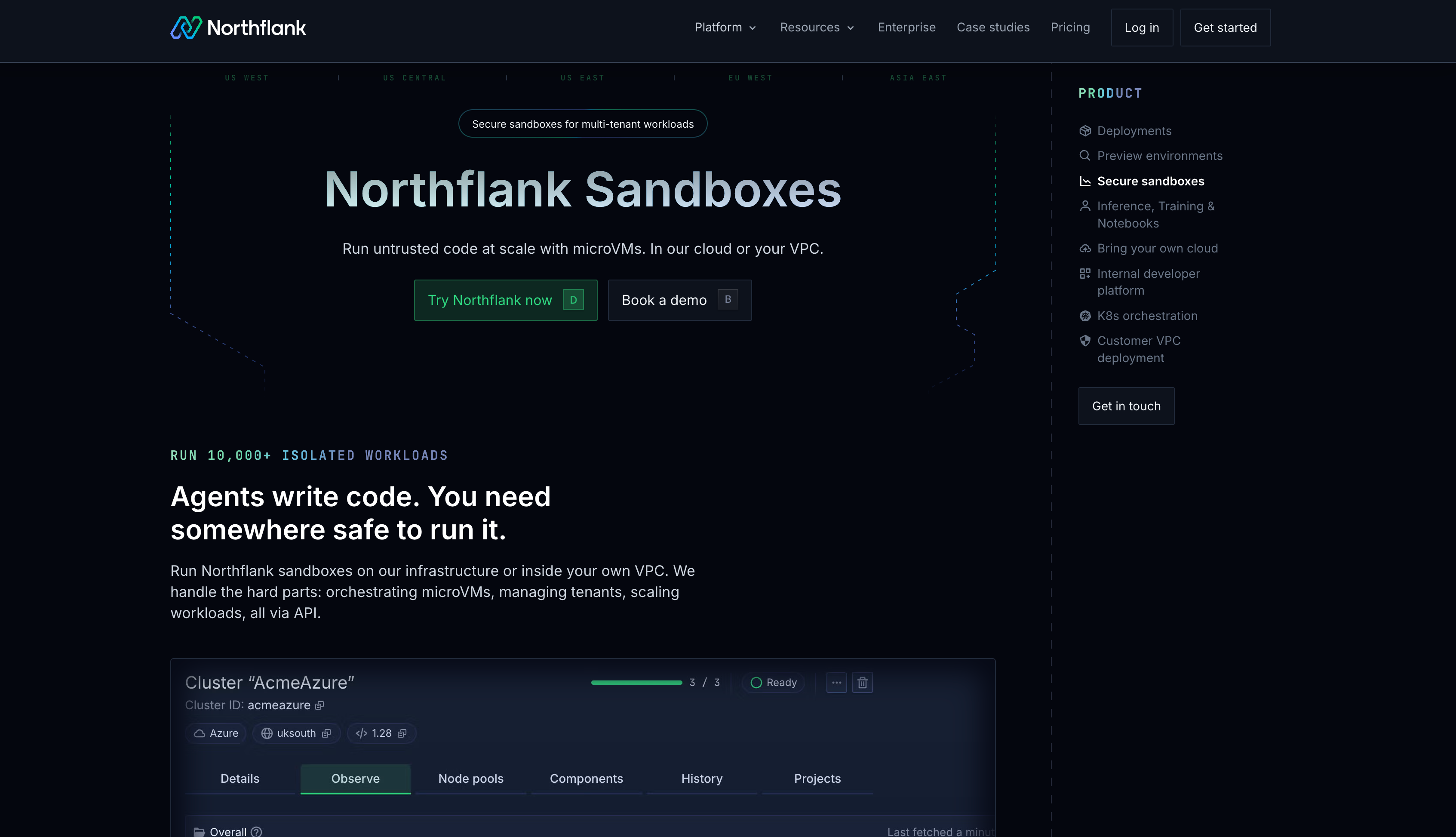
Here's how it compares:
- MicroVM sandboxes: Kata Containers, Firecracker, and gVisor isolation depending on workload. Sub-second cold starts. Built for running untrusted, LLM-generated code safely at scale with true multi-tenant isolation.
- Ephemeral and persistent, same control plane: Short-lived execution pools and long-running stateful services run together. No need to choose one model or stitch two tools.
- Self-serve BYOC: Deploy in your own infrastructure on AWS, GCP, Azure, Oracle, Civo, CoreWeave, or on-premises. Enterprises can run sandboxes entirely within their own infrastructure, which is important for teams with compliance or data residency requirements.
- On-demand GPUs without quota requests: Self-service provisioning for inference, training, and compute-heavy agent work. No waiting on allocations.
- Full workload runtime alongside sandboxes: Agents, APIs, workers, background jobs, databases, and inference run in the same platform. Teams that outgrow sandbox-only tools don't need to migrate.
- Provisioning reflects full workload readiness: End-to-end sandbox creation in 1-2 seconds: The full creation process, not just VM boot.
- In production since 2021: Multi-tenant microVM workloads across startups, public companies, and government deployments. For a concrete example, cto.new uses Northflank's microVMs to scale secure sandboxes in production.
- Pricing: CPU at $0.01667/vCPU-hour, memory at $0.00833/GB-hour. Full details on the Northflank pricing page.
To make the pricing difference concrete, here is what 200 sandboxes costs across providers under the same conditions.
Based on 200 sandboxes, plan: nf-compute-100-4, infra node: m7i.2xlarge
| Model | Provider | Cloud | Sandbox vendor | Total |
|---|---|---|---|---|
| PaaS | Northflank | — | $7,200.00 | $7,200.00 |
| PaaS | E2B | — | $16,819.20 | $16,819.20 |
| PaaS | Fly Sprites | — | $35,770.00 | $35,770.00 |
| BYOC (0.2 overcommit)* | Northflank | $1,500.00 | $560.00 | $2,060.00 |
| BYOC | E2B | $1,500.00 | $10,000.00 | $11,500.00 |
*Through Northflank's plans on BYOC, there's a default overcommit which allows a customer to spawn more services and sandboxes on the same amount of compute. A request modifier of 0.2 means each sandbox only requests 20% of its plan's resources as a guaranteed minimum, but can burst up to the full plan limit if there's available capacity on the node. So instead of fitting 8 sandboxes per node, you could fit 40 on the same hardware, reducing both infrastructure cost and the Northflank management fee.
Northflank sandboxes run untrusted code at scale with microVM isolation, in managed cloud or your own infrastructure. Ephemeral or persistent, CPU or GPU, with full workload orchestration alongside. Get started on Northflank or book a demo with an engineer if you have specific requirements for your organization.
E2B provides on-demand Linux microVM sandboxes for AI agents to execute code safely. Common use cases include coding agents, computer use agents, data analysis pipelines, and CI/CD workflows where each job needs an isolated execution environment, managed via Python or JavaScript/TypeScript SDKs.
Sprites are persistent, hardware-isolated Linux microVMs built by Fly.io. Unlike E2B, which is optimized for session-scoped agent execution, Sprites maintain full filesystem state indefinitely between runs and hibernate automatically when idle. The core difference is persistence model: E2B sandboxes are session-scoped; Sprites are long-lived.
Sprites use a standardized Linux base rather than custom templates. You configure the environment directly inside a running Sprite, and the persistent filesystem means you only do it once. E2B uses SDK-defined custom templates that provision a fresh, reproducible environment for each sandbox.
Both platforms provide hardware-level microVM isolation appropriate for executing untrusted code. E2B fits pipeline-driven, session-scoped execution where each run needs a clean environment. Sprites fit when execution state needs to persist. For teams with VPC or compliance requirements, E2B offers a BYOC option on AWS for enterprise customers; Sprites run on Fly.io's managed infrastructure only.
Beyond isolation, look at whether the platform supports your deployment model (managed vs. your own VPC), whether you need ephemeral, persistent, or both environment types, GPU availability, and whether you'll need additional infrastructure around the sandboxes. Platforms like Northflank combine microVM-based sandboxes with a full production runtime, reducing the number of tools you need as requirements grow.
If you're evaluating sandbox platforms or digging deeper into the architecture, these articles cover the adjacent decisions and trade-offs:
- E2B vs Modal vs Fly.io Sprites for AI code execution sandboxes - A three-way comparison across three of the most discussed platforms in the AI sandbox space.
- The best alternatives to E2B.dev for running untrusted code in secure sandboxes - If E2B isn't the right fit, this covers the strongest alternatives with a focus on isolation and security.
- Top Fly.io Sprites alternatives for secure AI code execution and sandboxed environments - Covers platforms with a similar persistent microVM model to Sprites.
- What is an AI sandbox? - A foundational explainer on what sandboxes are, why isolation is required, and how different approaches compare.
- How to spin up a secure code sandbox and microVM in seconds with Northflank - A practical walkthrough of launching a Northflank microVM sandbox using Firecracker, gVisor, or Kata Containers.
- Top AI sandbox platforms in 2026, ranked - A broader ranked overview of the AI sandbox market as it stands in 2026.
- How to sandbox AI agents in 2026: MicroVMs, gVisor and isolation strategies - A technical deep-dive into isolation approaches and trade-offs between Firecracker, gVisor, and Kata Containers for agent workloads.
- Self-hosted AI sandboxes: guide to secure code execution in 2026 — Useful if you're evaluating whether to run sandbox infrastructure inside your own VPC rather than using a managed service.
- What's the best code execution sandbox for AI agents in 2026? - A decision-focused guide for teams actively choosing a sandbox platform for their AI agent stack.
- Secure runtime for codegen tools: microVMs, sandboxing, and execution at scale - Covers the infrastructure considerations for code generation tools that need to run LLM-generated code at scale.