
E2B vs Modal vs Fly.io Sprites for AI code execution sandboxes
All three platforms solve the same core problem: where does your AI agent safely run code? They each make very different trade-offs:
- E2B - open-source, Firecracker microVM isolation, purpose-built for AI agents and LLM code execution. Sessions have a maximum length that varies by plan. Operates as a managed service.
- Modal - serverless cloud infrastructure with sandbox capabilities, gVisor isolation, Python-first. Scales to a large number of concurrent sessions. Operates as a managed service.
- Fly.io Sprites - stateful, persistent Linux VMs with checkpoint/restore, Firecracker isolation. CPU-only. Does not use Docker or OCI container images by design. Operates on Fly.io's infrastructure.
Note: If you need to run sandboxes inside your own cloud or VPC, Northflank Sandboxes offers bring-your-own-cloud deployment across AWS, GCP, Azure, Civo, Oracle Cloud, CoreWeave, and on-premise, self-serve and production-ready. It also supports both ephemeral and persistent environments, both CPU and GPU workloads, any OCI container image, and a full workload runtime beyond just sandboxes.
When you're building AI agents or platforms that execute untrusted code, choosing the right sandbox comes down to three things: how isolation works, whether your environments need to persist between sessions, and where your code actually runs.
E2B, Modal, and Fly.io Sprites each answer these questions differently. This guide breaks down the architectural differences between them so you can choose based on your use case, not just marketing claims.
If you're new to sandboxing concepts, what is an AI sandbox is a good starting point.
E2B is an open-source cloud platform built specifically for running AI-generated code in secure sandboxes.
Each sandbox runs inside a Firecracker microVM, giving every execution its own dedicated kernel.
E2B provides Python and JavaScript/TypeScript SDKs, supports custom sandbox templates, and offers pause-and-resume for long-running sessions. Sessions have a maximum lifetime that varies by plan.
Modal is a serverless cloud infrastructure platform built for data and ML workloads, with sandboxes as part of its broader offering.
Modal Sandboxes run inside gVisor containers - Google's user-space kernel that intercepts system calls to reduce the host attack surface.
You define sandbox environments dynamically in Python, and Modal handles scaling. GPU support is available across Modal's full infrastructure including sandboxes.
Fly.io Sprites is a stateful sandbox product from Fly.io. Unlike E2B and Modal, Sprites are designed to be persistent Linux computers rather than disposable execution environments.
Each Sprite runs inside a Firecracker microVM with an NVMe-backed filesystem that persists between sessions.
When a Sprite goes inactive, compute is removed and billing stops - but the filesystem stays intact and is restored when the Sprite resumes. Sprites support checkpoint/restore, which captures the entire disk state and can be rolled back to in under a second.
Sprites do not use Docker or OCI container images by design, and are CPU-only.
Isolation is the foundation of any sandbox. It determines whether untrusted code can escape its environment and affect your host system or other workloads.
| Platform | Isolation technology | Dedicated kernel per sandbox |
|---|---|---|
| E2B | Firecracker microVM | Yes |
| Modal | gVisor (user-space kernel) | No |
| Fly.io Sprites | Firecracker microVM | Yes |
E2B and Fly.io Sprites both use Firecracker microVMs. Each sandbox gets its own Linux kernel. A compromised sandbox cannot exploit shared kernel vulnerabilities to escape to the host or affect other sandboxes.
Modal uses gVisor, which runs a user-space kernel that intercepts system calls rather than passing them directly to the host. This provides meaningful isolation without the full overhead of a dedicated VM, but the isolation boundary sits at the syscall interception layer rather than at hardware virtualization.
For running untrusted code where escape prevention is a priority, microVM isolation provides a harder boundary. For trusted ML pipelines where scaling speed takes precedence, gVisor is a reasonable trade-off.
Worth knowing: Northflank Sandboxes uses microVM-based isolation with Kata Containers, Firecracker, and gVisor depending on the workload, so every workload gets the right level of isolation.
You can read more about these isolation differences in our guide on how to spin up a secure code sandbox with microVMs.
This is the most consequential architectural question in this comparison, and where the three platforms diverge most clearly.
- E2B is built around ephemeral execution. Sandboxes are created, run code, and are shut down. Sessions can be paused and resumed within their maximum allowed duration, suited for discrete tasks like generating code, executing it, and cleaning up.
- Modal leans toward task-based, serverless execution. Sandboxes have a configurable timeout with a short default that you can extend, and persistent storage is available via network filesystems and volumes.
- Fly.io Sprites are built around persistence as a first principle. Your Sprite's filesystem survives indefinitely between sessions - installed packages, created files, database state, and running services all remain exactly as you left them. The checkpoint/restore feature lets you snapshot your environment at any point and roll it back in under a second.
Note: Northflank Sandboxes supports both ephemeral execution pools and long-running stateful environments from the same platform, so you are not forced to choose one model or manage two separate tools depending on your agent architecture. See the best code execution sandbox for AI agents guide for a broader comparison.
All three platforms operate as managed services, meaning your sandboxes run on their infrastructure.
- E2B operates as a managed cloud service. BYOC deployment is available for enterprise customers, currently on AWS, with support for additional cloud providers listed as in progress.
- Modal is a serverless AI infrastructure platform built for data and ML workloads, with sandboxes as part of its broader offering
- Fly.io Sprites run on Fly.io's global infrastructure.
If your team needs to run sandboxes inside your own cloud or VPC, Northflank offers both a managed cloud and bring-your-own-cloud deployment across AWS, GCP, Azure, Civo, Oracle Cloud, CoreWeave, and on-premise. Most enterprise customers deploy inside their own VPC, and unlike most platforms, BYOC is self-serve and production-ready.
For teams with data residency requirements, compliance mandates, or a preference for running workloads inside their own cloud accounts, our self-hosted AI sandboxes guide covers your options in more detail.
GPU support varies significantly across the three platforms and is worth checking early if your agents require it.
- E2B does not currently offer GPU support in its sandbox offering.
- Modal supports GPUs across its full infrastructure including sandboxes, with access to a range of NVIDIA GPUs. GPU and CPU workloads are priced separately.
- Fly.io Sprites are CPU-only. Fly.io offers GPUs on its Fly Machines product, but Sprites specifically do not support GPU workloads.
Note: Northflank supports both CPU and on-demand GPU workloads. GPUs are available with self-service provisioning and without quota requests, with all-inclusive pricing. See the Northflank pricing page for details.
| If you need | Consider |
|---|---|
| Open-source SDKs for AI agent code execution with session pause/resume | E2B |
| GPU-accelerated ML pipelines, Python-first workloads at scale | Modal |
| Persistent stateful environments with checkpoint/restore | Fly.io Sprites |
| Both ephemeral and persistent in one platform | Northflank |
| OCI/Docker image support in sandboxes | E2B or Modal |
| Self-serve BYOC into your own cloud or VPC | Northflank |
| GPU sandboxes + BYOC + any OCI image | Northflank |
If your requirements go beyond what these three platforms offer, such as deploying inside your own cloud account, running GPU workloads, using existing OCI container images, or needing both ephemeral and persistent environments on the same platform, Northflank Sandboxes is worth evaluating.
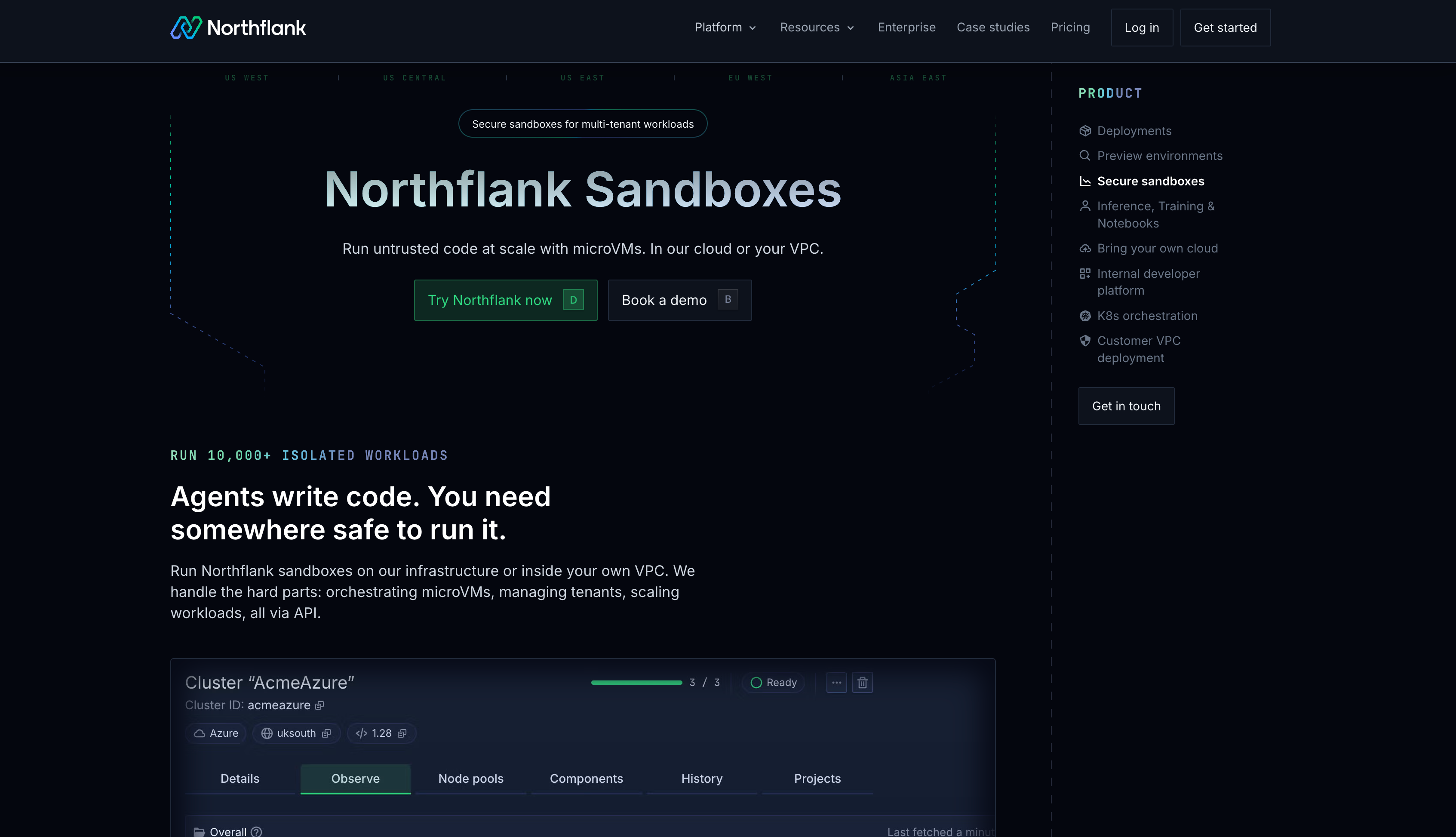
Here is what you get:
- Both ephemeral and persistent environments: Run short-lived execution pools or long-running stateful services from the same platform, depending on what your agent architecture needs.
- Any OCI-compliant container image: Bring images from any registry without a proprietary image format or SDK-defined build process.
- Multiple isolation layers: Kata Containers with Cloud Hypervisor, gVisor, and Firecracker, applied per workload based on your security and performance requirements.
- Self-serve BYOC: Deploy into your own AWS, GCP, Azure, Civo, Oracle Cloud, CoreWeave, or on-premise infrastructure, self-serve and production-ready.
- On-demand GPUs: NVIDIA L4, A100, H100, H200, and more available for sandboxed workloads, with self-service provisioning and no quota requests. (Request your GPU cluster)
- Full workload runtime: Run agents, APIs, databases, background jobs, and cron jobs alongside sandboxes on the same platform.
- API, CLI, and SSH access: Connect to your environments through your preferred interface.
- Environment creation in around 1-2 seconds: Accounting for full environment readiness, not just boot time.
- In production since 2021: Running across startups, public companies, and government deployments.
To make the pricing difference concrete, here is what 200 sandboxes costs across providers under the same conditions.
Based on 200 sandboxes, plan: nf-compute-100-4, infra node: m7i.2xlarge
| Model | Provider | Cloud | Sandbox vendor | Total |
|---|---|---|---|---|
| PaaS | Northflank | — | $7,200.00 | $7,200.00 |
| PaaS | E2B | — | $16,819.20 | $16,819.20 |
| PaaS | Modal | — | $24,491.50 | $24,491.50 |
| PaaS | Fly Sprites | — | $35,770.00 | $35,770.00 |
| BYOC (0.2 overcommit)* | Northflank | $1,500.00 | $560.00 | $2,060.00 |
| BYOC | E2B | $1,500.00 | $10,000.00 | $11,500.00 |
*Through Northflank's plans on BYOC, there's a default overcommit which allows a customer to spawn more services and sandboxes on the same amount of compute. A request modifier of 0.2 means each sandbox only requests 20% of its plan's resources as a guaranteed minimum, but can burst up to the full plan limit if there's available capacity on the node. So instead of fitting 8 sandboxes per node, you could fit 40 on the same hardware, reducing both infrastructure cost and the Northflank management fee.
You can see how Northflank compares directly to each platform: vs Modal, vs E2B, vs Fly.io Sprites. Pricing is on the Northflank pricing page.
Get started on Northflank or book a demo with an engineer if you have specific requirements for your organization.
What is the main difference between E2B and Fly.io Sprites? E2B is built for ephemeral, session-based code execution with a maximum session length per plan. Fly.io Sprites are persistent Linux computers: your filesystem, installed packages, and environment survive between sessions. Both use Firecracker microVMs for isolation, so the security model is similar, but the execution philosophy is fundamentally different.
Does Modal support microVM isolation? No. Modal Sandboxes use gVisor, which provides isolation via a user-space kernel that intercepts system calls. This is stronger than standard containers but does not provide a dedicated kernel per sandbox the way Firecracker microVMs do in E2B and Fly.io Sprites. Northflank supports both microVM isolation (Kata Containers with Cloud Hypervisor and Firecracker) and gVisor, applied per workload.
Can I use Docker images with Fly.io Sprites? No. Sprites do not use Docker or OCI container images by design. You start from a base Linux environment and install dependencies manually or restore from a checkpoint. Fly.io describes this as a deliberate choice to keep creation times fast.
Which platforms support GPU workloads inside sandboxes? E2B's sandbox offering is CPU-only, and Fly.io Sprites are also CPU-only. Modal supports GPUs across its infrastructure including sandboxes. Northflank supports both CPU and on-demand GPU workloads, including NVIDIA L4, A100, H100, H200, and more. GPUs are available with self-service provisioning without quota requests. See the Northflank pricing page for details.
Is E2B open source? Yes. The core E2B infrastructure and SDKs are open source and available on GitHub. The hosted cloud service is commercial with a free tier.
Where can I learn more about sandboxing options beyond these three? The top AI sandbox platforms for code execution guide covers a broader set of platforms and how they compare.