
Ephemeral execution environments for AI agents in 2026
Ephemeral execution environments for AI agents have moved from an architectural nice-to-have to a production requirement as agent workloads scale.
This article covers why the ephemeral pattern is critical for agents, how to implement it, the operational challenges you might encounter, and how platforms like Northflank handle it in production.
Ephemeral execution environments for AI agents are short-lived, isolated runtimes created per agent session or task and destroyed automatically once execution is complete. Unlike persistent environments, they carry no state between runs and reduce residual access to host infrastructure.
Three things determine if your ephemeral execution strategy holds up in production:
- How deep your isolation model needs to go: for untrusted or AI-generated code, process-level separation carries meaningful kernel-level risk that microVM-based isolation addresses.
- How you manage the tension between the stateless nature of ephemeral environments and the stateful execution patterns many agent workflows require.
- How fast and automated your environment creation and teardown is, to match the throughput of agent task pipelines at scale.
Northflank provides microVM-backed ephemeral and persistent execution environments for AI agent workloads, with Firecracker, gVisor, and Kata Containers isolation, and bring-your-own-cloud support across AWS, GCP, Azure, Civo, CoreWeave, Oracle Cloud, and on-premises and bare-metal infrastructure, available self-serve. The platform is used across a range of organisations, from early-stage startups to public companies and government deployments.
AI agents generate and execute code dynamically, without a human reviewing every run. That changes your threat model fundamentally compared to standard developer workflows, where the code running inside an environment is authored by your own engineers.
In an agent execution environment, the code is produced by a model at runtime. Unlike code your engineers write, it is generated dynamically and cannot be fully predicted or controlled in advance.
Ephemeral environments address this directly:
- Clean lifecycle per session: The environment is created fresh for each task and destroyed after, so a compromised session cannot persist access or affect subsequent runs.
- Hard isolation boundary: Combined with the right isolation model, what happens inside the environment is contained within the sandbox boundary.
- No state accumulation: Persistent shared environments accumulate state across sessions, meaning a malformed or malicious run earlier in the lifecycle can influence behaviour later. Ephemeral environments address that risk by design.
For multi-tenant agent platforms where multiple users' agents run on shared infrastructure, ephemeral environments with proper isolation are a hard requirement.
If you want a broader look at isolation strategies, see these guides on how to sandbox AI agents and ephemeral sandbox environments.
Standard ephemeral sandboxes are designed around discrete, one-shot execution: a task runs, produces output, and the environment is destroyed. Agent workloads break that assumption in several ways you need to plan for upfront:
- Execution is multi-step: A single agent session can involve dozens or hundreds of code steps, each shaped by what ran before it. Your environment needs to support stateful execution within a session while remaining ephemeral across sessions.
- Tool use adds network complexity: Agents call external APIs as part of normal operation. You need scoped outbound networking, open access creates exfiltration risk, and full lockdown breaks legitimate tool calls.
- Concurrent sessions require per-session isolation: When multiple agents run simultaneously on behalf of different users, one session must have no visibility into or impact on another. Application-level separation alone is not a reliable boundary when agents run arbitrary generated code.
- Throughput requirements are high: Agent pipelines can create and destroy hundreds to thousands of environments per hour. Creation latency, pool management, and teardown reliability become performance variables, not just operational concerns.
If you need a deeper look at these requirements, see this guide on code execution environments for autonomous agents.
Container-level isolation carries meaningful risk for agent workloads executing untrusted code. Containers share the host kernel, and a kernel vulnerability can expose the host node and other sessions running on it.
The three models suitable for production agent execution are:
- Firecracker microVMs: Each session runs in a lightweight VM with its own guest kernel via KVM. Designed for high-density, multi-tenant workloads.
- gVisor: Runs a userspace kernel (the Sentry) that handles syscalls from guest applications, reducing the attack surface on the host kernel. Lower overhead than a full microVM, but there are syscall compatibility gaps with some applications, and I/O-heavy workloads carry additional latency.
- Kata Containers: Runs OCI containers inside lightweight VMs via a pluggable VMM layer (Firecracker, Cloud Hypervisor, or QEMU). Hardware-level isolation with Kubernetes-native orchestration.
For most production multi-tenant agent platforms, Firecracker or Kata Containers is the right choice. gVisor is a reasonable middle ground for compute-heavy workloads where full VM overhead is not justified, and your application is compatible with its syscall coverage.
See how they compare in detail: Kata Containers vs Firecracker vs gVisor.
Get started with ephemeral execution environments for AI agents
Northflank is self-serve. You can spin up microVM-backed sandbox infrastructure with ephemeral and persistent execution modes and BYOC (Bring Your Own Cloud) support across major clouds and on-premises infrastructure.
Get started with Northflank to spin up your first sandbox in seconds. If you'd prefer to talk through your setup first, you can schedule a demo with an engineer.
See the following resources:
Pure ephemeral execution, where every session starts with a clean filesystem and no prior context, works for stateless tasks. Many agent workflows are not stateless, and this is where the ephemeral pattern gets complicated.
The practical approach is to separate session state from environment lifecycle:
- Ephemeral filesystem: The execution environment is destroyed after each session with no state leaking into subsequent runs.
- External state: Agent memory, execution history, intermediate outputs, and working data are written to attached volumes, object storage, or a database outside the sandbox boundary.
- Session continuity: If a session needs to resume, you create a new ephemeral environment and re-attach the external state, rather than keeping the original environment alive.
This gives you the security guarantees of ephemeral execution while supporting the stateful patterns agent workflows require. Teardown is also clean by design: the environment has nothing to clean up because all meaningful state lives outside it.
Running ephemeral agent environments at scale introduces challenges that go beyond building the execution environment itself. See the main challenges below:
- Cold start latency: Full initialization including networking and runtime setup adds overhead beyond VM boot time alone. Pre-warmed execution pools reduce perceived latency but require pool sizing logic, drain and refill orchestration, and idle resource cost management.
- Pool management: Pre-warming means paying for idle capacity. Under-provisioning causes latency spikes under load. Getting the balance right requires continuously monitoring actual utilization patterns, which adds operational overhead.
- Lifecycle leakage: Environments not torn down correctly leave dangling resources that accumulate cost and can hold residual state longer than intended. Automated garbage collection is essential at any meaningful scale.
- Network policy management: Each environment needs scoped outbound access. Managing per-environment network policies at scale requires automation.
Northflank is a developer platform for running full workload environments at scale, covering services, databases, background jobs, and agents. Its Sandboxes product provides secure, isolated execution environments for running untrusted code, AI agent workloads, and multi-tenant pipelines at scale.
The platform is used across a range of organisations, from early-stage startups to public companies and government deployments.
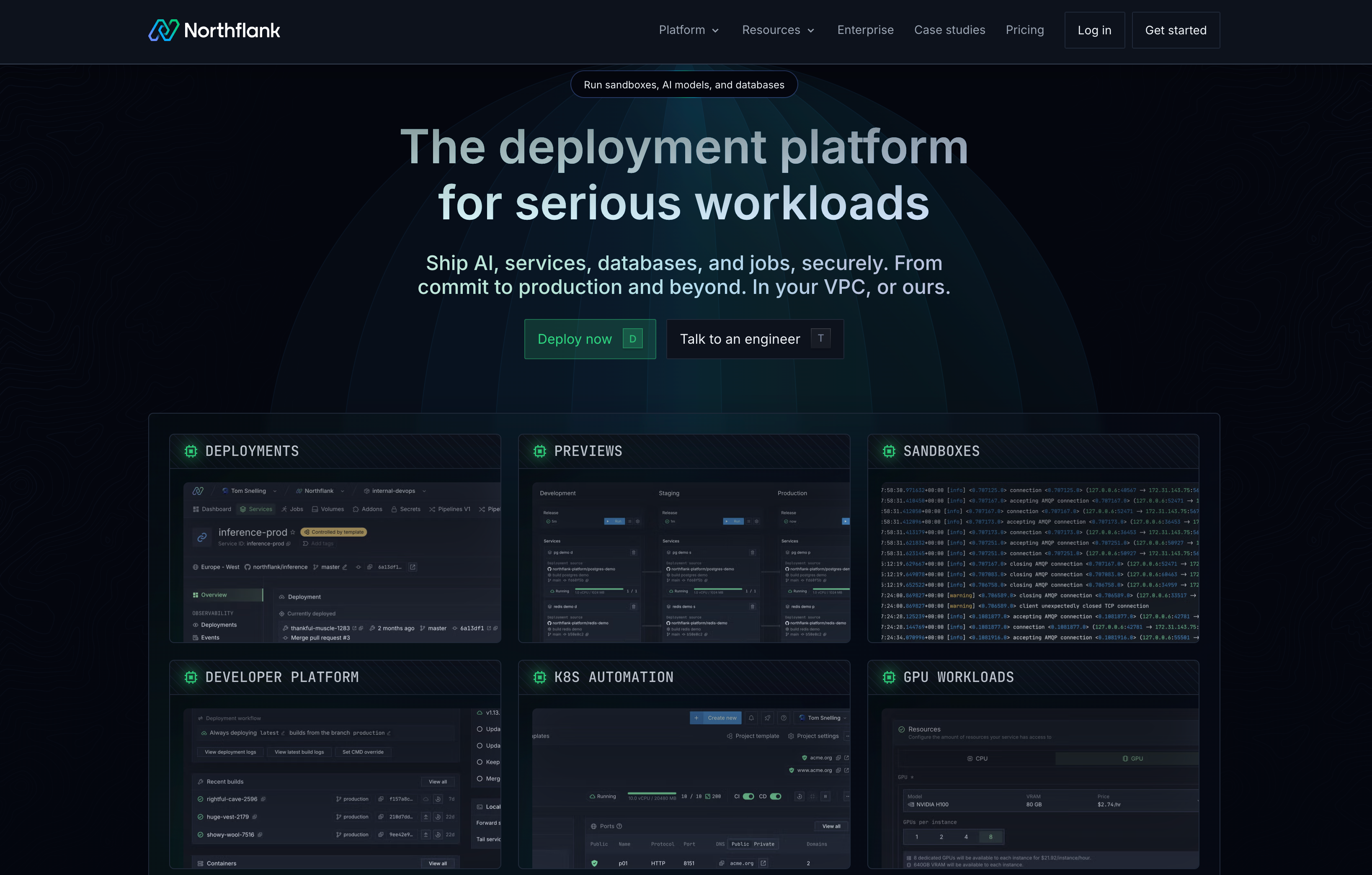
Here is what it provides across the full stack:
Short-lived sessions are destroyed after each run with no state leakage. Persistent sessions support attached volumes, S3-compatible object storage, and stateful databases including PostgreSQL, Redis, MySQL, and MongoDB for agent memory and execution history. Both modes are available in the same platform.
Every agent session runs in its own microVM. Northflank supports Kata Containers, Firecracker, and gVisor, each applied based on your workload requirements and threat model.
You can create environments in roughly 1-2 seconds end-to-end, covering the full creation lifecycle including networking and service initialization. Trigger environments via the API, CLI, or programmatically as part of your agent pipeline, with configurable lifecycle rules for automatic teardown.
You can deploy sandbox infrastructure inside your own VPC on AWS, GCP, Azure, Civo, CoreWeave, Oracle Cloud, or on-premises and bare-metal infrastructure. Northflank handles orchestration while your data stays within your network boundary. BYOC (Bring Your Own Cloud) is self-serve.
Your execution environment is not limited to the sandbox itself. You can run agents, background workers, APIs, and supporting databases together in the same platform, with CPU and on-demand GPU support. GPUs are available without quota requests.
To spin up isolated microVM environments on Northflank step by step, see this guide on how to spin up a secure code sandbox and microVM in seconds with Northflank.
Usage is billed at $0.01667 per vCPU per hour and $0.00833 per GB of memory per hour, with GPU pricing on the Northflank pricing page.
Run ephemeral agent execution environments on Northflank
Northflank provides the full stack for running ephemeral agent execution environments in production: microVM isolation, BYOC (Bring Your Own Cloud) deployment across major clouds and on-premises infrastructure, both CPU workloads and on-demand GPUs, and both ephemeral and persistent execution modes, all in one platform.
Get started with Northflank or schedule a demo if you'd prefer to talk through your setup with an engineer first.
Related resources:
The right configuration depends on your trust model, throughput requirements, and compliance constraints. Use this as a starting point:
| Situation | Recommended approach |
|---|---|
| Internal agents, trusted code | Hardened containers with resource limits and network restrictions |
| External users, moderate trust | gVisor or Kata Containers, ephemeral by default |
| LLM-generated code, multi-tenant | Firecracker or Kata, ephemeral sessions, default-deny networking, external state storage |
| Compliance or data residency requirements | MicroVM isolation with BYOC deployment inside your own VPC |
| High-throughput agent pipelines | Pre-warmed execution pools with automated lifecycle management |
A short-lived, isolated runtime created per agent session or task and destroyed automatically once execution is complete. It carries no state between runs and gives agent-generated code no access to host infrastructure or other sessions.
Yes, by separating session state from environment lifecycle. The execution environment is ephemeral, but agent memory, working data, and execution history are written to external storage (volumes, object storage, or a database) that persists independently of the environment.
For untrusted or AI-generated code, container-level isolation alone carries meaningful kernel-level risk. You need microVM-based isolation to enforce a harder boundary between agent code and the host system. Northflank supports Firecracker, gVisor, and Kata Containers for exactly this purpose.
Pre-warmed pools keep a set of initialized environments ready to accept workloads immediately, reducing perceived creation latency for incoming agent tasks. The trade-off is idle resource cost for environments sitting in the pool. Pool size needs to be calibrated against your actual throughput patterns.
These articles go deeper on specific aspects covered here.
- Ephemeral sandbox environments: the broad concept, all isolation models, and key considerations for production use.
- Code execution environments for autonomous agents: runtime requirements, session management, and what production-grade agent execution looks like.
- How to sandbox AI agents: microVM and gVisor isolation strategies specific to agent workloads.
- Secure runtime for codegen tools: microVMs, sandboxing, and execution at scale: execution at scale for code generation pipelines.
- Best sandboxes for coding agents: platform comparison with isolation and operational trade-offs.
- Best code execution sandbox for AI agents: options for different agent workload types and use cases.
- What is an AI sandbox?: what AI sandboxes are and how isolation requirements differ from standard dev environments.