
Best sandboxes for coding agents in 2026
The best sandbox for a coding agent depends on the repositories it works on, how many tasks it runs at once, and what needs to survive between sessions:
- Northflank: Best for coding agent sandbox execution at high concurrency. A fit for teams that want fast, isolated sandboxes for AI-generated code and agent workloads, with custom environments for repository builds, test suites, scripts, APIs, and GPU tasks.
- E2B: Best for agent workflows with reusable sandbox state. A fit for teams whose agents return to the same environment across tasks, with pause/resume to preserve state and plan-based session and concurrency limits.
- CodeSandbox: Best for cloning coding environments for parallel tasks. A fit for teams that need reusable templates, VM snapshots, and separate workspaces for agents trying different changes.
- Modal: Best for coding agent tasks that need programmatic compute and GPUs. A fit for teams configuring custom environments through SDKs and combining code execution with compute-intensive workloads.
- Fly.io Sprites: Best for persistent coding workspaces. A fit for teams that want project files and installed tools to remain available between sessions, with filesystem checkpoints for rollback.
Follow the Northflank sandbox quickstart to run your first coding task in an isolated environment. Create an account to test your repository, or book a demo to discuss sandbox concurrency, isolation, and deployment requirements.
When a coding agent runs, it executes code you have not reviewed. That code can access credentials, consume unbounded resources, make external requests, or escape container boundaries through bugs, hallucinations, or prompt injection. Standard containers share the host kernel, so a kernel vulnerability can allow untrusted code to escape. Purpose-built sandboxes use microVMs or user-space kernel interception to put a hard boundary between agent code and everything else.
Beyond security, the sandbox you pick affects what you can actually build. Session length, cold start speed, state persistence, and whether execution runs inside your own infrastructure all matter in production. Here is how the leading options compare.
Northflank provides fast, isolated sandboxes for running AI-generated code and coding agent workloads at high concurrency. Teams can run repository builds, test suites, scripts, generated APIs, and GPU tasks with custom environments and persistent files.
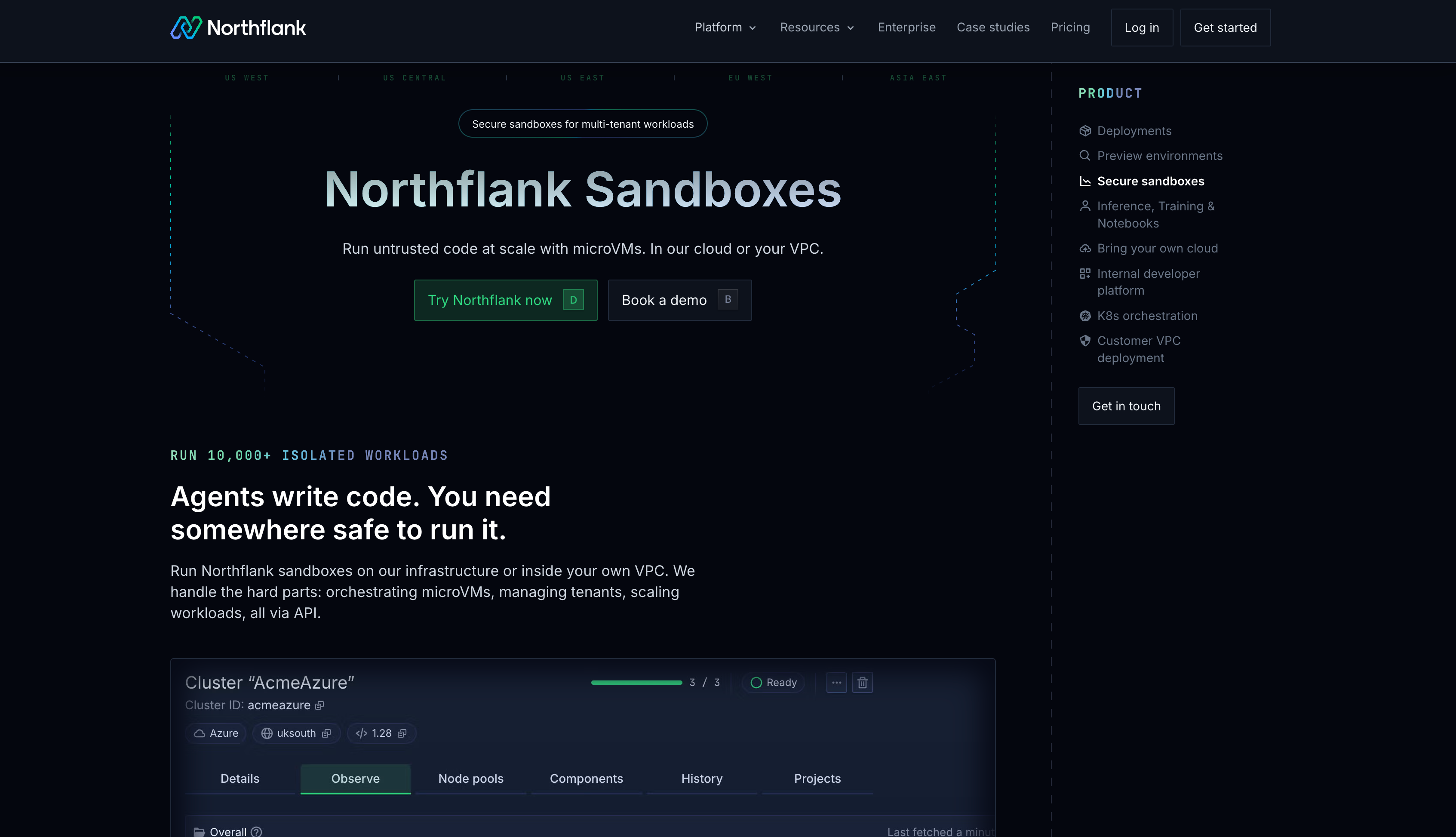
- Fast boot and high concurrency: Northflank Sandboxes support thousands of concurrent agent sessions, with sub-second sandbox boot times on Northflank Cloud. Create separate environments for users, repositories, or parallel coding tasks.
- Custom coding environments: Package compilers, language runtimes, test tools, and dependencies in container images. Give each repository the environment it needs to build and run, including applications that expose an API or use a GPU.
- CPU and GPU isolation: On Northflank Cloud, CPU sandboxes use microVMs and GPU sandboxes use gVisor. Isolation is automatic on managed infrastructure; GPU availability depends on the region.
- No fixed session time limit: Keep a sandbox running for a short test or an extended coding task without a provider-imposed session cutoff.
- Persistent files: Attach volumes for repository changes and artifacts that must survive restarts. Pausing stops running processes and removes ephemeral data while retaining configuration and attached-volume files.
- Deployment options: Use managed infrastructure or bring your own cloud (BYOC), where Northflank acts as the control plane to run coding agents and their sandboxes in your virtual private cloud (VPC). Sandbox isolation requires a supported runtime configured in your cluster.
- Programmatic execution: JavaScript and Python clients support creating environments, running commands, transferring files, and deleting sandboxes when work finishes.
Best for: Teams running coding agents across many users or repositories that need fast execution, custom tooling, persistent files, and high concurrency.
cto.new migrated its sandbox infrastructure to Northflank in a couple of days, replacing EC2 metal provisioning with API-driven environments and per-second billing for thousands of daily deployments.
Pricing: $0.01667/vCPU-hour, $0.00833/GB-hour, with H100 GPU plans at $2.74/hour all-inclusive (CPU and RAM included). The free developer Sandbox tier includes always-on compute with no sleeping, two free services, one database, and two cron jobs for development and testing. Pay-as-you-go offers self-service CPU and GPU workloads, per-second billing, no seat-based fees, and autoscaling. Enterprise plans offer custom pricing, volume discounts, 24/7 support, service-level agreements (SLAs), single sign-on (SSO), and audit logs. See the full pricing details for additional GPU options and compute plans.
E2B provides sandboxes for AI-generated code with Python and JavaScript/TypeScript clients for execution and environment management.
- Isolation: Firecracker microVMs give sandboxes a separate guest kernel.
- Workspace operations: Agents can execute commands and work with files as they change and test code.
- Pause and resume: Normal pause preserves files and memory state. Filesystem-only pause keeps files but reboots on resume, so processes and in-memory variables are lost.
- Session and concurrency limits: Hobby includes one-hour sessions and 20 concurrent sandboxes. Pro supports 24-hour sessions and 100 concurrent sandboxes, with paid concurrency add-ons increasing that to 1,100. Enterprise offers higher limits and longer sessions.
- Deployment options: Enterprise offers bring your own cloud (BYOC) deployment for AWS and GCP.
Best for: Teams that want SDK-based execution and the ability to return to preserved agent workspace state.
Pricing: Free Hobby plan available. Pro costs $150/month plus usage, with 24-hour sessions and configurable CPU and RAM.
CodeSandbox SDK lets teams create VM-backed development environments for agents, including separate copies of a prepared workspace. CodeSandbox is part of Together AI, and its SDK infrastructure also powers Together Code Sandbox.
- Reusable templates: Prepare dependencies and tools once, then create agent workspaces from that environment.
- Snapshots and cloning: Save VM state and clone environments so agents can explore changes independently from a common starting point.
- Repository workflows: Source-control integration helps agents work with project code rather than isolated snippets.
- Custom setup: Dockerfile support lets teams configure the software a repository requires.
- Hibernation: Suspend a workspace between runs and return to it for follow-up work.
Best for: Teams whose coding agents need cloned development environments for parallel experiments, generated applications, or repeated test runs.
Pricing: Build is free. Scale starts at $170 per workspace per month, with included VM credits and additional usage charges.
Modal supports programmatically configured sandboxes for coding tasks, including work that requires GPU resources or specialized dependencies.
- Custom environments: Create sandboxes through SDKs, configure dependencies, and use existing container images.
- Isolation options: Standard sandboxes use gVisor. VM Sandboxes provide a separate Linux kernel in beta and currently support CPU workloads only.
- GPU tasks: GPU sandbox configurations support accelerated computation when a coding workflow needs it.
- Session recovery: The default timeout is five minutes, configurable up to 24 hours. Filesystem snapshots let an agent continue from saved files in another sandbox.
- Resource control: Configure resource requests and limits for demanding builds or tests. CPU and memory billing uses the greater of requested and actual usage.
Best for: Teams that want SDK-configured execution environments for coding tasks involving substantial compute or GPUs.
Pricing: Per-second usage. Sandbox CPU costs $0.1419/physical-core-hour and memory costs $0.0240/GiB-hour. GPU usage has its own rates.
Fly.io Sprites provide persistent Linux workspaces for agents that repeatedly return to the same project. Installed packages and repository files remain on disk between sessions.
- Isolation: Each Sprite runs in a Firecracker microVM with its own kernel.
- Persistent storage: A 100 GB filesystem retains files across inactivity, with a local cache backed by durable object storage.
- Filesystem rollback: Checkpoints capture disk state so you can restore an earlier workspace. They do not restore process memory.
- Idle behavior: Compute charges stop when the Sprite is idle; retained storage can still incur charges.
- Application access: Each Sprite has an HTTPS URL, which can wake the environment when a request arrives.
Best for: Coding agents that need persistent project files, installed tools, and a way to roll back filesystem changes.
Pricing: Pay-per-use based on CPU, memory, and storage.
If you are running user-generated or untrusted code in a multi-tenant system, compare the isolation boundary alongside network access and permissions. Northflank, E2B, CodeSandbox, and Fly.io Sprites offer microVM-backed environments. Modal uses gVisor for standard sandboxes and also offers CPU-only VM Sandboxes in beta.
For coding agents that need fast startup, thousands of concurrent sessions, custom environments, and no fixed session cutoff, Northflank is a strong fit. Its sandboxes can run repository builds, tests, scripts, generated APIs, and GPU tasks.
| Platform | Isolation | Bring your own cloud (BYOC) | Session limit | GPU support |
|---|---|---|---|---|
| Northflank | Managed CPU: microVMs; GPU: gVisor | Yes; multiple clouds and on-premises | No fixed session time limit | Yes |
| E2B | Firecracker | AWS and GCP, Enterprise | Hobby: 1 hour; Pro: 24 hours; longer Enterprise options | No |
| CodeSandbox | MicroVM-backed VM Sandboxes | No | No fixed session time limit | No |
| Modal | gVisor; CPU-only VM Sandboxes in beta | No | Up to 24 hours | Yes |
| Fly.io Sprites | Firecracker | No | Persistent workspace; compute sleeps when idle | No |
Pricing checked in September 2026. Hourly equivalents are rounded where needed. Billing models differ across platforms (some bill based on active CPU usage only, others bill for the entire duration the sandbox is running). Verify current rates on each platform's pricing page before making cost decisions.
| Platform | CPU | Memory | Storage | GPU | Billing model |
|---|---|---|---|---|---|
| Northflank | $0.01667/vCPU-hr | $0.00833/GB-hr | $0.15/GB-month | L4: $0.80/hr, A100 40GB: $1.42/hr, A100 80GB: $1.76/hr, H100: $2.74/hr | Per second |
| E2B | $0.0504/vCPU-hr | $0.0162/GiB-hr | 10–20GB included free | Do not provide GPU compute | Per second |
| Fly.io Sprites | $0.07/CPU-hr | $0.04375/GB-hr | $0.000683/GB-hr hot storage; $0.000027/GB-hr cold storage | Do not provide GPU compute | Per second, actual usage; idle compute is free, retained storage is billed |
| CodeSandbox | Pico VM: $0.075/hour (1 core) | 2 GB included in starting VM tier | 20 GB per VM on standard plans | Do not provide GPU compute | VM credits; prices before subscription savings |
| Modal Sandboxes | $0.1419/physical core-hr (2 vCPU) | $0.0240/GiB-hr | — | L4: $0.80/hr, A100 40GB: $2.10/hr, A100 80GB: $2.50/hr, H100: $3.95/hr, H200: $4.54/hr | Per second |
Billing units differ: CodeSandbox includes CPU and RAM in its VM price, while Modal charges per physical core (two vCPUs).
Fly.io Sprites pricing update: From October 1, 2026, CPU costs $0.03825/CPU-hour and memory costs $0.021875/GB-hour. Storage rates remain unchanged.
The table below shows how each platform handles bring your own cloud (BYOC) deployment, which clouds are supported, and whether it requires a sales process.
| Platform | Bring your own cloud (BYOC) available | Clouds supported | Access model | Pricing model |
|---|---|---|---|---|
| Northflank | Yes | AWS, GCP, Azure, and supported Kubernetes infrastructure, including on-premises and bare-metal | Self-serve; enterprise contracts available | Cloud infrastructure costs plus Northflank management charges |
| E2B | Yes | AWS and GCP | Enterprise, contact sales | Custom enterprise pricing plus cloud infrastructure costs |
| Modal | No | Managed only | — | — |
| Fly.io Sprites | No | Managed only | — | — |
| CodeSandbox | No | Managed only | — | — |
Coding agents execute code they generate autonomously, often without human review of each run. Without a sandbox, that code runs with your system permissions and can access credentials, make external requests, or escape to the host. A sandbox puts a hard isolation boundary around execution to limit what a misbehaving or compromised agent can affect.
Containers share the host kernel using Linux namespaces and cgroups. A kernel vulnerability or misconfiguration can allow container escape. Firecracker microVMs and VM-based runtimes such as Kata Containers run each workload with its own dedicated kernel inside a lightweight virtual machine. This adds a virtualization boundary between the workload’s kernel and the host.
Prompt injection is when untrusted content in an agent's environment sneaks instructions into the agent's context. A README, a webpage, or a code comment could instruct your agent to exfiltrate credentials or perform operations you never authorized. Because the agent cannot reliably distinguish its original instructions from injected ones, sandboxing the execution environment limits the blast radius when this happens.
There is no single strongest option for every workload. Northflank Cloud uses microVMs for CPU sandboxes and gVisor for GPU sandboxes. E2B and Fly.io Sprites use Firecracker, while CodeSandbox uses microVM-backed environments. Modal uses gVisor for standard sandboxes and offers CPU-only VM Sandboxes in beta. Compare the runtime, permissions, and network controls against your threat model.
Not always. You need bring your own cloud (BYOC) when sandbox execution must happen inside your own infrastructure, such as when agents access private APIs, internal databases, or regulated data that cannot leave your VPC. For public-facing coding tools with no private data access, a managed sandbox is fine. Northflank offers self-serve bring your own cloud (BYOC), acting as the control plane to run coding agents and their sandboxes in your virtual private cloud (VPC).
It depends on the platform. Northflank and CodeSandbox impose no fixed session time limit. E2B allows up to 24 hours on Pro, with longer Enterprise options. Modal allows up to 24 hours. Fly.io Sprites retains workspace files when compute goes idle. For agents that need to maintain state across multi-day workflows or keep a development environment warm between uses, choose a platform without an artificial time limit.
Coding agents are moving fast, and the infrastructure decisions you make now will shape what you can build later. The sandbox is the most critical part of that infrastructure. It determines whether your agents can run safely in production, how much you pay at scale, and whether you can meet compliance requirements as your product grows.
For most teams taking a coding agent to production, Northflank is the platform worth evaluating first. Its sandboxes combine sub-second boot times on Northflank Cloud, support for thousands of concurrent sessions, custom environments, and no fixed session time limit. Run coding agents, test generated code, start APIs, or execute GPU tasks in isolated environments built around your workload.
You can get started for free on Northflank or talk to the team if you have specific infrastructure requirements for your coding agent.