
Top 7 AI agent runtime tools and platforms in 2026
AI agent runtime tools are the infrastructure layer that lets your agents actually run: isolated, scalable, and without compromising your production environment. The decision usually comes down to workload scope, isolation model, session lifecycle, GPU requirements, and deployment model.
Top AI agent runtime tools and platforms (compared):
- Northflank - Full-stack cloud platform for running AI agents, APIs, databases, background workers, and isolated sandbox environments in a single control plane. Supports microVM-based isolation (Kata Containers, Firecracker, and gVisor), on-demand GPUs, self-service BYOC across AWS, GCP, Azure, Oracle, CoreWeave, on-premises, and bare-metal, and both ephemeral and persistent environments with no forced time limits. In production since 2021 across startups, public companies, and government deployments.
- E2B - Purpose-built sandbox tool for AI agents and LLM apps. Firecracker microVMs, Python and TypeScript SDKs, sessions up to 24 hours on paid tiers.
- Modal - Serverless Python-first platform for GPU-accelerated ML workloads and agent sandboxing. gVisor isolation, elastic GPU scaling with no reserved capacity required.
- Fly.io Machines - API-driven KVM hardware-isolated VMs that accept any OCI container. Good general-purpose agent runtime for polyglot teams.
- Together AI Sandbox - Managed microVM sandbox infrastructure built on CodeSandbox's stack. Best for teams already using Together's model inference.
- Cloudflare Workers - V8 isolate-based edge execution across a global network. Stateless by design, JavaScript and TypeScript native.
- Vercel Sandbox - Firecracker-based sandboxes running on Fluid compute, integrated into the Vercel deployment platform. Best for frontend-adjacent AI workloads on Vercel.
If you need a complete AI agent runtime, not just sandboxes: Prioritize platforms where agents, persistent services, databases, and sandboxes share a single control plane. Northflank supports self-serve BYOC across major clouds and on-premises infrastructure, microVM-based isolation (Kata Containers, Firecracker, and gVisor), on-demand GPUs, and both ephemeral and long-running environments with no forced time limits.
An AI agent runtime is the compute infrastructure that executes the code, tools, and processes your agent invokes during a task. It is not the LLM and it is not the orchestration framework. It is what happens when your agent writes and runs a Python script, spins up a subprocess, executes a terminal command, or calls an external API in an isolated environment.
Runtime platforms handle multiple workload types under one control plane: ephemeral sandboxes, long-running stateful services, databases, and background workers together. Specialized sandbox tools focus narrowly on isolated code execution and hand off everything else to you. The distinction matters when you are choosing infrastructure for agents that need to maintain state, access GPUs, or run inside your own cloud.
Not every tool addresses every dimension of the problem. Before choosing, verify each option against these requirements:
- Isolation model: Does it use microVMs (Firecracker, Kata Containers, gVisor) or container-level isolation? MicroVMs provide stronger tenant separation for untrusted code.
- Ephemeral and persistent support: Can it run both short-lived sandboxes and long-running stateful services, or only one? Agents with memory and state need persistence.
- Session limits: Does the platform impose time limits that would break long-horizon agent tasks? Some platforms cap sessions at 24 hours or less.
- GPU availability: Does your agent need GPU-accelerated tools or inference? Only a subset of platforms in this category support it without separate infrastructure.
- BYOC and deployment model: Enterprise customers frequently require execution inside their own VPC. Most managed-only platforms do not support this.
- Language and SDK support: Is your team Python-first, TypeScript-first, or polyglot? Some platforms are tied to specific language ecosystems.
The tools and platforms below cover the full range of the category, from purpose-built sandboxes to full-stack production runtimes. Each has a distinct set of trade-offs worth understanding before committing to infrastructure.
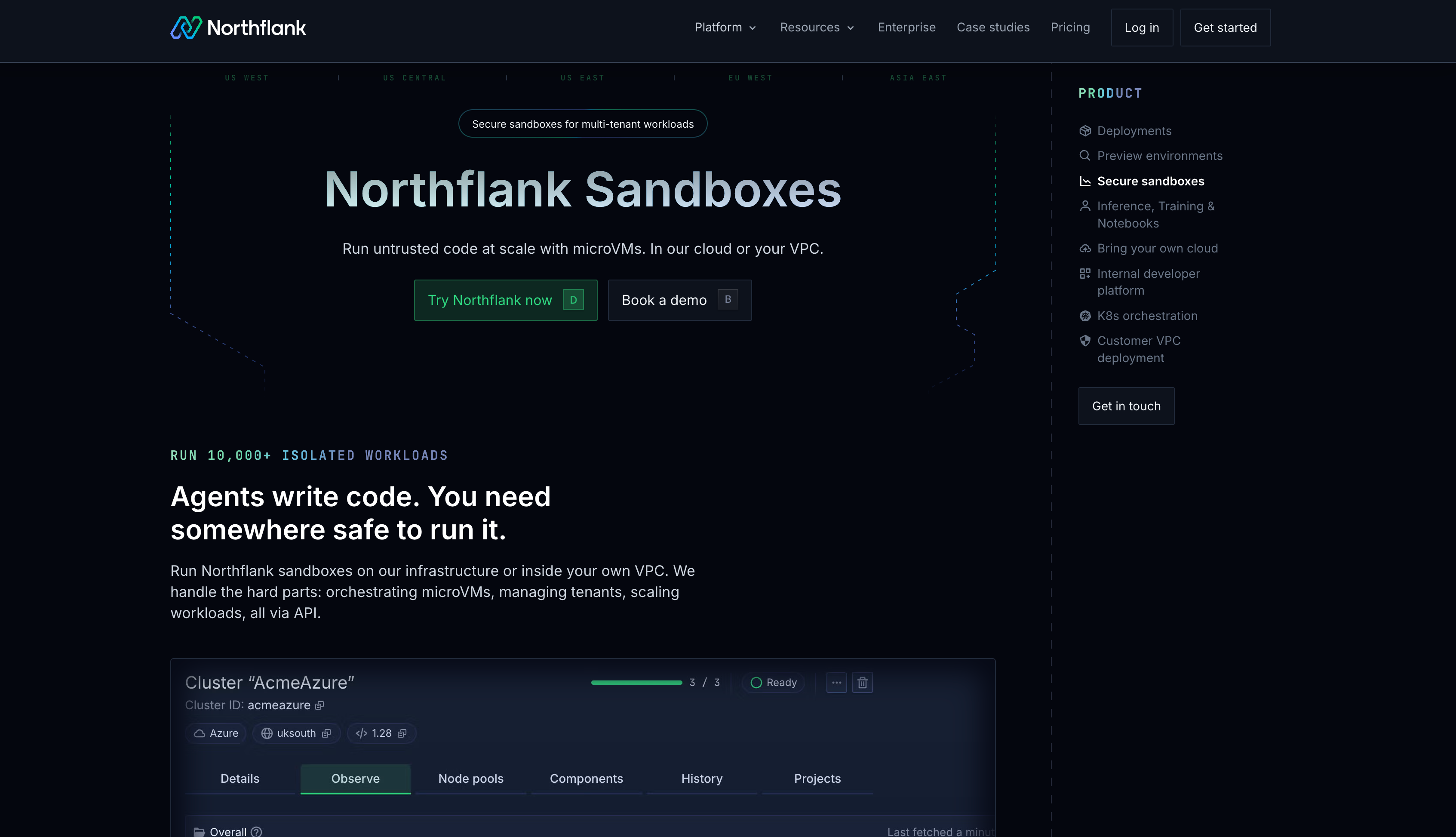
Northflank is a production infrastructure platform that runs the complete stack an AI product needs: agents, APIs, background workers, databases, cron jobs, and isolated sandbox execution in one place. Unlike purpose-built sandbox tools that cover only code execution, Northflank handles the entire operational surface, from provisioning to scaling to BYOC enterprise deployment.
What separates Northflank from single-purpose sandbox tools is that secure execution is one feature of a comprehensive runtime, not the whole product. Teams running AI agents in production need more than ephemeral sandboxes. They need persistent services for memory and state, databases for storage, background workers for async tasks, and GPUs for inference, and they need all of it to work together under a single control plane. That is what Northflank provides.
Northflank uses microVM-based isolation with Kata Containers, Firecracker, and gVisor depending on workload type, giving teams the ability to tune the security and performance trade-off per use case. Environment creation takes 1-2 seconds end-to-end, accounting for the full orchestration cycle.
Key features:
- MicroVM isolation: Kata Containers, Firecracker, and gVisor options applied per workload type
- Full workload runtime: Run agents, APIs, databases, background workers, and cron jobs inside a single platform, CPU and GPU supported
- Ephemeral and persistent environments: Short-lived execution pools for isolated code runs alongside long-running stateful services for memory and agent state
- Bring your own cloud: Deploy inside your own AWS, GCP, Azure, Oracle, CoreWeave, on-premises, or bare-metal infrastructure with full feature parity, available self-serve.
- On-demand GPUs: Self-service GPU provisioning without quota requests or reservation overhead
- API, CLI, and SSH access: Multiple access modes for operational flexibility across automated pipelines and direct access
Best for:
- Teams building multi-tenant AI products that need both sandbox execution and persistent infrastructure in one platform
- Enterprise deployments where data residency, VPC isolation, or compliance requirements make fully managed external platforms non-viable
- AI workloads that combine code execution sandboxes with long-running stateful agents, APIs, and databases
- Teams that want GPU access without managing quotas or reservations
Northflank in production
Northflank has been running production workloads since 2021 across startups, public companies, and government deployments.
Get started on Northflank or book a demo with an engineer to see if the platform fits your agent infrastructure requirements.
E2B is an open-source cloud sandbox platform built for AI agents and LLM applications. It runs isolated environments using Firecracker microVMs, providing kernel-level isolation per sandbox, with Python and TypeScript SDKs for integration into agent workflows.
Key features:
- Firecracker microVM isolation: Kernel-level isolation per sandbox
- Python and TypeScript SDKs: Clean APIs for programmatic sandbox lifecycle management
- Code Interpreter Sandbox: Pre-built execution environment with a running Jupyter server for code generation agents
- Open-source core: Self-hostable alongside a managed SaaS tier
- Fast startup: Firecracker-based environments start quickly for interactive agent use cases
- Persistent filesystem: State within a session persists across commands
Best for:
- Teams building code-execution features inside AI applications who need reliable, low-setup sandboxing with Python or TypeScript SDKs
Modal is a serverless compute platform built for data and ML teams. Developers define compute requirements through Python decorators, and Modal handles container builds, scheduling, and scaling automatically. It uses gVisor isolation across all workloads and supports GPU types from T4 through B200 without long-term reservations.
Key features:
- Python-native infrastructure-as-code: Define hardware requirements with Python decorators, no YAML required
- Fast cold starts: Custom Rust runtime and lazy-loading filesystem enable fast container initialization
- Elastic GPU scaling: Scale from zero to many GPUs across multiple GPU types without quotas or reservations
- Sandboxes for untrusted code: Containers with configurable TTL, dynamically defined at runtime, for agent code execution
- gVisor isolation: User-space kernel interception applied across all container workloads
- Filesystem and memory snapshots: Save and restore sandbox state for agent persistence
Best for: ML engineers and agent teams running Python workloads who need GPU access, fast sandboxes, and elastic scale without managing infrastructure
Fly.io Machines are KVM hardware-isolated VMs controlled through a REST API, accepting any OCI-compliant container image across multiple global regions. The Machines API supports per-user isolated environments, ephemeral sandboxes for agent-generated code, and persistent VM instances for stateful agents.
Key features:
- KVM hardware isolation: Hardware-assisted virtualization giving strong tenant separation
- OCI-compatible: Any Docker or Kubernetes image runs without modification
- Fast VM startup: API-driven lifecycle with fast boot times for agent session creation
- Multi-language execution: Runs JavaScript, Python, Go, or any language inside standard containers
- Ephemeral and persistent modes: Clean-slate ephemeral machines or persistent machines with volume storage for stateful agents
- Global region placement: Multiple regions for latency-optimized agent deployment
Best for: Teams that need hardware-isolated, OCI-compatible agent environments without platform-specific SDK lock-in
Together AI Sandbox provides managed microVM sandbox environments for code execution, built on CodeSandbox's infrastructure. It covers two use cases on the same stack: Together Code Sandbox for full-scale development environments, and Together Code Interpreter for session-based Python execution via API.
Key features:
- Fast VM snapshot resume: Resume from a paused sandbox state quickly for repeated agent sessions
- Sandbox forking: Clone a running sandbox including its active processes, not just the filesystem
- Hot-swappable VM sizing: Resize compute without tearing down the environment
- Code Interpreter API: Session-based Python execution for agentic and RL workflows
- Git-versioned storage: Repository-style versioning for agent workspace state
- Live preview hosts: Running services can be exposed via preview URLs during execution
Best for: Teams already using Together AI for model inference who want code execution capability on the same platform
Cloudflare Workers uses V8 isolates to run agent code at the network edge across a globally distributed network. Workers are stateless by design, which makes them well-suited for stateless tool calls, API proxies, and short-lived agent actions. Durable Objects extend this with optional persistent state, though the programming model differs significantly from traditional server-based runtimes.
Key features:
- V8 isolate-based execution: JavaScript and TypeScript native edge runtime with very fast cold starts
- Global edge network: Execution close to users without manual region configuration
- Stateless by default: Clean execution per invocation with no residual state between requests
- Durable Objects for state: Optional persistent state with strong consistency guarantees
- WebAssembly support: Compile other languages to WASM for edge execution
- Cloudflare ecosystem integration: Native integration with R2 storage, KV, and AI Gateway
Best for: JavaScript and TypeScript teams building stateless agent tool calls or API proxy layers where global low latency matters most
Vercel Sandbox provides Firecracker-based isolated execution environments for AI-generated code, running on Vercel's Fluid compute infrastructure. It integrates directly with the Vercel AI SDK and Vercel deployment platform. Node.js and Python runtimes are available by default, and sandboxes are billed only when code is actively running.
Key features:
- Firecracker microVM isolation: MicroVM-level isolation per sandbox on Fluid compute
- Vercel AI SDK integration: Works natively with the AI SDK's agent and tool abstractions
- Node.js and Python runtimes: Available by default with package installation support
- Active CPU pricing: Billed only when code is actively running, not during idle or I/O wait
- Port exposure: Running services can be accessed via sandbox preview URLs
Best for: Teams already deploying on Vercel who need lightweight sandbox execution for frontend-adjacent AI workloads
Use this table as a starting framework, then validate against your actual requirements:
| Factor | What to consider | Recommended options |
|---|---|---|
| Workload type | Do you need only sandboxes, or a full stack including persistent services and databases? | Full stack: Northflank. Sandboxes only: E2B, Modal |
| GPU requirements | Does your agent need GPU-accelerated inference or ML tools? | Northflank, Modal, Together AI Sandbox |
| Session duration | Do your agents run for hours or days, or just seconds to minutes? | Northflank (no limits), Fly.io persistent machines (long-lived); avoid Vercel for long-running sessions |
| Enterprise/compliance | Do you need deployment inside your own VPC? | Northflank (self-service BYOC across all major clouds and on-prem) |
| Language requirements | Is your team Python-first, TypeScript-first, or polyglot? | Modal (Python-first), E2B (Python and TypeScript), Fly.io (any OCI), Cloudflare (JS/WASM) |
| Existing ecosystem | Are you already committed to a cloud or platform? | Together AI (if using their models), Vercel (if deploying on Vercel), Cloudflare (if on Workers) |
What is an AI agent runtime tool?
An AI agent runtime tool is infrastructure that executes the code, commands, and processes an AI agent invokes during a task. It provides isolation so agent-generated code cannot affect production systems, scaling so many agent sessions can run concurrently, and lifecycle management for spinning environments up and tearing them down automatically.
What is the difference between an AI sandbox and a full agent runtime platform?
An AI sandbox focuses specifically on isolated code execution. A full agent runtime platform handles sandboxes alongside persistent services, databases, background workers, GPUs, and deployment infrastructure. Sandboxes solve one problem; runtime platforms solve the complete operational challenge of running production AI agents at scale.
Do I need BYOC for running AI agents in enterprise environments?
For enterprise customers with data residency requirements, compliance needs (SOC 2, HIPAA, FedRAMP), or internal security policies that prohibit third-party execution environments, BYOC deployment inside their own VPC is typically non-negotiable. Northflank provides self-service BYOC with full feature parity across AWS, GCP, Azure, Oracle, CoreWeave, on-premises, and bare-metal.
Can AI agents run GPU workloads in these platforms?
Yes, but only a subset of platforms support it. Northflank, Modal, and Together AI Sandbox all provide GPU-backed execution environments. Fly.io has limited GPU availability. E2B, Cloudflare Workers, and Vercel Sandbox do not support GPU workloads.
Which runtime is best for multi-tenant AI products?
For multi-tenant products where each user or session needs an isolated environment, Northflank's multi-tenant architecture, Fly.io's per-user VM model, and E2B's programmatic sandbox management are all viable. Northflank is the most complete option if you also need persistent services, databases, and BYOC for enterprise accounts within the same platform.
- How to sandbox AI agents
- Code execution environment for autonomous agents
- Best code execution sandbox for AI agents
- Secure runtime for codegen tools: microVMs, sandboxing, and execution at scale
- Top AI sandbox platforms for code execution
- Top BYOC AI sandboxes
- AI infrastructure
- Top AI PaaS platforms