
Code execution environment for autonomous agents in 2026
Autonomous agents require a dedicated code execution environment to run generated tool calls, shell commands, and scripts safely without exposing host infrastructure or adjacent workloads.
This guide covers what makes agent execution environments distinct, what they require in production, how to evaluate them, and what a production-ready platform looks like.
A code execution environment for autonomous agents is an isolated runtime where agent-generated code executes without access to the host system, other tenants, or sensitive infrastructure.
A production-grade environment enforces:
- Per-session isolation: Each agent session runs in its own boundary
- Scoped network access: Outbound connectivity limited to known endpoints, not open by default
- Resource limits: CPU, memory, and I/O caps per agent session
- Ephemeral or persistent execution: Depending on whether the agent needs state across steps
- Audit logging: Every execution is traceable for debugging and compliance
Northflank provides microVM-backed execution environments for agent workloads, with both ephemeral and persistent modes and BYOC (Bring Your Own Cloud) support across AWS, GCP, Azure, Civo, Oracle Cloud, CoreWeave, and on-premise or bare metal.
A code execution environment for autonomous agents is the runtime layer where an agent executes code it generates or receives as part of its reasoning loop.
The code is produced by a model, not submitted by a human, and it runs immediately as part of an automated workflow.
The key distinction from a standard remote code execution sandbox is continuity: a sandbox handles discrete, independent executions, while an agent execution environment handles sessions that evolve over time.
Standard sandbox infrastructure is designed around one-shot execution. Agent workloads break that assumption in ways that matter at the infrastructure level:
- Execution is multi-step: A single session can involve dozens or hundreds of code steps, each shaped by what ran before it
- State compounds risk: A compromised or malformed step early in a session can influence every subsequent step
- Code is unpredictable by design: You cannot whitelist what will run because the model decides at runtime
Beyond execution itself, tool use adds another layer of complexity. Agents call external APIs as part of normal operation, which creates a real tension between giving agents the connectivity they need and preventing exfiltration.
And when multiple agents run concurrently on behalf of different users, tenant isolation becomes as critical as workload isolation. One agent's execution should have no visibility into, or impact on, another's.
If you are running agent workloads in standard containers today, your containers aren't as isolated as you think: containers share the host kernel, and a successful escape gives an attacker access to the host node and potentially adjacent workloads running on it.
This guide on microVMs, VMMs, and container isolation breaks down why that is a problem for multi-tenant agent workloads and how microVMs and VMMs close that gap.
Running agent workloads safely requires controls across isolation, state management, networking, and observability. Take a look at the key requirements below:
- Per-session isolation: Each agent session runs in a dedicated boundary, preventing interference between sessions
- Stateful execution support: Agents that maintain context across steps need persistent storage, not just ephemeral filesystems
- Scoped outbound networking: Tool calls require connectivity, but access should be limited to known endpoints with default-deny policies everywhere else
- Resource limits per session: Runaway agents can exhaust CPU, memory, or I/O and affect other tenants without hard limits
- Clean teardown: Ephemeral sessions must be fully destroyed after completion, with no state leaking into subsequent sessions
- Audit logging: Every execution step should be traceable, including what ran, what it produced, and what resources it consumed
Isolation models for agent workloads are the same as for general sandbox execution, but the tradeoffs shift when execution is multi-step and stateful.
For a full breakdown of isolation primitives, see this guide on remote code execution sandbox.
The summary as it applies to agents:
- Hardened containers: Acceptable for internal agents running bounded, low-risk tasks. The shared kernel boundary is a meaningful risk when agents execute LLM-generated code on behalf of external users
- gVisor: A reasonable middle ground. Syscalls are intercepted before reaching the host kernel, but there are latency costs, kernel feature compatibility gaps, and an additional attack surface from the interception layer
- MicroVMs (Firecracker/Kata): The standard choice for production multi-tenant agent platforms. Each session gets its own guest kernel. A guest kernel compromise does not directly expose the host kernel, but the hypervisor remains part of the attack surface
If you are evaluating isolation for agent code execution environments, see the following guides:
- How to sandbox AI agents: microVMs, gVisor, and isolation strategies specific to agent workloads
- Secure runtimes for codegen tools: execution at scale for code generation pipelines
- Best code execution sandbox for AI agents: platform comparison with isolation and operational tradeoffs
Building the execution environment is only part of the problem: operating it reliably across concurrent agent sessions introduces a different set of challenges. See the most common challenges below:
- Cold start latency: MicroVM initialization takes longer than container startup, and full initialization including networking and runtime setup adds overhead beyond VMM boot alone. Pre-warmed pools reduce perceived latency but require pool sizing logic, drain and refill orchestration, and idle resource cost management.
- State management across steps: Persistent sessions need attached volumes or databases; ephemeral sessions need guaranteed clean teardown after every step
- Concurrent session scaling: Hundreds of simultaneous agent sessions require autoscaling, bin-packing, and load balancing that accounts for in-progress workload state, not just request count
- Multi-tenant isolation at scale: Tenant boundaries must be enforced at the infrastructure level. Application-level separation is not sufficient when agents run arbitrary generated code (see this guide on What is multitenancy? if you want a deeper breakdown of multi-tenant architecture and its risks).
- Observability constraints: Monitoring inside a sandboxed agent session is deliberately limited. External log collection and tracing infrastructure needs to be designed carefully to avoid creating side channels between tenants
- Dependency and image management: Agent environments often require specific runtimes, packages, or tools. Base image management, vulnerability scanning, and environment versioning add ongoing operational overhead
- Access model: Full API, CLI, and SSH access for programmatic control and debugging.
Northflank provides infrastructure designed for production agent workloads, combining microVM-based isolation with full workload orchestration.
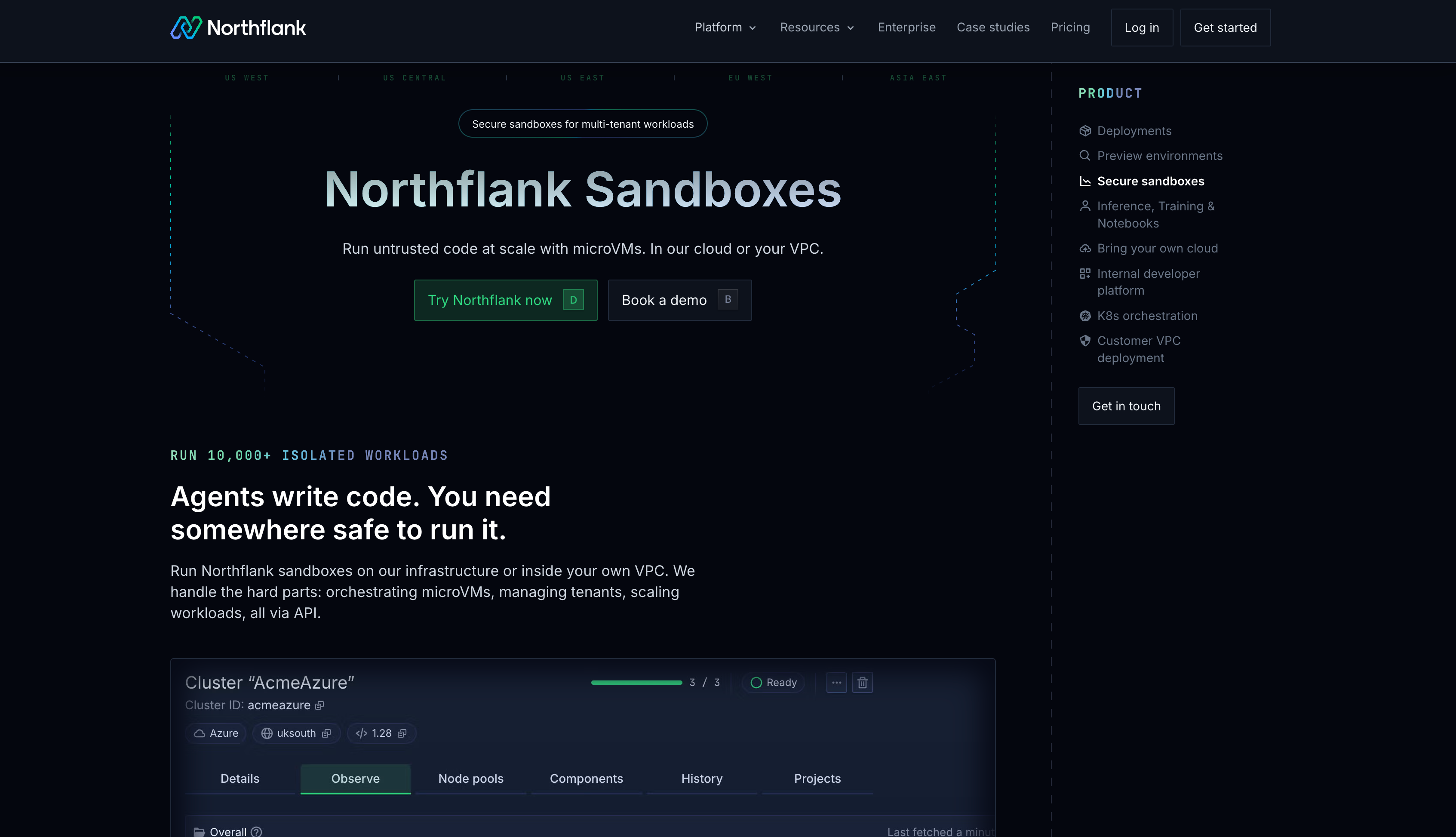
Here's what Northflank offers:
- MicroVM isolation: Every agent session runs in its own microVM using Kata Containers, Firecracker, or gVisor, selectable depending on workload requirements.
- Ephemeral and persistent execution: Short-lived sessions are destroyed after each run. Persistent sessions support attached volumes starting at 4GB, S3-compatible object storage, and stateful databases including PostgreSQL, Redis, MySQL, and MongoDB for agent memory and execution history
- Bring your own cloud: Support for running inside your own VPC across AWS, GCP, Azure, Civo, Oracle Cloud, CoreWeave, or on-premise and bare metal. Production-ready and self-serve.
- Full workload runtime: Agents, background workers, APIs, and supporting databases run in the same platform alongside sandbox execution, reducing architectural fragmentation
- GPU support: On-demand CPU and GPU provisioning without manual quota requests, relevant for teams running inference or training workloads alongside agent execution
- Pricing: CPU at $0.01667 per vCPU per hour and memory at $0.00833 per GB per hour, with full details on the Northflank pricing page
Next steps for your agent execution environment
If you'd like a step-by-step walkthrough of spinning up isolated microVM environments, see how to spin up a secure code sandbox and microVM in seconds with Northflank.
You can review deployment models and sandbox capabilities on Northflank. And if you want to talk through your organization's specific compliance, networking, GPU, or BYOC requirements, you can book a demo to speak with an engineer.
The right choice depends on your trust model, scale, and operational capacity.
| Situation | Recommended approach |
|---|---|
| Internal agents, low-risk tasks | Hardened containers with seccomp and resource limits |
| External users, moderate trust | gVisor or Kata Containers |
| LLM-generated code, multi-tenant | MicroVMs, ephemeral by default, default-deny networking |
| Compliance requirements | MicroVMs with BYOC deployment inside your own VPC |
| Scale with limited infra team | Managed platform with built-in orchestration and autoscaling |
User-submitted scripts are discrete, one-shot executions. Agent code execution is multi-step and stateful, with each step potentially influenced by previous outputs and the code itself generated dynamically rather than reviewed before running.
Escape risk depends on the isolation model. Container-based environments share the host kernel, making kernel exploits a realistic path. MicroVM-based environments give each session its own guest kernel, significantly raising the cost of a successful escape. No isolation model provides an unconditional guarantee.
It depends on the workload. Stateless tool calls and one-shot tasks benefit from ephemeral environments that reset between runs. Agents that maintain memory, write artifacts, or run across multiple sessions require persistent storage alongside their execution environment. For example, Northflank supports both modes (ephemeral and persistent) within the same platform, so you are not forced to choose one architecture over the other.
Each agent session should run in its own isolated boundary, enforced at the infrastructure level. Application-level separation is insufficient when agents execute arbitrary generated code. MicroVM-based isolation with per-session guest kernels is the standard approach for production multi-tenant agent platforms. Platforms like Northflank enforce this by default, running every workload in its own microVM with Kata Containers or gVisor.