
OpenShift vs VMware: key differences and how to choose in 2026
Broadcom's acquisition of VMware triggered 2x to 10x increases in renewals among enterprise customers. Perpetual licensing is gone. Many organizations are now evaluating alternatives, and Red Hat OpenShift is one of the most common destinations.
This article compares OpenShift and VMware on architecture, use case fit, migration path, and cost, and explains where platforms like Northflank fit for organizations modernizing beyond traditional virtualization.
- VMware (now Broadcom) is the dominant enterprise virtualization platform. It runs traditional VMs on ESXi hypervisors managed through vCenter and vSphere. Best for organizations with existing VMware investments, Windows Server workloads, and applications that are not yet containerized.
- OpenShift is Red Hat's enterprise Kubernetes platform. It runs containers natively and supports VMs via OpenShift Virtualization (based on KubeVirt). Best for organizations modernizing from VMs to containers, running hybrid workloads, or looking for a VMware exit path.
- Both platforms are operationally heavy. VMware's post-Broadcom pricing has forced many enterprises to re-evaluate. OpenShift is a credible migration target but carries its own complexity and cost.
- Northflank is the modern alternative. If you are moving off VMware and do not want to take on the operational burden of running OpenShift, Northflank provides managed Kubernetes with a full developer platform on top: self-serve BYOC into your own cloud or on-premises, preview environments, managed databases, GPU workloads, microVM sandbox isolation, RBAC, SSO, and audit logging. SOC 2 Type 2 certified. Get started or book a demo.
VMware is a virtualization platform that runs multiple virtual machines on physical servers. The core products are ESXi (the hypervisor), vCenter (the management layer), and vSphere (the suite combining both). Organizations use VMware to run Windows Server, Linux VMs, and legacy applications that predate containers. Capabilities include vMotion (live VM migration between hosts), Distributed Resource Scheduler (DRS) for automated workload balancing, high availability (HA) for automatic VM restart on host failure, and vSAN for software-defined storage.
Red Hat OpenShift is an enterprise Kubernetes platform. It runs containerized applications natively and, through OpenShift Virtualization (based on KubeVirt), can also run virtual machines alongside containers in the same cluster. OpenShift ships with built-in security controls (Security Context Constraints), a developer console, integrated CI/CD (Pipelines and GitOps), monitoring (Prometheus and Grafana), and a service mesh. It runs on bare-metal, existing VMware infrastructure, or public clouds.
VMware runs traditional VMs on ESXi. OpenShift runs containers on Kubernetes, with VM support via OpenShift Virtualization. Here is how they compare across the dimensions that matter most for enterprises evaluating a migration.
If you are evaluating VMware alternatives or OpenShift, Northflank is worth including in your shortlist. It provides enterprise-grade container hosting without the operational overhead of either platform, self-serve BYOC into your own cloud or on-premises, and a full developer platform built in. Get started (self-serve)](https://app.northflank.com/signup) or book a demo.
VMware runs hypervisor-based VMs. Each VM gets a dedicated OS kernel, allocated CPU and memory, and runs entirely independently of other VMs on the same host. The isolation is hardware-level. Applications run inside VMs without modification. This is the model that most enterprise applications were built around over the last 20 years.
OpenShift runs containers on Kubernetes. Containers share the host kernel, start in milliseconds rather than minutes, and pack more workloads per host than VMs. OpenShift Virtualization adds VM support by running VMs as Kubernetes pods via KubeVirt, giving enterprises a migration path for workloads that cannot be containerized immediately.
VMware is the right platform for organizations whose application portfolio is primarily traditional VMs: Windows Server, SQL Server, Oracle databases, SAP, and legacy enterprise applications that require dedicated OS instances, specific kernel configurations, or software licensing tied to physical cores or VMs.
OpenShift is the right platform for organizations that are actively modernizing their application portfolio toward containers, microservices, and cloud-native architectures. It is also a credible migration target for VMware customers who want to consolidate VMs and containers in a single platform during the transition period.
VMware's security model is perimeter-based. VMs are isolated at the hypervisor level. Security controls live in the network layer (NSX for micro-segmentation) and the management plane (vCenter RBAC and audit logging).
OpenShift enforces security at the container level by default through Security Context Constraints (SCCs). Containers run with restricted permissions unless explicitly granted elevated privileges. This default-deny posture breaks many standard container images but provides a stronger baseline for regulated environments. OpenShift also integrates with Red Hat Advanced Cluster Security (ACS) for runtime threat detection and vulnerability scanning.
Red Hat provides the Migration Toolkit for Virtualization (MTV) for moving VMware VMs to OpenShift Virtualization. The migration toolkit converts VMware VMDK disk images to KubeVirt-compatible volumes. VMs that cannot be containerized run on OpenShift Virtualization, while containerized workloads run natively on Kubernetes in the same cluster.
The migration is feasible but not trivial. Testing and validation in the target environment before decommissioning VMware infrastructure is essential, particularly for applications with complex storage or networking dependencies.
VMware's operations center revolves around vCenter. Day-to-day operations, patching, capacity management, and troubleshooting all happen through the vCenter console. Teams with years of VMware operational experience can manage large environments with relatively small teams.
OpenShift operations require Kubernetes expertise in addition to OpenShift-specific operational knowledge around operators, upgrades, security policies, and cluster lifecycle management. Cluster upgrades through the Cluster Version Operator are more automated than manual VMware patching, but require careful planning. The security model, operator framework, and all-in-one platform approach mean OpenShift platform teams spend significant time maintaining the platform itself.
VMware pricing changed fundamentally after the Broadcom acquisition. Perpetual licensing was eliminated in favor of subscription-only models. Many organizations report renewal increases of 2x to 10x compared to previous licensing costs. VMware Cloud Foundation (VCF) bundles vSphere, vSAN, NSX, and other products into a mandatory subscription that forces customers to pay for features they do not use.
OpenShift is licensed on a subscription basis, typically based on core count and support tier. OpenShift Virtualization is included as part of the platform, allowing organizations to run virtual machines and containers on the same infrastructure without requiring a separate virtualization product. Managed offerings such as ROSA (Red Hat OpenShift Service on AWS) and ARO (Azure Red Hat OpenShift) add infrastructure costs on top of Red Hat subscription fees. Organizations evaluating OpenShift should work with Red Hat or a partner to obtain pricing based on their specific deployment size and support requirements.
| Capability | VMware | OpenShift |
|---|---|---|
| Primary workload | Virtual machines | Containers (with VM support via KubeVirt) |
| Hypervisor | ESXi | KVM (via OpenShift Virtualization) |
| Management plane | vCenter / vSphere | OpenShift console / oc CLI |
| Container support | Via Tanzu (separate product) | Native |
| VM support | Native | Yes (OpenShift Virtualization) |
| Built-in CI/CD | No | Yes (Pipelines, GitOps) |
| Built-in monitoring | No (vRealize separate) | Yes (Prometheus, Grafana) |
| Air-gapped support | Yes | Yes |
| GPU support | Yes | Yes |
| Managed cloud option | VMware Cloud | ROSA (AWS), ARO (Azure) |
| BYOC / on-premises | Yes | Yes |
| Licensing model | Broadcom subscription (mandatory bundles) | Per core per year |
| Operational complexity | High (established tooling) | High (Kubernetes expertise required) |
VMware remains the right platform for organizations whose application portfolio is primarily traditional VMs with no near-term containerization roadmap, organizations with Windows Server and SQL Server workloads that rely on VMware-specific features like vMotion and DRS, and organizations locked into VMware-based storage or networking infrastructure that would require a full platform replacement to migrate.
For these organizations, the post-Broadcom pricing increase is painful but the migration cost and risk may be higher than the licensing increase. Evaluate the total cost of migration, including the engineering time, testing, and the operational learning curve for the replacement platform, before committing to an exit.
OpenShift is the right migration target for organizations that are actively modernizing their application portfolio toward containers and cloud-native architectures, organizations that want to consolidate VMs and containers in a single platform during a phased migration, and organizations in regulated industries that need OpenShift's default-deny security posture and Red Hat's enterprise support commitment.
The migration is most successful when organizations treat it as an application modernization program rather than a platform swap. Lift-and-shift of VMs to OpenShift Virtualization is a stepping stone, not the end state.
The common friction point with both VMware and OpenShift is operational overhead. VMware operations require specialized vSphere expertise. OpenShift operations require Kubernetes and OpenShift-specific expertise. Both require dedicated platform engineering teams to run at enterprise scale.
Northflank is the alternative for teams of all sizes that want enterprise-grade container hosting without operating the platform layer. Managed Kubernetes underneath with a full developer platform on top: self-service deployment, built-in CI/CD pipelines, preview environments per pull request, managed databases, GPU workloads, and microVM sandbox isolation. RBAC, SAML, and OIDC SSO, audit logging, SOC 2 Type 2, and self-serve BYOC into AWS, GCP, Azure, Oracle, CoreWeave, Civo, on-premises, and bare-metal.
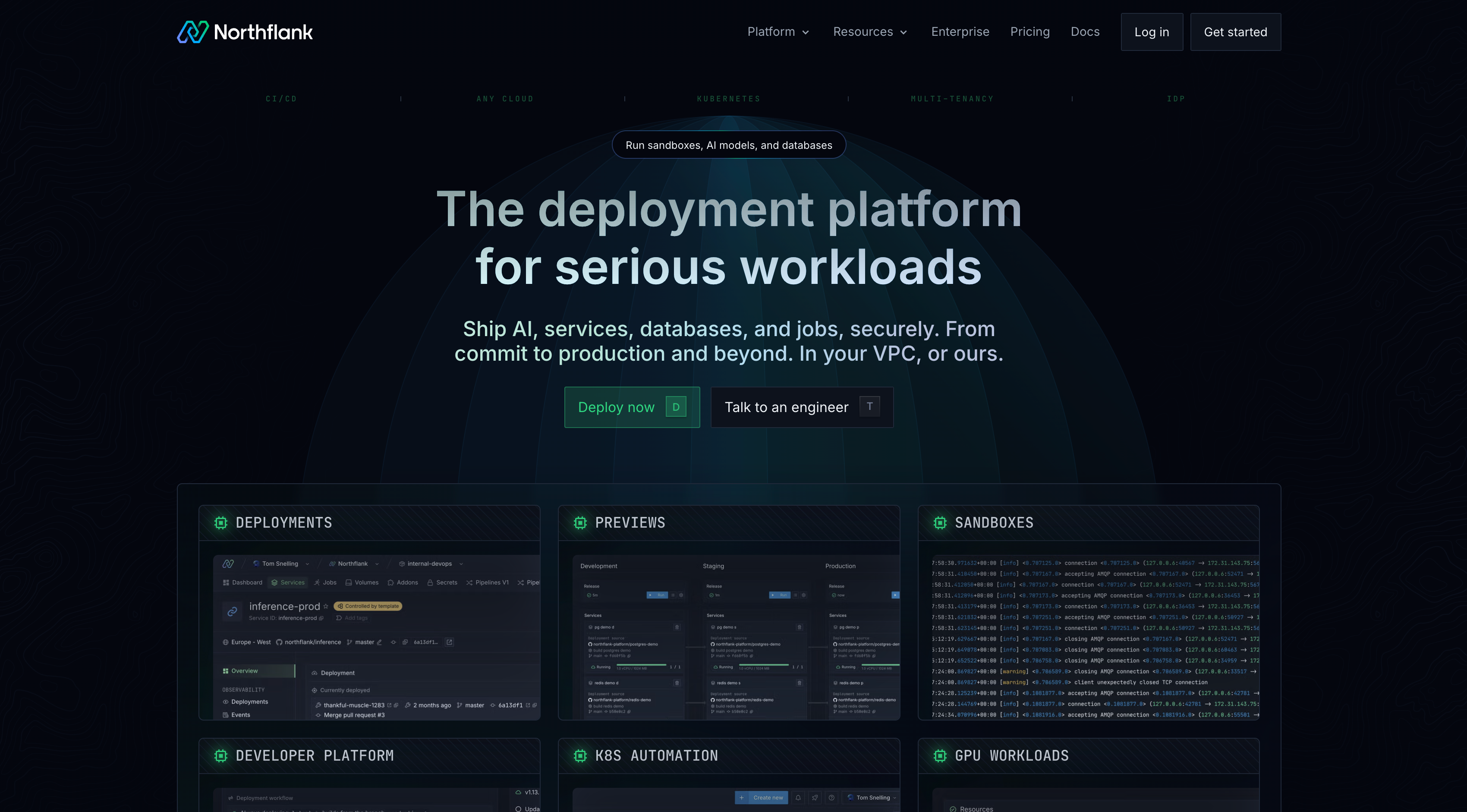
For organizations migrating off VMware that are containerizing their workloads rather than just moving VMs, Northflank eliminates the platform engineering overhead that OpenShift requires. Weights scaled to millions of users on Northflank without a dedicated DevOps team. Ultralight moved off AWS ECS to Northflank-managed Kubernetes and eliminated the infrastructure management overhead that was consuming engineering time.
Get started on Northflank (self-serve) or book a demo to walk through your migration requirements.
OpenShift can replace VMware for container workloads natively and for VM workloads via OpenShift Virtualization. However, OpenShift Virtualization does not replicate every VMware feature with the same maturity or ease of configuration. vMotion, DRS, and vSAN each have functional equivalents: live migration between nodes, Kubernetes scheduling with affinity rules, and CSI-based storage respectively. But these require more manual configuration and are generally less mature than their VMware counterparts. Organizations with complex VMware-specific dependencies need to evaluate the migration effort carefully before committing.
Red Hat's Migration Toolkit for Virtualization (MTV) converts VMware VMDK disk images to KubeVirt-compatible volumes and migrates VMs to OpenShift Virtualization. The migration process involves network mapping, storage mapping, and validation testing. VMs run on OpenShift after migration via KubeVirt, while containerized workloads run natively on Kubernetes in the same cluster.
At a small scale, OpenShift is typically less expensive than post-Broadcom VMware pricing. At a large scale with complex workloads, the total cost of ownership depends heavily on the support tier, the infrastructure costs, and the engineering time required to operate the platform. OpenShift Virtualization is included in the OpenShift Container Platform subscription at no additional cost, which is an advantage for mixed VM and container environments.
Northflank provides the same enterprise container hosting capabilities as OpenShift with significantly less operational overhead. OpenShift is a platform you deploy and maintain with a dedicated platform engineering team. Northflank is a managed platform that handles the infrastructure layer for you, with self-serve BYOC when workloads need to run inside your own infrastructure. The developer experience is simpler, and the time to production is measured in minutes rather than months.
VMware remains the right platform for organizations whose workloads are primarily traditional VMs with no near-term containerization roadmap. OpenShift is a credible migration target for organizations modernizing to containers, with built-in VM support for workloads that cannot be containerized immediately. Both carry significant operational overhead and cost.
For enterprises that are containerizing their workloads and want enterprise-grade hosting without the platform engineering burden of OpenShift, Northflank provides the managed Kubernetes, enterprise controls, and BYOC flexibility that regulated industries require, without requiring a dedicated team to operate the platform.
Get started on Northflank (self-serve) or book a demo to see how it compares for your requirements.
- Top managed Kubernetes hosting platforms in 2026: How managed Kubernetes platforms compare on control plane, BYOC, sandbox isolation, and enterprise controls.
- Top internal developer portals in 2026: How platform teams give developers self-service access to Kubernetes-powered infrastructure.
- Kubernetes alternatives: finding the right fit for your team: Options for teams that need container orchestration without managing a Kubernetes cluster directly.