
Best PaaS platforms for AI-generated and vibe-coded apps in 2026
Most vibe-coded apps never make it to production. The code generation problem is solved. The deployment gap is where momentum dies. A PaaS removes that gap, but not all of them cover what production actually requires.
- Northflank – A full-stack PaaS for vibe-coded apps. Managed databases, secrets groups, preview environments per pull request, CI/CD, sandbox isolation for AI-generated code execution, GPU workloads, and self-serve BYOC into your own cloud. No infrastructure knowledge required.
- Vercel – Best for Next.js and React frontends where the backend is minimal or handled by external APIs. Serverless-only, no native managed databases.
- Render – Best for straightforward full-stack apps with a single service and database, where managed-only infrastructure is acceptable.
- Railway – Best for teams that want the fastest path from code to a deployed app with a database using template-based setup.
Northflank is a full-stack cloud platform built for teams that need more than a prototype host. Managed databases, secrets management, preview environments, CI/CD, sandbox isolation for AI-generated code, GPU workloads, and self-serve BYOC into AWS, GCP, Azure, and on-premises. SOC 2 Type 2 compliant and HIPAA compliant with BAAs available. Sign up to get started or book a demo.
Vibe coding gets an app to localhost fast. A PaaS is what keeps it running reliably after the first deploy. The gap between built-in hosting in vibe coding tools and a PaaS is managed databases, secrets management, preview environments, autoscaling, and the controls that real users and compliance frameworks require.
This article covers what a PaaS for vibe coding needs to handle, where built-in hosting in vibe coding tools falls short, and which platforms cover the full stack.
A Platform-as-a-Service abstracts the infrastructure layer so builders define what to run rather than how to run it. Connect a Git repository, configure a service, and the platform handles building, deploying, scaling, TLS, and health checks. For vibe coders, this means deployment becomes an extension of building rather than a separate discipline requiring DevOps knowledge.
The distinction between built-in hosting in vibe coding tools and a PaaS is what happens after the first deploy. Built-in hosting in vibe coding tools gets your app live with a URL while a PaaS handles what comes next: managed databases that provision in minutes with scoped credentials, secrets injected at runtime so credentials never appear in source code, preview environments that spin up per pull request and tear down on merge, autoscaling that adjusts to traffic without manual intervention, and observability that tells you what is happening inside the app.
Built-in hosting from Lovable, Bolt, and Replit works for the first deploy. The constraints surface quickly as apps grow. Data lives on the platform's infrastructure with no clear path to owning it. Database connections require external providers and manual credential management. Environment separation between development and production is limited or nonexistent. Pricing scales unpredictably as usage grows. Compliance requirements that enterprise customers or regulated industries introduce cannot be met on shared managed infrastructure.
The same applies to platforms like Vercel for full-stack workloads. Vercel is optimized for frontend and serverless. Long-running services, background workers, persistent database connections, and stateful AI workloads need external providers or workarounds. For apps that start as a Next.js frontend and grow into a full-stack system with a database, background jobs, and AI execution, a single-purpose PaaS creates friction that a full-stack platform removes.
These are the capabilities that separate a PaaS from built-in hosting in vibe coding tools.
- Managed databases: Your app needs somewhere to store data with automated backups, scaling, and connection management. A PaaS that provisions PostgreSQL, MySQL, MongoDB, or Redis as a first-class addon and automatically injects connection credentials removes the hardest part of full-stack deployment.
- Secrets management: API keys, database passwords, and third-party credentials must never appear in source code or build logs. A PaaS that stores secrets in a managed secrets store and injects them at runtime prevents the credential exposure that is the most common production security failure in vibe-coded apps.
- Preview environments: Every pull request should spin up an isolated copy of the app with its own database instance and tear it down on merge. This lets builders test changes against real data without affecting production.
- CI/CD from Git: Push to a branch, the platform builds and deploys automatically. No manual deployment steps between writing code and seeing it live.
- Autoscaling: Traffic is unpredictable. The platform should scale services up to handle load and down to reduce cost without manual intervention or pre-provisioning.
- Sandbox isolation for AI-generated code: Apps that execute AI-generated or user-submitted code at runtime need microVM isolation. Standard container execution shares the host kernel and is not sufficient for code you do not fully trust.
- Observability: Real-time logs and performance metrics should be built in so builders can see what is happening inside the app without adding a separate monitoring tool.
- BYOC for compliance and cost: When apps grow into production systems with enterprise customers, compliance requirements, or significant cloud spend, the ability to deploy into your own AWS, GCP, or Azure account keeps data inside your own infrastructure and eliminates vendor lock-in. Northflank itself is SOC 2 Type 2 compliant and HIPAA compliant, and signs BAAs for apps that handle PHI, on both managed cloud and BYOC.
Northflank is a full-stack cloud platform that covers the full production PaaS requirement for vibe-coded apps. Connect a Git repository, and Northflank detects the framework, builds the app, and deploys it with TLS, environment variables, and health checks configured automatically. Managed databases (PostgreSQL, MySQL, MongoDB, Redis, MinIO, RabbitMQ) provision in minutes with scoped credentials injected through secret groups. Credentials never appear in code or logs.
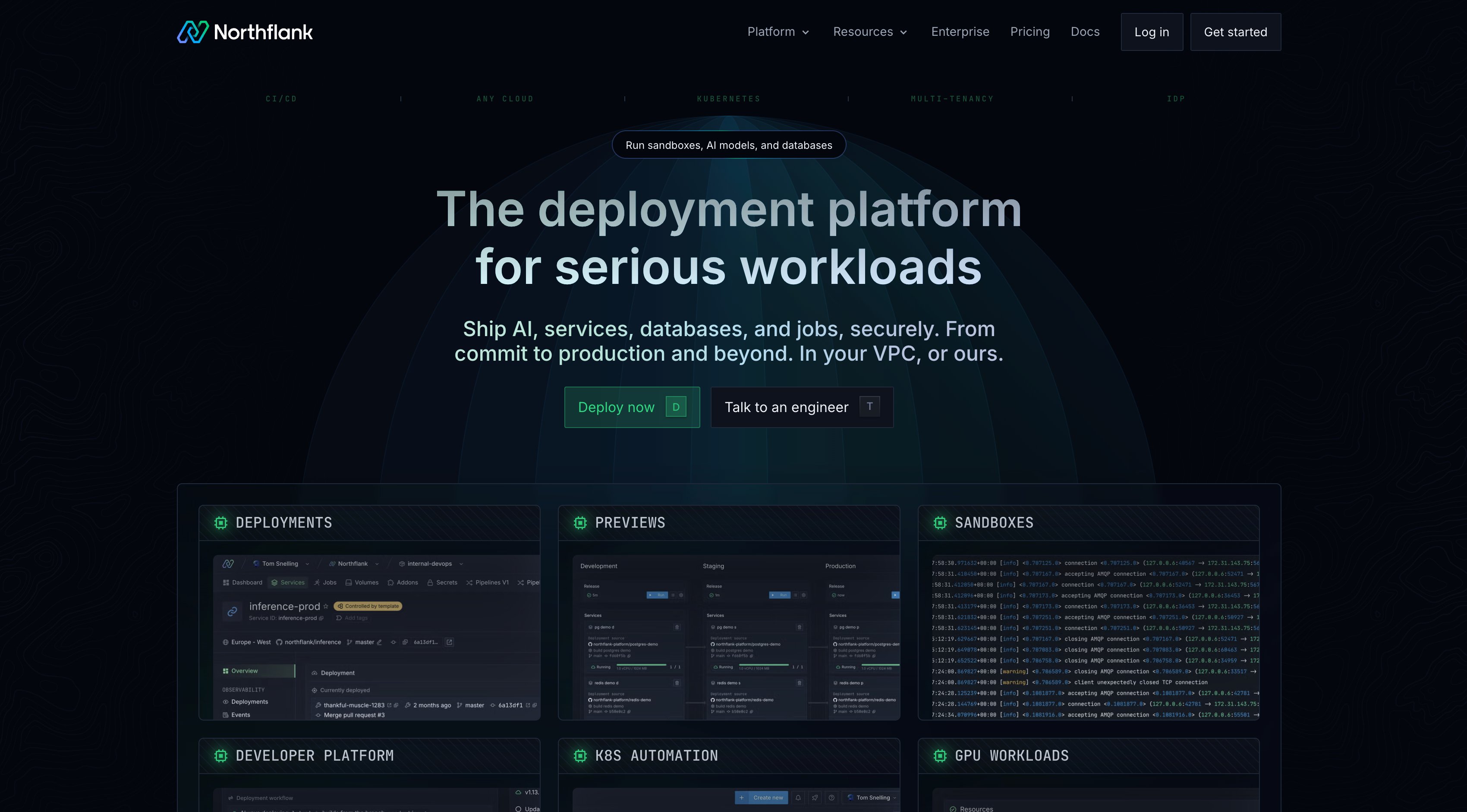
Preview environments spin up per pull request with isolated database instances and tear down on merge. Background workers, scheduled jobs, and build pipelines run in the same control plane as the main application. For apps that execute AI-generated or user-submitted code at runtime, Northflank's sandbox infrastructure runs microVM-backed execution using Kata Containers, Firecracker, and gVisor. GPU workloads (H100, A100, L4, and more) run alongside services and databases in the same control plane. BYOC is self-serve into AWS, GCP, Azure, Oracle, CoreWeave, Civo, on-premises, and bare-metal for apps that need to run inside existing infrastructure. SOC 2 Type 2 compliant and HIPAA compliant with BAAs available..
Best for: Vibe coders whose apps have grown beyond prototypes and need managed databases, secrets management, preview environments, and the option to run inside their own cloud account.
Pricing: Free tier includes two services, one database, and two cron jobs. Paid compute from $0.01667/vCPU-hour and $0.00833/GB-hour, billed per second.
Vercel is optimized for Next.js and React frontends. Git integration handles CI/CD automatically, preview deployments spin up per pull request, and the edge network provides fast global delivery. For vibe-coded apps that are primarily frontend with minimal backend, Vercel provides the cleanest deployment experience in the category.
The ceiling for full-stack vibe coding is backend scope. Long-running services, background workers, and stateful database connections need external providers. Database connections come via Marketplace integrations (Neon, Supabase, others) rather than native managed addons. For apps that outgrow a serverless model, the platform requires adding external tooling.
Best for: Vibe-coded Next.js or React apps where the backend is minimal or handled by external APIs.
Pricing: Free tier available. Pro from $20/user/month.
Render provides managed PostgreSQL, Redis, background workers, static sites, and preview environments from a Git repository. Setup is minimal, and the operational model is simpler than AWS. For straightforward full-stack vibe-coded apps with a service and a database, Render covers the production baseline well.
Render is managed-only with no BYOC option and charges separately for each service and database instance, which adds up faster than usage-based alternatives for apps with multiple services. Preview environment support requires a Professional plan.
Best for: Vibe-coded full-stack apps that need managed databases and a simpler operational model than AWS, where managed-only infrastructure is acceptable.
Pricing: Services from $7/month. Managed Postgres from $7/month.
Railway provides fast, template-based deployment with managed databases (PostgreSQL, MySQL, Redis, MongoDB) and resource-based pricing. Templates cover common stacks. Git integration handles CI/CD automatically. For vibe coders who want the fastest path from code to a deployed app with a database, Railway reduces friction.
Resource-based pricing becomes unpredictable for apps with variable traffic or multiple services. Preview environments are available but less mature than on Northflank or Vercel. RBAC and SSO require enterprise plan commitments.
Best for: Vibe coders who want the fastest path to a deployed app with a database using template-based setup.
Pricing: Hobby from $5/month plus usage. Pro from $20/month.
The right choice depends on where your app is in its lifecycle and what it needs to run reliably in production.
If the app is a Next.js frontend with minimal backend, Vercel is the right default. If you need a service and a database with minimal setup, Render or Railway gets you there fast. If the app has grown into a full-stack system with background workers, multiple databases, AI code execution, GPU workloads, or compliance requirements, Northflank covers the full production stack in one platform without requiring external tooling for each capability.
| Platform | Managed databases | Secrets management | Preview environments | Sandboxes | GPU support | BYOC |
|---|---|---|---|---|---|---|
| Northflank | Yes (6+ types) | Yes, built-in | Yes, with isolated DBs | Yes (Firecracker, Kata, gVisor) | Yes (H100, A100, and more) | Yes, self-serve |
| Vercel | Via Marketplace | Environment variables | Yes | Yes | No | No |
| Render | Postgres, Redis | Environment variables | Yes (Professional plan+) | No | No | No |
| Railway | Postgres, MySQL, Redis, MongoDB | Environment variables | Yes (PR environments) | No | No | Yes, enterprise-only |
Built-in hosting from Lovable, Bolt, or Replit deploys your app to the tool's own infrastructure. It works for prototypes. A PaaS is a separate deployment platform that takes your code from any source and handles the infrastructure underneath it. A PaaS gives you portability, control over your data, environment separation, and the ability to add managed databases, secrets management, and compliance controls as your app grows.
On a PaaS with native managed database support like Northflank, you add a database addon from the dashboard or CLI, and the platform provisions the database, creates scoped credentials, and injects the connection string as an environment variable automatically. On platforms without native databases, you provision a database from an external provider and configure the connection manually.
Secrets management stores API keys, database passwords, and third-party credentials in a secure secrets store rather than in source code or environment files committed to a repository. AI coding tools regularly include credentials in generated code. A PaaS with built-in secrets management intercepts this before credentials reach production by injecting them at build and runtime from a separate secure store.
Any vibe-coded app that executes code at runtime, including AI coding assistant features, code interpreter functionality, agentic workflows, or any feature that runs user-submitted input as code, needs sandbox isolation. Without microVM isolation, a single bad execution can compromise the host application. This matters most for apps that let users run code or that embed LLM-generated tool calls.
BYOC (Bring Your Own Cloud) means the PaaS deploys your app into your own AWS, GCP, Azure, or on-premises infrastructure rather than the vendor's shared managed environment. Your data stays inside your own VPC. This matters when apps grow into production systems with enterprise customers who require data residency controls, or when you want to use existing cloud credits or negotiated pricing.
Yes. Moving to a production PaaS typically means connecting a Git repository, provisioning a managed database, migrating existing data, and configuring secrets. The application code does not need to change. The migration is an infrastructure operation, not a code rewrite.
Vibe coding gets an app to a working prototype fast. A PaaS is what keeps it running reliably after the first deploy. The gap between built-in hosting in vibe coding tools and a PaaS is managed databases, secrets management, preview environments, autoscaling, observability, and the controls that enterprise customers and compliance frameworks require.
Northflank covers the full production stack for vibe-coded apps in one platform, with the option to run inside your own cloud account as the app grows. Vercel, Render, and Railway cover specific use cases well but require external tooling as complexity increases.
Sign up for free on Northflank or book a demo to deploy your vibe-coded app to production.
- Best deployment platforms for vibe coders in 2026: A comparison of Northflank, Vercel, Render, Railway, and Fly.io on databases, secrets management, preview environments, and full-stack scope.
- How to deploy vibe-coded apps: A step-by-step walkthrough of taking a vibe-coded app from localhost to a live HTTPS URL on Northflank.
- Enterprise vibe coding: how to deploy AI-generated apps safely: Covers the governance, security, and compliance controls required for enterprise vibe coding at scale.
- Top managed database services in 2026: Managed Postgres, MySQL, Redis, MongoDB, and more for apps that need a database alongside their PaaS.