
Top AI companies in 2026: models, infrastructure, and tooling
Top AI companies in 2026 operate across distinct layers of a shared stack: hardware, foundation models, deployment infrastructure, data intelligence, and application tooling.
This article breaks down eight of the most significant AI companies by category, covering what each one provides and where it fits in the stack. The goal is to help engineers and technical teams understand the landscape and make better decisions about tooling, vendors, and architecture.
- Northflank is the deployment infrastructure layer for AI engineering teams. It runs AI services, agents, GPU workloads, and microVM-backed sandboxes for secure agentic code execution, in your cloud or its own. If you are building an AI product and need a platform that handles deployment, orchestration, sandboxing, and GPUs without a dedicated DevOps team, Northflank is built for that.
- Most engineers building AI products in 2026 need at least three of these layers: a model provider, a data platform, and a deployment platform. The infrastructure layer is where most teams underinvest early and pay for it later.
- NVIDIA supplies the compute that nearly every other company on this list runs on. OpenAI, Anthropic, and Mistral AI build the models that sit on top of it.
- Databricks handles data pipelines and AI governance at scale. Hugging Face is where most engineers start when evaluating open-weight models. ElevenLabs covers voice AI for teams building conversation or audio products.
The table below organises each company by category and location to help you quickly identify which part of the AI stack they occupy.
| Company | Category | HQ | Founded |
|---|---|---|---|
| Northflank | Deployment infrastructure, sandboxes, GPU workloads | London, UK | 2019 |
| NVIDIA | AI hardware, GPU architecture, software ecosystem | Santa Clara, USA | 1993 |
| OpenAI | Foundation models, AI APIs, consumer AI | San Francisco, USA | 2015 |
| Anthropic | Foundation models, AI safety research | San Francisco, USA | 2021 |
| Mistral AI | Open-weight and proprietary LLMs | Paris, France | 2023 |
| Databricks | Data intelligence platform, lakehouse architecture | San Francisco, USA | 2013 |
| Hugging Face | Open-source model hub, ML collaboration platform | New York, USA | 2016 |
| ElevenLabs | Voice AI, text-to-speech, voice agents | London, UK | 2022 |
The companies below are selected to cover the breadth of the AI stack rather than a single category. Each entry covers what the company provides, its key products, and its relevance to engineering teams building AI systems in production.
Category: Deployment infrastructure, AI sandboxes, GPU workloads
Northflank is a London-based deployment platform for engineering teams running AI workloads, services, databases, and background jobs. Founded in 2019, it provides a control plane for Kubernetes-based infrastructure, running either on Northflank's managed cloud or inside a customer's own VPC.
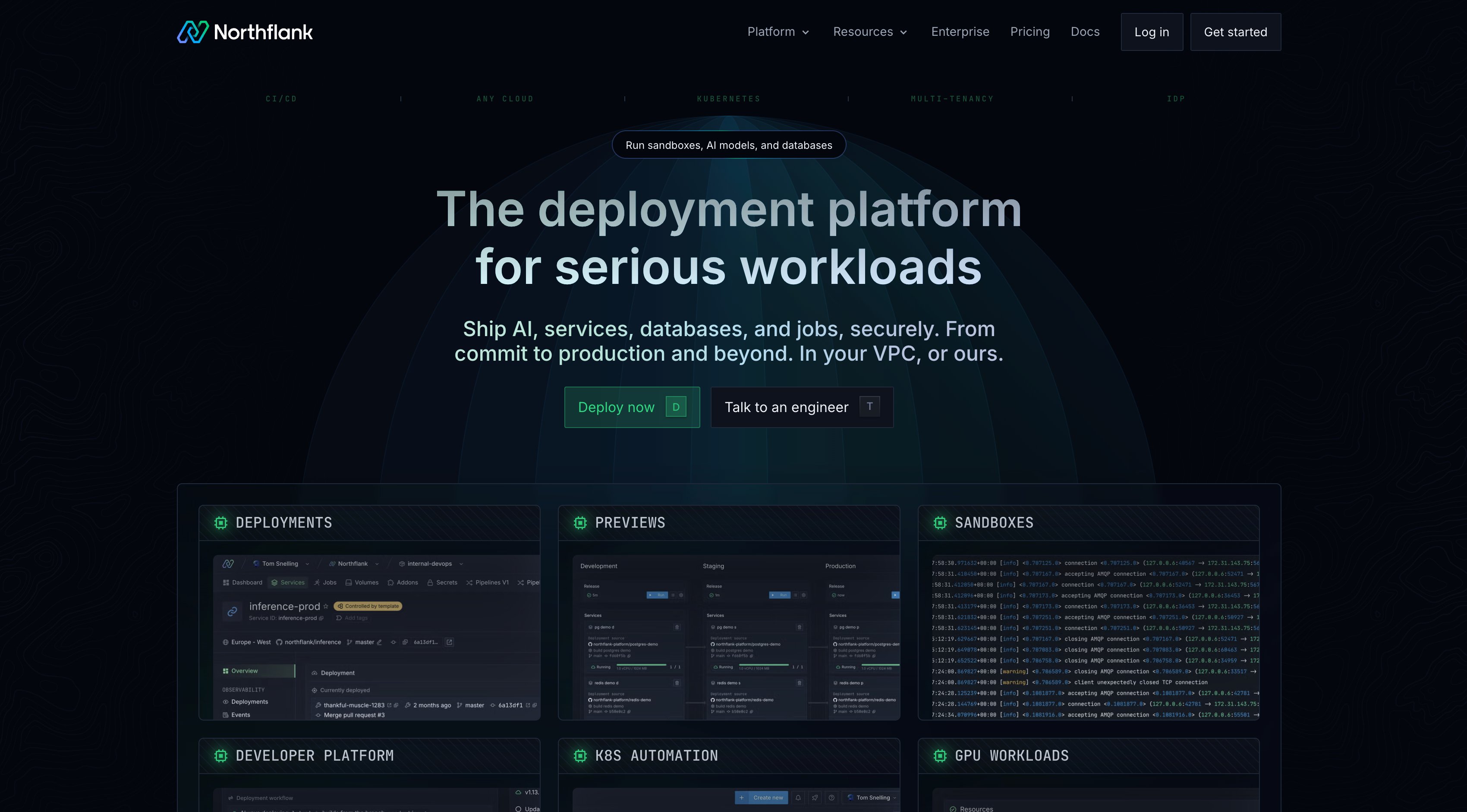
Sandboxes run inside microVM-backed containers using Kata Containers, Firecracker, or gVisor, giving each workload its own kernel instance and preventing container escape. They spin up in 1 to 2 seconds and support both ephemeral and persistent environments, making them suitable for LLM-generated code execution, AI agents, and multi-tenant platforms. See the sandbox documentation for full details.
Northflank supports GPU workloads on its managed cloud and in your own cloud account. Supported hardware includes NVIDIA H100 ($2.74/hr) and B200 ($5.87/hr). The platform handles spot instance orchestration, GPU timeslicing, custom autoscaling, multi-read-write storage for model loading, and Jupyter notebook support. Full configuration options are covered in the GPU workloads documentation.
Most enterprise customers deploy Northflank inside their own VPC. BYOC support covers AWS (EKS), GCP (GKE), Azure (AKS), CoreWeave, Civo, and Oracle, and is self-serve rather than requiring a professional services engagement. Northflank is SOC 2 Type 2 compliant. See the BYOC features page for a full breakdown.
Beyond AI workloads, Northflank covers the full deployment lifecycle: Git-connected CI/CD, release pipelines, preview environments, managed databases (PostgreSQL, MongoDB, MySQL, Redis, RabbitMQ, MinIO), secrets management, RBAC, and GitOps. Pricing starts at $0.01667/vCPU/hour and $0.00833/GB/hour, with GPU pricing and a cost calculator on the pricing page.
One engineering team of two used Northflank to run 10,000+ AI training jobs and half a million inference runs per day across nine clusters, 40+ microservices, and 250+ concurrent GPUs on AWS, GCP, and Azure, without a dedicated DevOps hire. Read the Weights case study to see how they did it.
Northflank is self-serve. Get started for free or book a demo if you want to talk through your infrastructure requirements first.
Category: AI hardware, GPU architecture, software ecosystem
NVIDIA is the semiconductor company that supplies the compute underpinning almost all AI training and inference. Its GPUs are the standard hardware layer for large language model development across research labs, cloud providers, and enterprise deployments.
Current GPU architectures include Hopper (H100) and Blackwell (B200, GB200). Beyond hardware, NVIDIA's software ecosystem includes CUDA-X (GPU-accelerated libraries), NIM microservices (model inference), Dynamo (inference engine), and the NGC catalog (GPU-optimised containers and models).
Engineers evaluating GPU infrastructure will encounter NVIDIA hardware on almost every cloud platform. CUDA compatibility is a practical consideration when selecting frameworks, containers, and deployment targets. Northflank runs NVIDIA GPUs on its managed cloud and supports deploying them inside your own cloud account.
Category: Foundation models, AI APIs, consumer AI
OpenAI is a San Francisco-based AI research organisation structured as a public benefit corporation. It develops the GPT family of large language models, DALL-E for image generation, Whisper for speech-to-text, and Codex for coding tasks.
The current model lineup includes GPT-5.5, the o-series reasoning models, GPT-4o for multimodal tasks across text, image, and audio, and GPT-4o Mini for cost-sensitive applications. All models are accessible via REST API. OpenAI also offers a Realtime API for low-latency voice AI and Codex for agentic coding workflows.
For engineering teams, OpenAI's API is the most widely integrated LLM endpoint in the ecosystem. A broad model selection across price points and extensive third-party tooling support make it a common starting point when evaluating which model to build on.
For teams considering open-source alternatives alongside proprietary models, Northflank's complete guide to open-source LLM deployment covers the tradeoffs and deployment options.
Category: Foundation models, AI safety research
Anthropic is a San Francisco-based AI safety company and public benefit corporation, founded in 2021. Its stated focus is developing reliable, interpretable, and steerable AI systems.
The Claude model family includes Opus (frontier reasoning), Sonnet (balanced performance and cost), and Haiku (fast and lightweight). Models are available via the Claude API, Claude.ai for consumer and team use, and Claude Code for terminal-based agentic coding workflows. Claude is also available through AWS Bedrock and Google Cloud Vertex AI.
Anthropic's published safety research includes Constitutional AI, interpretability research into model internals, and the Responsible Scaling Policy. For engineering teams, Claude models are notable for strong performance on long-context tasks, coding, and document analysis. Anthropic's safety research is relevant to teams deploying AI in regulated industries where output reliability and auditability matter.
For a direct comparison of Claude Code against other coding tools, see Northflank's Claude Code vs OpenAI Codex breakdown.
Category: Open-weight and proprietary large language models
Mistral AI is a Paris-based AI company founded in April 2023. It develops open-weight and proprietary large language models with a focus on efficiency and European data sovereignty.
The model portfolio includes Mistral Large, Mistral Medium, Mistral Small, Codestral, Mistral NeMo, Ministral, Voxtral, and Document AI. Models are accessible via La Plateforme (developer API), Mistral AI Studio (enterprise platform), and Le Chat (consumer and enterprise assistant), with self-hosted and private cloud deployment options available.
Mistral's MoE architecture activates only a relevant subset of expert layers per token, reducing inference cost while preserving capability. Apache 2.0 models are deployable on your own infrastructure without per-token API costs, and teams with European data residency requirements benefit from Mistral's EU-based infrastructure and GDPR compliance.
Mistral models are deployable on GPU platforms such as Northflank's GPU workloads. For a broader look at deploying open-source models in production, see Northflank's engineer's guide to open-source AI models.
Category: Data intelligence platform, lakehouse architecture
Databricks is a San Francisco-based data and AI company founded in 2013. It invented the lakehouse architecture, combining features of a data warehouse and data lake into a unified platform for managing structured and unstructured data.
The Data Intelligence Platform covers data engineering, SQL analytics, ML and AI (MLflow, Agent Bricks), governance (Unity Catalog), and business intelligence. Its open-source contributions include Apache Spark, Delta Lake, and MLflow, all widely used independently of the commercial platform.
For data and AI engineering teams, Databricks is the standard platform when the workload requires managing large-scale data pipelines alongside model training, experiment tracking, and agent deployment in a governed environment.
Category: Open-source model hub and ML collaboration platform
Hugging Face is a New York-based AI company that operates the largest open-source model repository and ML collaboration platform available. The Hub is the de facto distribution layer for open-weight AI models, where most major releases including Llama, Mistral, Qwen, and DeepSeek are distributed with versioning, model cards, evaluation results, and licence information.
The software library ecosystem includes Transformers, Diffusers, Datasets, and Tokenizers. The Inference Providers API gives developers access to models from multiple AI providers through a single unified API, and Inference Endpoints allows teams to deploy any Hub model on dedicated infrastructure. Enterprise tier includes private model hosting, SSO, audit logs, and dedicated deployment regions.
For engineering teams, Hugging Face is the starting point for discovering, evaluating, and pulling open-weight models into a deployment pipeline. Teams running open-weight models on GPU infrastructure such as Northflank's GPU workloads will typically source model weights from the Hub. For a practical example, see Northflank's guide to self-hosting DeepSeek V3.
Category: Voice AI, text-to-speech, voice agents
ElevenLabs is a London and New York-based voice AI company providing voice generation, cloning, and agent products accessible via API and a consumer platform.
The core product set covers text-to-speech generation, speech-to-text transcription (batch and real-time), voice cloning, voice design, voice changing, audio dubbing for content localisation, sound effects generation, and AI music generation.
The conversational AI agent platform supports customer support, outbound calling, lead qualification, and AI receptionist workflows. The Voice Library is a two-sided marketplace where creators can upload and license voice clones. All capabilities are available via API, with enterprise access including SAML SSO, audit logs, and a trust and compliance centre.
ElevenLabs is relevant to engineering teams building voice interfaces, TTS pipelines, real-time conversation systems, or content localisation workflows.
The top AI companies in 2026 span several distinct categories. Northflank is the deployment infrastructure platform for AI engineering teams, covering GPU workloads, microVM-backed sandboxes for secure agentic code execution, CI/CD, managed databases, and BYOC deployment inside your own VPC. NVIDIA dominates AI hardware. OpenAI and Anthropic lead on proprietary foundation models. Mistral AI is the leading European open-weight model provider. Databricks is the standard platform for data and AI engineering at scale. Hugging Face is the primary distribution layer for open-source models. ElevenLabs leads voice AI.
An AI model company builds and trains large language models and makes them accessible via API or direct deployment. OpenAI, Anthropic, and Mistral are model companies. Northflank is an infrastructure company: it does not train models, but provides the runtime environment for services, agents, sandboxes, and GPU workloads that use those models.
Northflank (London, UK), ElevenLabs (London and New York), and Mistral AI (Paris, France) are the three European companies on this list. For teams with European data residency requirements or GDPR compliance constraints, both Mistral and Northflank's BYOC deployment options are relevant starting points.
Northflank covers the full stack AI engineering teams need in production: GPU workloads on managed cloud or BYOC, microVM-backed sandboxes for secure agentic code execution, CI/CD, managed databases, and secrets management, all deployable inside your own VPC. See the Northflank docs for a technical breakdown or the enterprise page for large-scale deployment details.
Pull model weights from the Hugging Face Hub, deploy a serving framework such as vLLM, TGI, or Ollama as a container, and run it on a GPU-enabled platform. Northflank supports this workflow via GPU workloads, with on-demand H100 and B200 support, spot instance orchestration, and BYOC deployment. The GPU workloads documentation covers configuration and optimisation.
If you are building with any of the platforms on this list, whether that is serving a Mistral model, running an ElevenLabs voice agent, or executing LLM-generated code in a secure sandbox, Northflank provides the deployment infrastructure to run it in production.
Get started for free or book a demo to talk through your setup with an engineer.