
Enterprise AI coding agent deployment in 2026
- 88% of enterprise AI agent pilots never reach production. Gartner predicts over 40% of agentic AI projects will be canceled by 2027 due to unclear business value and inadequate risk controls, not model quality.
- Enterprise deployment requires seven non-negotiable controls: SSO integration, SIEM-connected audit logging, secret scanning on agent PRs, PR policy gates, license governance, sandbox isolation for agent execution, and incident response runbooks.
- The infrastructure layer, compute isolation, RBAC, network controls, and data residency are separate from the AI coding tool itself. Most enterprise deployments fail because they treat tool selection as the deployment decision and skip the infrastructure layer.
- Northflank provides the execution infrastructure for enterprise AI coding agent deployment: microVM sandbox isolation, self-serve BYOC into your own cloud or on-premises, RBAC, audit logging, SSO, and GPU workloads in one control plane.
Northflank is a full-stack cloud platform that provides the execution infrastructure enterprises need to deploy AI coding agents safely in production. MicroVM sandbox isolation, BYOC into AWS, GCP, Azure, and on-premises, RBAC, audit logging, SSO, and GPU workloads. Sign up to get started or book a demo.
Enterprise AI coding agent adoption is widespread. Getting agents from pilot to production is not. 88% of agent pilots never reach production. The blocker is rarely the agent itself. It is the deployment infrastructure: isolation, governance, compliance controls, and data residency that enterprise security teams require before any agent touches production code.
This article covers what enterprise AI coding agent deployment actually requires, where most deployments stall, and how to build the infrastructure layer that gets agents from pilot to production.
The production gap is not a model quality problem. By April 2026, Claude Code, OpenAI Codex, Google Jules, Cursor, Amazon Kiro, and Windsurf all produce strong code. What separates deployments that reach scale from the ones that get pulled after a quarter is whether the identity, logging, code review, and incident controls around the agent are in place from day one.
Gartner predicts over 40% of agentic AI projects will be canceled by the end of 2027 due to escalating costs, unclear business value, or inadequate risk controls. McKinsey research shows that while nearly two-thirds of enterprises have experimented with AI agents, fewer than 10% have scaled them to deliver measurable value, with poor data quality and governance cited as the primary barriers. None of these are model-quality problems. They are scoping, ownership, and governance problems. The enterprise security and compliance review that every AI coding agent deployment must pass does not ask which model scores highest on SWE-bench. It asks whether the agent survives contact with Okta, Splunk, and the code review policy.
These are the controls every enterprise deployment must clear before an AI coding agent reaches general availability. Skipping anyone creates a gap that blocks the rollout at the next audit cycle.
Every agent session must map to a named human identity. Without this, access reviews, offboarding, and audit trails do not work. Every mature AI coding agent, including Claude Code, Codex, Cursor, and GitHub Copilot, supports SAML SSO and SCIM provisioning against Okta, Entra ID, and Google Workspace. Configure SSO before anything else. Every agent request needs to be attributable to a specific person when the audit team asks.
Agent activity must be centrally logged and queryable. This means every file access, every shell command, every PR creation, and every API call the agent makes should flow into the enterprise SIEM. Log retention must meet the compliance framework's requirements. For SOC 2 Type 2, auditors need demonstrable evidence that controls operated consistently across the audit period, not just at a point in time.
AI coding agents commit code with credentials in it more often than human developers. Every PR created by an agent must run secret scanning before merge. This is not optional. Configure pre-receive hooks or required status checks in GitHub, GitLab, or Bitbucket that block merges when secrets are detected. Do not rely on agents to avoid this problem. Enforce it at the infrastructure level.
Agent PRs must go through the same review gates as human PRs, with no pilot exemptions. Required checks include owner review, coverage thresholds, lint, SAST, and secret detection. Make these mandatory and tie any override to a named role. Log every bypass. Label agent PRs with the tool and session ID (for example, agent:claude-code) so security operations can pivot from a PR to the originating session in the SIEM.
Agents that execute shell commands, install packages, read files, or make network requests at runtime need isolated execution environments. Without sandbox isolation, a misconfigured agent can access the host system, other teams' infrastructure, or sensitive data stores. MicroVM isolation with a dedicated kernel per agent workload is the right baseline for production deployments handling proprietary code.
AI coding agents generate code that may contain snippets matching open-source licensed material. Enterprise legal teams require a policy covering what licenses are acceptable in agent-generated code, a scanning mechanism for detecting problematic licenses before merge, and a remediation process when issues are found.
When an agent causes a production incident, the enterprise needs a documented process covering who gets paged, how agent access is revoked, how the affected code is identified and rolled back, and how the incident is reported to auditors. Teams that deploy agents without runbooks discover their gaps at the worst possible moment.
Deploy the AI coding agent to one team with above-average security maturity. Configure SSO and basic logging. Instrument PR gates. Run for four to six weeks and measure PR throughput, defect rate, and security findings. Establish a baseline before expanding.
Before expanding to additional teams, close the infrastructure gaps identified in the pilot. Wire audit logging to SIEM. Configure sandbox isolation for agent execution. Implement secret scanning as a required check. Define the license governance policy. Build the incident response runbooks. Do not expand until these controls are in place.
Roll out to two or three additional teams with active monitoring. Track agent-authored PR volume per team, security finding rates, and any anomalies in agent network activity. Use this phase to validate that the infrastructure controls work at slightly higher volume before general availability.
Open to all eligible teams with documented governance: approved agents, approved models, approved use cases, and documented escalation paths. Assign an AI agent owner or agentic ops lead responsible for the program. 56% of enterprises that successfully scale AI agent programs name a dedicated owner. Ownership maturity correlates strongly with reaching the production threshold.
Most enterprise AI coding agent deployments treat tool selection as the deployment decision. They pick Claude Code or Cursor, configure SSO, and consider the deployment done. The infrastructure layer is where production deployments diverge from pilots.
The infrastructure layer handles where agents run, not what they do. It covers compute isolation so agent execution is hardware-separated from other workloads, network controls so agents cannot make arbitrary outbound requests, data residency so proprietary code never leaves the enterprise's own infrastructure, and audit logging at the execution level rather than just at the tool level.
AI coding tools provide governance within their own perimeter. Cursor's Sandbox Mode and hooks apply to Cursor. GitHub Copilot's audit logs cover Copilot sessions. When an enterprise runs multiple agents across multiple tools, a platform-level infrastructure layer provides consistent governance across all of them, regardless of which tool is running.
Northflank provides the execution infrastructure layer that enterprise AI coding agent deployments require. It is also an off-the-shelf internal developer platform built for the scale that AI-native software delivery creates: 10x to 100x the workload volume, more people across the organization contributing code, and net-new workloads that need to move from generated to production without a platform team as the bottleneck. It covers the four layers enterprises need when AI coding agents move from pilot to production at scale.
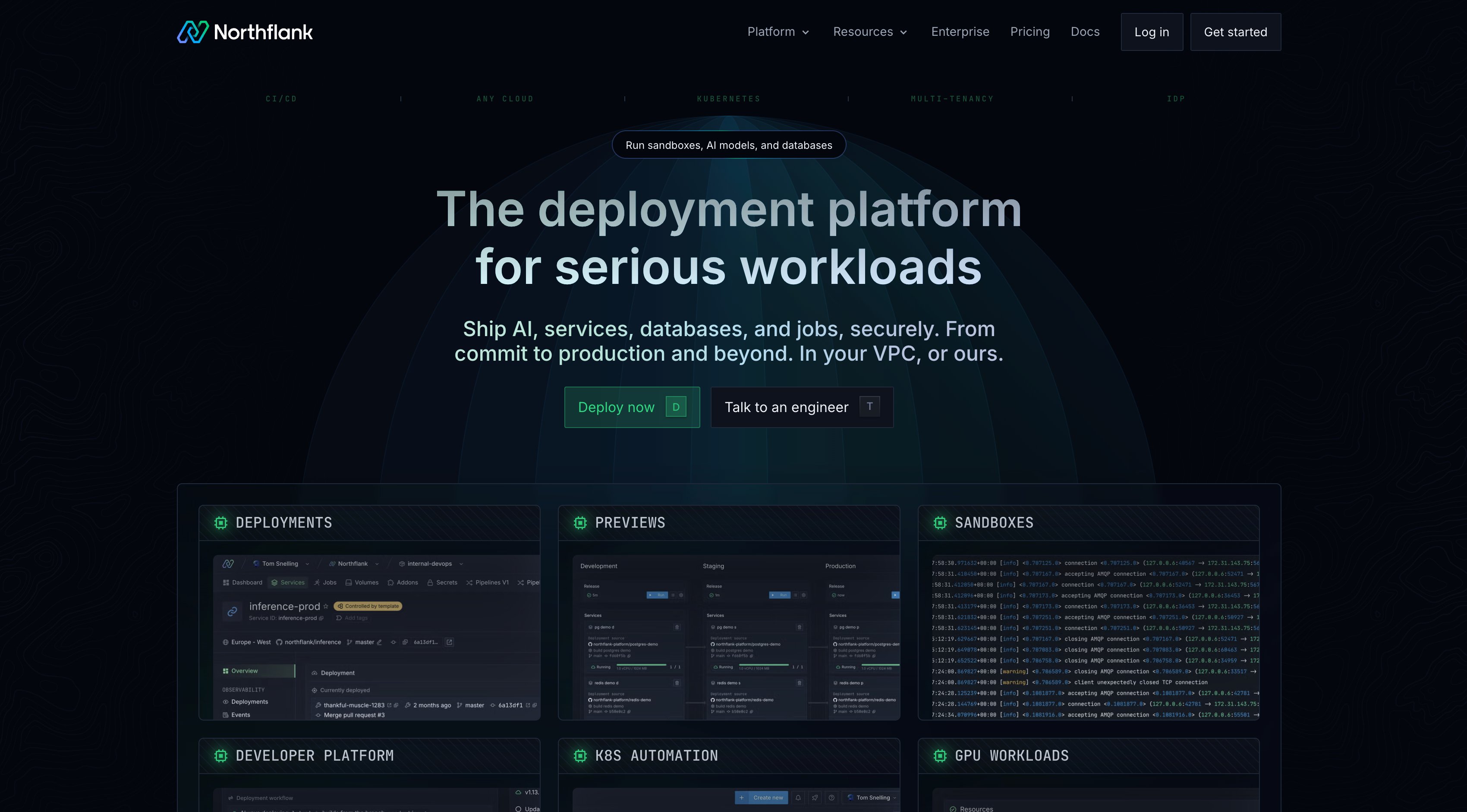
Remote coding sandboxes. AI coding agents run in microVM-backed environments using Kata Containers, Firecracker, and gVisor. Every execution gets its own dedicated kernel with network isolation, usage controls, tenancy boundaries across business units, and observability built in. Developers and agents get self-service access without the platform team becoming a bottleneck. No shared kernel. No cross-tenant bleed.
Preview environments for AI-generated PRs. The only way to know if an AI-generated change actually works is to run it end-to-end in a real environment. Preview environments spin up in seconds, fork databases, and cover multiple microservices simultaneously. They run on spot capacity and tear down automatically on merge, leaving no orphaned infrastructure. At 10x to 100x the PR volume AI coding generates, manual validation is not an option. Northflank makes it automatic.
Staging and production at scale. CI/CD pipelines, environment promotion, secrets management, and deployment guardrails move generated code from PR to production with full automation. The same control plane that runs agent sandboxes and preview environments handles staging and production deployments. There is no separate toolchain to build or maintain for each layer. Enterprises deploying existing and net-new workloads through AI coding tools can run all of it in production at scale in minutes, not months.
Enterprise platform controls. RBAC across organisation, project, and environment. SAML and OIDC SSO integrating with Okta, Entra ID, and Google Workspace. Audit logs exported to SIEM. Default-deny network policies. BYOC self-serve into AWS, GCP, Azure, Oracle, CoreWeave, Civo, on-premises, and bare-metal. Agent execution, preview environments, and production deployments all run inside your own VPC. SOC 2 Type 2 certified across managed cloud and BYOC deployments. Northflank is also HIPAA compliant and signs BAAs, so agents operating on codebases or datasets that touch PHI can run within the same compliance boundary.
Get started on Northflank (self-serve, no demo required). Or book a demo to walk through your enterprise AI coding agent deployment requirements.
Forrester's root-cause analysis of agent deployments with negative ROI at 12 months attributes failures to unclear success criteria (41%), insufficient tool or data access (33%), and drift in evaluation coverage (26%). None are model quality problems. The most common infrastructure gap is missing governance controls: SSO not configured, audit logs not connected to SIEM, PR gates not enforced, and no sandbox isolation for agent execution.
The AI coding tool handles agent logic, model inference, and code generation. Deployment infrastructure handles where the agent runs, who can access the environment, what network traffic is allowed, and whether all activity is logged. Tool selection and infrastructure are separate decisions. Most enterprise deployments fail because they treat them as the same decision.
Yes, for any agent that executes shell commands, installs packages, or makes network requests at runtime. Without sandbox isolation, a misconfigured agent can access the host system, other teams' environments, or sensitive data. MicroVM isolation with a dedicated kernel per agent workload enforces a hardware boundary around agent execution.
Deploy agents on infrastructure where code never leaves the enterprise's own VPC. BYOC deployment on Northflank runs agent execution inside the enterprise's own AWS, GCP, Azure, or on-premises infrastructure. The enterprise retains full data sovereignty. Code does not route through Northflank's managed infrastructure.
Every agent file access, shell command, PR creation, and API call should be logged with a timestamp and user identity and exported to the enterprise SIEM. Log retention must meet the compliance framework's requirements. For SOC 2 Type 2, auditors require demonstrable evidence that controls operated consistently across the audit period.
Enterprise AI coding agent deployment is an infrastructure problem as much as a tooling problem. The agents are capable. The governance and execution infrastructure is where most deployments stall. SSO, audit logging, PR gates, sandbox isolation, secret scanning, license governance, and incident response runbooks are not optional. They are the controls that determine whether a pilot becomes a production program or gets pulled at the next security review.
But governance alone is not enough. AI coding increases workload volume by 10x to 100x and changes who is contributing code across the organization. The platform underneath needs to absorb that demand. Northflank provides the off-the-shelf internal developer platform for AI-native software delivery: remote coding sandboxes, preview environments for AI-generated PRs, staging and production at scale, and enterprise platform controls, all in one control plane with self-serve BYOC into your own infrastructure.
Sign up for free on Northflank or book a demo to see how Northflank handles enterprise AI coding agent deployment infrastructure.
- Enterprise vibe coding: how to deploy AI-generated apps safely: Covers governance, security, and compliance controls for enterprise vibe coding at scale.
- Best enterprise-safe platforms for running and hosting AI apps in 2026: A comparison of platforms covering SOC 2, HIPAA, BYOC, sandbox isolation, and GPU support for enterprise AI app deployment.
- Best platforms for untrusted code execution in 2026: Isolation model selection, multi-tenant design, and network controls for platforms running AI-generated code.