
Enterprise AI remote coding environments in 2026
- An enterprise AI remote coding environment runs AI coding agents in cloud infrastructure rather than on developer machines, providing compute, isolation, network controls, and audit trails that local environments cannot.
- The shift from local to remote AI coding environments is driven by security risk, compliance requirements, and the compute demands of running multiple parallel agents.
- Enterprise requirements include sandbox isolation, RBAC, SSO, audit logging, BYOC for data residency, network controls, and GPU access for agents running local model inference.
- The landscape splits into two layers: the AI coding tools that handle agent logic and model inference, and the execution infrastructure that provides the isolation, governance, and compliance controls.
Northflank provides the execution infrastructure layer for enterprise AI remote coding environments: microVM sandbox isolation, self-serve BYOC into AWS, GCP, Azure, and on-premises, RBAC, audit logging, SSO, and GPU workloads in one control plane. Sign up to get started or book a demo.
AI coding agents have moved from developer tools to critical enterprise infrastructure. About 65 to 70 percent of enterprise code is now written by AI. The question enterprises are now asking is not whether to use AI coding agents but where they run, what they can access, and whether their activity is auditable and compliant.
Most AI coding tools default to local execution on developer machines. That model breaks at enterprise scale: no audit trail, no network controls, agents accessing sensitive infrastructure through unmanaged devices, and no path to data residency compliance. Remote coding environments solve this by running agent execution in governed cloud infrastructure instead.
A remote coding environment is a cloud-based workspace where development tasks run on remote infrastructure rather than a developer's local machine. For AI coding agents specifically, the remote environment is where the agent executes: running shell commands, reading and writing files, calling APIs, executing tests, and submitting pull requests.
This distinction matters at enterprise scale. When an AI agent runs locally, it has access to whatever the developer's machine can reach: credentials in environment files, internal network services, SSH keys, and other sensitive context. When it runs remotely, access is defined by the environment's configuration, network policies, and access controls, not the developer's local setup.
Most AI coding tools default to local execution. This model works for individual developers on trusted devices. It creates several problems at enterprise scale.
- Security and IP exposure: Local execution means proprietary source code, internal credentials, and sensitive business logic pass through the developer's machine and potentially through the AI provider's cloud infrastructure. Enterprises in financial services, healthcare, and government routinely block cloud-based AI coding tools because the data-sharing model is incompatible with their compliance posture.
- No audit trail: When an AI agent runs locally, the enterprise has no centralized record of what the agent accessed, what code it generated, or what commands it executed. SOC 2 Type 2 audits and security incident investigations require this visibility.
- Unmanaged compute: Running multiple parallel AI coding agents is compute-intensive. Developer laptops are not provisioned for this workload. Remote environments provide on-demand compute that scales with the number of agents running in parallel.
- No network controls: Local AI agents can make arbitrary outbound network requests. Remote environments apply default-deny egress policies, whitelist specific endpoints, and log all network activity.
- No environment standardization: Local developer environments drift over time. Remote coding environments are provisioned from a template, ensuring every agent runs in an identical, reproducible environment with defined dependencies, tooling versions, and access policies.
These are the controls that enterprise security and compliance teams require when AI coding agents run in production development workflows.
- Sandbox isolation: Each agent execution runs in an isolated environment with its own filesystem, network namespace, and process space. For multi-tenant deployments, microVM isolation with a dedicated kernel per workload is the right baseline.
- RBAC and access controls: Different teams, projects, and environments need different access levels. Developers should be able to provision agent environments without accessing other teams' codebases or infrastructure.
- Audit logging: Every agent action, every file access, every network request, and every code generation event should be logged with a timestamp and identity for SOC 2 Type 2 compliance and security incident investigation.
- SSO integration: Agents should authenticate through the same SAML or OIDC-based identity infrastructure as human developers.
- Network controls: Agents operate under defined policies covering which external endpoints they can reach, which internal services they can access, and what traffic is blocked by default.
- BYOC and data residency: Enterprises with data residency requirements need agent execution inside their own VPC, on-premises, or bare-metal. Code should never leave the enterprise's own infrastructure boundary.
- GPU access: Enterprises running local model inference alongside coding agents need GPU compute available in the same environment.
- Ephemeral and persistent environments: Some agent tasks run ephemerally and tear down on completion. Others maintain state across sessions for longer-running projects.
The landscape splits into two distinct layers: the AI coding tools that handle agent logic and model inference, and the execution infrastructure that provides isolation, governance, and compliance controls. Most enterprises need both.
Claude Code runs in cloud-based remote environments and supports background agent tasks that complete asynchronously. It handles complex multi-file changes, repository understanding, and long-horizon coding tasks. Enterprise deployment requires a separate infrastructure layer for compliance controls.
GitHub Copilot Workspace runs agent tasks in GitHub's cloud infrastructure, integrated directly with pull requests and GitHub Actions. It covers the full GitHub workflow natively, but execution happens on GitHub's managed infrastructure with no BYOC option.
Cursor provides IDE-native AI coding with Sandbox Mode for agent isolation and hooks for policy enforcement. SOC 2 Type 2 certified. Governance applies only within Cursor itself. Teams running Claude Code or other agents in parallel need a separate governance layer.
Mistral Vibe, launched in April 2026 with Medium 3.5, runs coding sessions asynchronously and in parallel in cloud environments. Agents can receive tasks via CLI, run multiple jobs simultaneously, and deliver results as pull requests. Integrates with GitHub, Jira, Slack, and Teams.
Coder provides self-hosted remote development environments using Terraform-provisioned workspaces. Supports air-gapped and on-premises deployments. Used by enterprises in finance, government, and defense. Focused on developer workspaces rather than agent execution infrastructure specifically.
The execution infrastructure layer is what makes AI coding agent environments enterprise-safe. It handles compute isolation, RBAC, audit logging, network policies, and data residency independently of which AI coding tool runs on top.
Northflank provides the execution infrastructure layer with production-grade enterprise controls. MicroVM sandbox isolation using Kata Containers with Cloud Hypervisor, Firecracker, and gVisor per workload. Self-serve BYOC into AWS, GCP, Azure, Oracle, CoreWeave, Civo, on-premises, and bare-metal. RBAC at the organisation, project, and environment level. SAML and OIDC-based SSO with automatic role assignment. Full audit logging is exportable for SIEM integration. GPU workloads (H100, H200, A100, L4, L40S, B200) alongside agent sandbox environments. SOC 2 Type 2 certified across managed cloud and BYOC deployments. No enterprise sales process required.
AI coding tools and execution infrastructure are not alternatives. They work in combination. An enterprise might run Claude Code agents inside Northflank-provisioned microVM sandbox environments, with BYOC deployment keeping all execution inside the enterprise's own AWS VPC, RBAC controlling which teams can provision agent environments, and audit logs exporting to the enterprise's SIEM.
The AI coding tool handles what the agent does. The execution infrastructure handles where it runs, who can access it, what it can reach, and whether the activity is logged.
| Layer | What it handles | Examples |
|---|---|---|
| AI coding tools | Agent logic, model inference, code generation, repository understanding | Claude Code, GitHub Copilot, Cursor, Mistral Vibe |
| Execution infrastructure | Compute isolation, RBAC, audit logging, network controls, BYOC, data residency | Northflank |
Northflank provides the execution infrastructure that enterprises need to run AI coding agents safely at scale. Connect a Git repository, provision an agent environment in minutes, and Northflank handles the microVM isolation, networking, secrets management, and observability. AI coding agents from any provider run inside isolated Firecracker or Kata Container microVMs with dedicated kernels, hardware-enforced boundaries between agent workloads, and no shared kernel state between tenants.
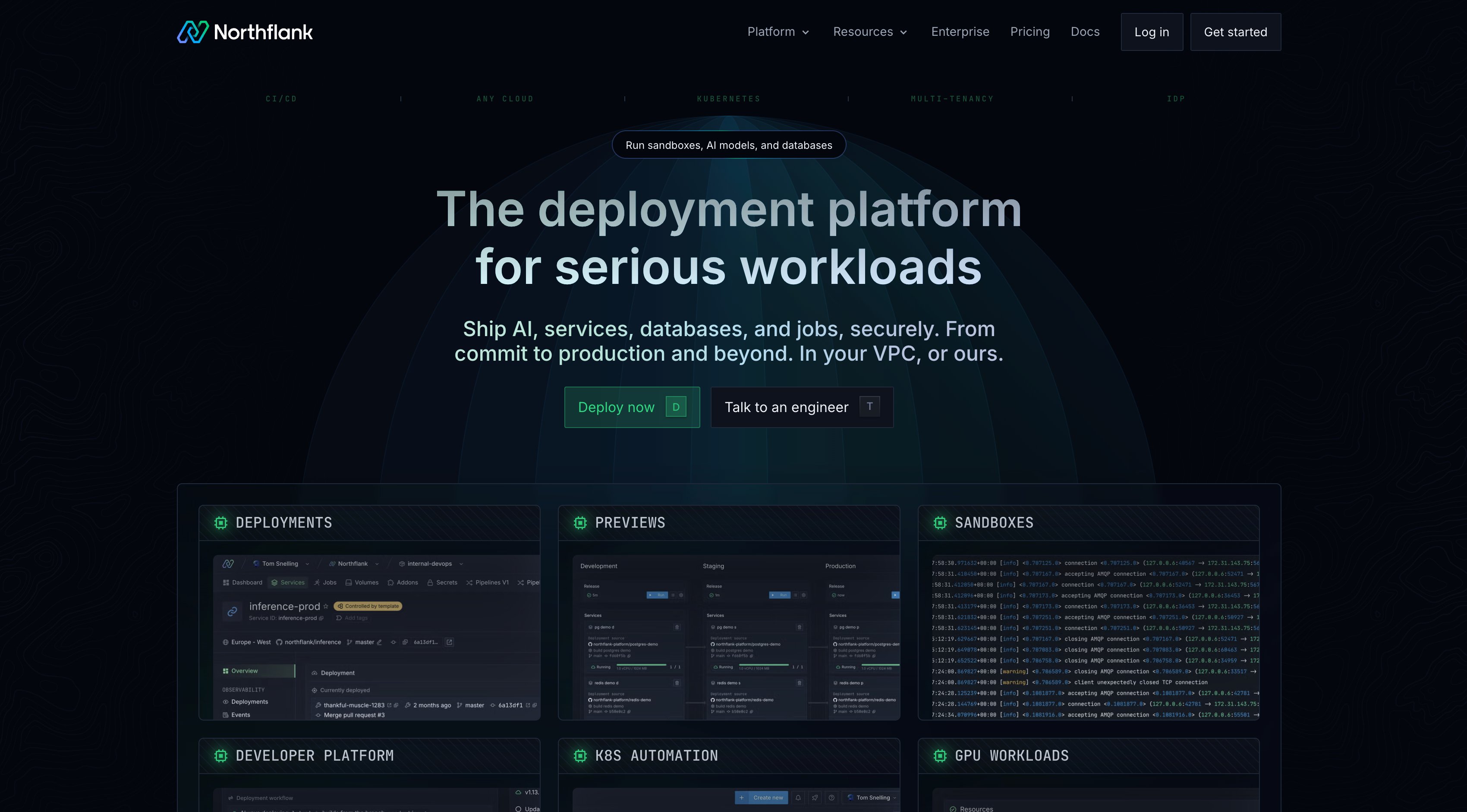
For enterprise teams with data residency requirements, BYOC is self-serve. Northflank deploys the platform into the enterprise's existing AWS, GCP, Azure, or on-premises infrastructure and manages orchestration and microVM lifecycle on the enterprise's hardware. Agent execution runs inside the enterprise's own VPC. Code never leaves the enterprise's own infrastructure boundary. The enterprise retains full data sovereignty without building the execution infrastructure themselves.
Get started on Northflank (self-serve, no demo required). Or book a demo to walk through your enterprise AI coding environment requirements.
A local AI coding environment runs agent execution on the developer's machine using local compute, local credentials, and local network access. A remote AI coding environment runs agent execution in cloud infrastructure with defined compute resources, network policies, access controls, and audit logging. Remote environments provide the governance and isolation controls that enterprise compliance frameworks require.
AI coding agents execute shell commands, install packages, read and write files, and make network requests at runtime. Without sandbox isolation, a misconfigured or compromised agent can access the host system, other tenants' environments, or sensitive infrastructure. MicroVM isolation gives each agent its own dedicated kernel, enforcing a hardware boundary around agent execution.
Yes, with the right infrastructure. Northflank supports air-gapped and on-premises deployments where agent execution has no dependency on any public cloud or internet connectivity. Agents need to be configured to use internally hosted models rather than cloud-based inference APIs.
Audit logging at the platform level captures every agent execution event, file access, network request, and environment change with a timestamp and user identity. Northflank's audit logs are exportable for SIEM integration. For SOC 2 Type 2 compliance, this provides the demonstrable audit trail that auditors require.
BYOC deploys Northflank's platform into the enterprise's existing AWS, GCP, Azure, or on-premises infrastructure, self-serve. Northflank manages orchestration and microVM lifecycle on the enterprise's infrastructure. Agent execution runs inside the enterprise's own VPC. Data never leaves the enterprise's own infrastructure boundary.
Enterprise AI remote coding environments require two layers working together: the AI coding tools that handle agent logic and model inference, and the execution infrastructure that provides isolation, governance, and compliance controls. Most enterprises have the tools. The infrastructure layer is where most deployments fall short.
Northflank provides that infrastructure layer out of the box with self-serve BYOC, microVM sandbox isolation, RBAC, audit logging, SSO, and GPU workloads in one control plane. AI coding agents from any provider run inside it with the enterprise compliance posture that regulated industries and security teams require.
Sign up for free on Northflank or book a demo to see how Northflank handles enterprise AI remote coding environment infrastructure.
- Enterprise vibe coding: how to deploy AI-generated apps safely: Covers the governance, security, and compliance controls required for enterprise vibe coding at scale.
- Best enterprise-safe platforms for running and hosting AI apps in 2026: A comparison of platforms covering SOC 2, HIPAA, BYOC, sandbox isolation, and GPU support for enterprise AI app deployment.
- Sandboxes on Kubernetes: isolation options and how to run them in production: Covers isolation options for AI agent workloads on Kubernetes, including Kata Containers and gVisor.
- What is sandbox infrastructure?: The full stack required to run isolated workloads safely at scale, covering isolation technology, orchestration, and lifecycle management.