
Best deployment platforms for vibe coders in 2026
Vibe coding tools have solved the code generation problem. You describe what you want, and Lovable, Bolt, Cursor, or Claude Code produces working application code in minutes. The problem most vibe coders hit next is deployment: where does this thing actually run, how do you connect it to a real database, and how do you keep credentials out of the code?
Some tools bundle hosting. Most do not. And the ones that do lock you into their infrastructure, which creates problems the moment you need more control, better pricing, or compliance requirements that their platform cannot meet.
Most vibe coding tools either bundle opinionated hosting or generate code you have to deploy yourself. The platforms below address the deployment gap: they take AI-generated code and provide the underlying infrastructure.
- Northflank – Full-stack deployment platform with managed databases, secrets injection, preview environments per pull request, CI/CD, Sandboxes, GPU workloads, and self-serve BYOC. The strongest option for vibe coders who need production-grade infrastructure without writing infrastructure code.
- Vercel – Frontend-focused deployment optimized for Next.js and React. Excellent DX for static and serverless apps. Limited for full-stack workloads with persistent services.
- Render – Simple cloud platform with managed Postgres and Redis. Good for straightforward web apps. Less suited for complex multi-service architectures.
- Railway – Template-based deployment with managed databases and usage-based pricing. Fast time to first deploy.
- Fly.io – Container-based deployment with global edge networking. More control but more configuration is required than the others.
Most vibe coders hit the deployment gap, not the code generation gap. Northflank closes that gap: managed databases, secrets injection, preview environments, sandboxes, and GPU workloads in one platform, without an infrastructure learning curve.
These are the dimensions that matter most when your project needs to move beyond a prototype.
- Managed databases. Your app needs somewhere to store data. A platform that provisions a managed Postgres, MySQL, or Redis instance and connects it to your app automatically removes the hardest part of full-stack deployment.
- Secrets management. API keys, database credentials, and environment variables should never live in your code. A deployment platform that manages secrets and injects them at runtime is a security baseline, not a premium feature.
- Preview environments. Every pull request should spin up an isolated copy of your app and tear it down on merge. This lets you test changes without touching production.
- CI/CD from Git. Push to a branch, and the platform builds and deploys automatically.
- Sandboxes. If your app executes AI-generated or user-submitted code, you need isolated execution environments with microVM isolation. Not every platform provides this.
- GPU workloads. If your app runs inference, fine-tuning, or any ML workload, the deployment platform should support GPUs in the same control plane as your services and databases.
- Managed or BYOC. Managed infrastructure is fine early. When compliance requirements emerge or costs need to be controlled, you need the option to run inside your own cloud account.
- Full-stack scope. Static sites and serverless functions are not enough for most apps. Background workers, scheduled jobs, long-running services, and managed databases should all be available in the same platform.
Northflank handles the full deployment stack for AI-generated code without requiring any infrastructure knowledge. Connect a Git repository, and Northflank detects the framework, builds the application, and deploys it with TLS, environment variables, and health checks configured automatically. Managed databases (PostgreSQL, MySQL, MongoDB, Redis, MinIO, RabbitMQ) provision in minutes and connect to the application via scoped credentials injected through secret groups. Credentials never appear in code or logs.
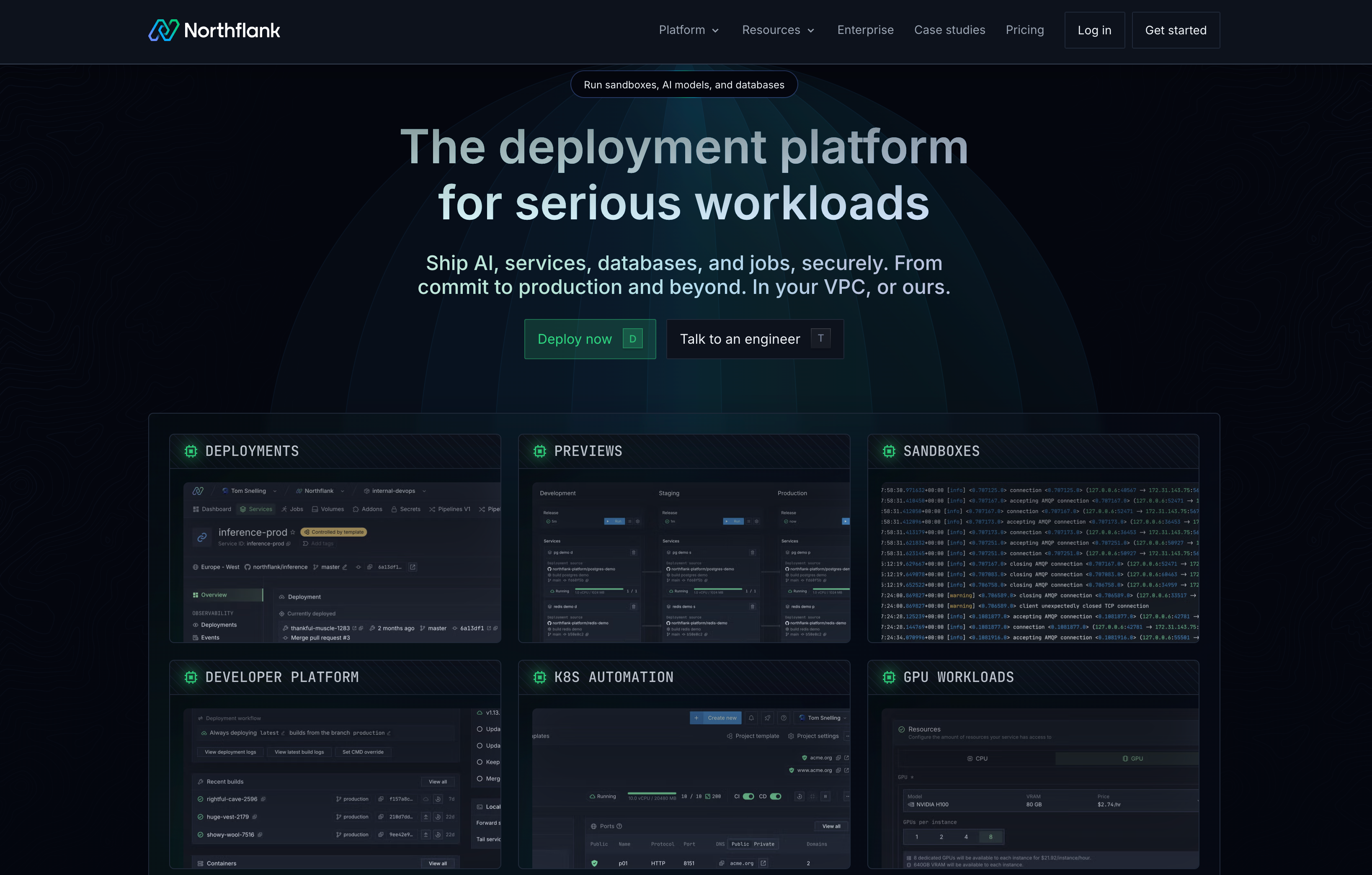
Preview environments spin up per pull request with isolated database instances and tear down automatically on merge. Background workers, scheduled jobs, and build pipelines run in the same control plane as the main application, so a vibe coder does not need a separate CI/CD tool, database provider, or secrets manager to ship a complete application. BYOC is self-serve into AWS, GCP, Azure, Oracle, CoreWeave, Civo, on-premises, or bare-metal for projects that grow into systems with compliance or data residency requirements.
Key features:
- Managed databases: PostgreSQL, MySQL, MongoDB, Redis, MinIO, RabbitMQ, and more. Scoped credentials are injected automatically.
- Secrets management: Secret groups inject environment variables at build and runtime. Never stored in code or exposed in logs.
- Preview environments: Isolated app and database instances per pull request, torn down on merge.
- CI/CD: Automatic builds on push. Build pipelines, release flows, and GitOps sync built in.
- Full-stack scope: Services, workers, cron jobs, databases, and GPU workloads in the same control plane.
- Sandboxes: Firecracker, Kata Containers, and gVisor microVM isolation for AI agent workloads and untrusted code execution.
- GPU workloads: H100, H200, B200, A100, L4, L40S, TPUs, and more, with all-inclusive pricing, running alongside your services in the same control plane.
- Managed or BYOC: Northflank's managed cloud or self-serve BYOC into AWS, GCP, Azure, Oracle, CoreWeave, Civo, on-premises, or bare-metal.
- SOC 2 Type 2 certified: Covers managed cloud and BYOC deployments.
Best for: Vibe coders who need production-grade deployment with managed databases, secrets management, and preview environments without writing infrastructure code. Projects that grow beyond prototypes into real production systems.
Pricing: Free tier includes two services, one database, and two cron jobs. Paid compute from $0.01667/vCPU-hour and $0.00833/GB-hour. See full pricing.
Get started on Northflank (self-serve, no demo required). Or book a demo with an engineer to walk through your deployment requirements.
Vercel is the standard deployment platform for Next.js and React frontends. Git integration handles CI/CD automatically, preview deployments spin up per pull request, and the edge network provides fast global delivery. The ceiling for vibe coders is backend scope: long-running services, background workers, and persistent databases require external providers. Managed Postgres was sunset in 2024 and is now handled through Marketplace integrations like Neon and Supabase.
Best for: Vibe coders building Next.js or React frontends and JAMstack applications where the backend is minimal or handled by external APIs.
Pricing: Free tier available. Pro from $20/month per user. Enterprise custom.
Render is a straightforward cloud platform with managed PostgreSQL, Redis, background workers, and static sites. Most frameworks deploy from a Git repository with minimal setup. The constraints appear at scale: pricing charges separately per service and database instance, which adds up faster than usage-based alternatives for multi-service applications. Preview environments are available on Professional plans and above.
Best for: Vibe coders building standard web applications with a single service and database, where simplicity matters more than infrastructure flexibility.
Pricing: Services from $7/month. Managed Postgres from $7/month. Free tier with limited hours.
Railway provides template-based deployment with managed PostgreSQL, MySQL, Redis, and MongoDB alongside resource-based pricing. Most stacks deploy in minutes with minimal configuration. Pricing is transparent but can become unpredictable for applications with variable traffic or multiple services. Preview environments exist but are less mature than on Northflank or Vercel.
Best for: Vibe coders who want the fastest path from code to a deployed application with a database.
Pricing: Hobby from $5/month plus resource usage. Pro from $20/month.
Fly.io deploys containerized applications globally using Firecracker microVMs and provides more control over the execution environment than the other platforms here. Any OCI-compliant container image deploys without modification. The tradeoff is configuration complexity: Fly.io requires familiarity with containerization concepts, and Fly Postgres is a self-managed cluster rather than a fully managed service.
Best for: Vibe coders comfortable with containerization who need geographic distribution or more infrastructure control than managed platforms provide.
Pricing: Free allowances included. Pay-per-second usage-based billing.
The decision comes down to how much backend complexity your application needs and how much infrastructure configuration you are willing to handle.
If your application is a Next.js or React frontend with minimal backend, Vercel is the right choice. If you need a service and a database with minimal configuration, Render or Railway get you there fast. If you need the full stack, managed databases, secrets management, preview environments, background workers, Sandboxes, GPUs, and the option to deploy into your own cloud account as your project grows, Northflank covers it without requiring you to learn infrastructure to get there.
| Platform | Managed databases | Secrets management | Preview environments | Sandboxes | GPU workloads | BYOC | Full-stack scope |
|---|---|---|---|---|---|---|---|
| Northflank | Yes (7+ types) | Yes, built-in | Yes, with isolated DBs | Yes (Firecracker, Kata, gVisor) | Yes | Yes, self-serve | Yes |
| Vercel | Via Marketplace (Neon, Supabase, others) | Environment variables | Yes | Yes | No | No | Frontend-focused |
| Render | Postgres, Redis | Environment variables | Yes | No | No | No | Yes |
| Railway | Postgres, MySQL, Redis, MongoDB | Environment variables | Yes | No | No | No | Yes |
| Fly.io | Self-managed Postgres cluster | Secrets via flyctl | Yes | Yes | No | No | Yes |
Built-in hosting from Lovable, Bolt, or Replit works for prototypes. The limitations appear when you need a real database with your own data, secrets management, environment separation, or pricing that does not lock you into the tool's infrastructure. A separate deployment platform gives you portability and production-grade controls regardless of which AI coding tool generated the code.
Cursor and Claude Code generate code to your local machine or repository. Push to a Git repository and connect it to a deployment platform. Northflank, Vercel, Render, and Railway all connect directly to Git repositories and deploy automatically on push.
Use a deployment platform that provisions managed database instances and injects credentials automatically. On Northflank you add a database addon, and the platform creates a scoped user and injects the connection string as an environment variable. No manual database setup or credential management required.
Store API keys and database passwords in your deployment platform's secrets store, not in your application code or repository. Northflank's secret groups inject environment variables at build and runtime. The credentials never appear in the codebase or build logs.
Yes, with Northflank BYOC. Connect your AWS, GCP, Azure, or other cloud account, and Northflank deploys and manages your applications inside your own infrastructure. This matters when projects move from prototypes to production systems with compliance or data residency requirements.
Vibe coding has removed the code generation barrier. The deployment barrier is what remains for most builders. Built-in hosting handles prototypes but falls short when applications need real databases, secrets management, environment isolation, and production-grade infrastructure.
Northflank removes the deployment barrier without replacing it with an infrastructure learning curve. Managed databases, secrets injection, preview environments, CI/CD, and BYOC deployment in one platform, configured by default, without writing infrastructure code.
You can get started for free on Northflank or talk to the team to deploy your first vibe-coded app.