
SST alternatives in 2026: What to use now that development has slowed
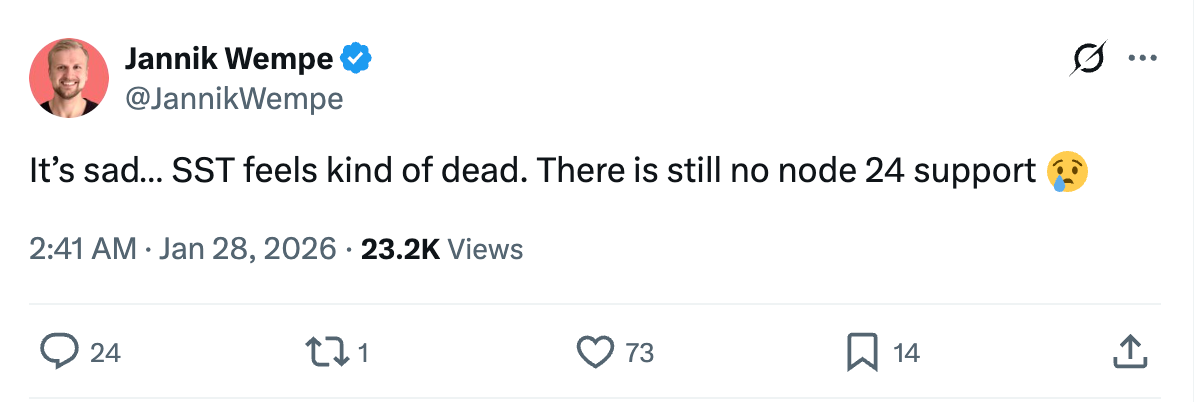
SST development slowed in 2025 after the team shifted focus to OpenCode, their AI coding agent. The framework still works but is in maintenance mode.
Northflank is the strongest SST alternative for most teams:
- Supports infrastructure-as-code through templates with bidirectional GitOps
- Deploys to any cloud (AWS, GCP, Azure) or your own infrastructure via BYOC
- Runs any workload type beyond just serverless
- Avoids vendor lock-in entirely
Other SST alternatives include Pulumi (IaC without SST's abstraction), Render (simpler, less flexible), and Railway (fast prototyping, limited for production).
SST (Serverless Stack) made AWS serverless development good. Live Lambda Development gave you sub-second feedback instead of CloudFormation waits. TypeScript configuration replaced YAML. High-level constructs handled the tedious coordination between Lambda, API Gateway, and DynamoDB.
In mid-2025, the SST team launched OpenCode, an AI coding agent that hit 650,000 monthly users within five months. SST's GitHub activity dropped and the organization restructured under Anomaly Co.
SST v3 works fine and will get maintenance updates, but active development has moved on. This matters because SST is an opinionated framework you buy into, and investing in a framework with uncertain development carries risk when SST alternatives exist.
If you're looking for an SST replacement, Northflank is the strongest option for most teams. It takes a different approach than SST. Instead of infrastructure-as-code abstractions over one cloud, it's a workload platform that handles infrastructure for you across any cloud provider.
The key differentiator that makes Northflank the top SST alternative is BYOC. You can run workloads in your own AWS, GCP, or Azure account while using Northflank's interface, CI/CD, and observability.
This means you:
- Keep full infrastructure ownership
- Use existing cloud credits and enterprise agreements
- Maintain data in your own network for compliance
- Avoid lock-in to any platform's infrastructure
You can also deploy to Northflank's managed cloud if you'd rather not deal with cloud accounts. Same platform experience either way.
SST was designed around AWS serverless primitives, particularly Lambda. While SST v3 added 150+ providers via Pulumi, the constructs stayed serverless-first.
Northflank doesn't care what you run or where. Containers, scheduled jobs, databases, background workers, GPU workloads. All deploy through the same interface to whichever cloud fits your needs.
This matters as applications outgrow what serverless handles well. Long-running processes, stateful workloads, and compute-heavy tasks often fit containers better than Lambda. Switching paradigms mid-project is painful when your infrastructure is tied to serverless-specific constructs. As an SST alternative, Northflank avoids this limitation entirely.
For teams migrating from SST who want the repeatability of infrastructure-as-code, Northflank offers a full template system.
You define your entire stack (services, jobs, databases, pipelines) as JSON templates. Edit them through a visual drag-and-drop interface or directly as code. Your choice.
Templates support bidirectional GitOps:
- Changes committed to your repo automatically update infrastructure on Northflank
- Changes made through the UI get committed back to your repo
- Git stays the single source of truth
You can make templates dynamic with variables and arguments, deploying the same stack across different environments, regions, or cloud providers. Northflank also provides pre-built stack templates for common setups like PostHog and GrowthBook.
- Preview environments spin up automatically per PR
- Deployments happen in seconds rather than CloudFormation minutes
- Logging and metrics built in
- Kubernetes abstracted without being hidden
You get production-grade orchestration without writing manifests.
| Capability | SST | Northflank |
|---|---|---|
| Cloud providers | AWS-first | AWS, GCP, Azure, or managed |
| BYOC | No | Yes |
| Workload types | Serverless-first | Any container workload |
| Infrastructure as code | TypeScript with Pulumi | JSON templates with GitOps |
| Development status | Maintenance mode | Active ($22M Series A) |
| Static IPs / Private networking | Via AWS VPC | Built-in |
SST v3 uses Pulumi under the hood. If you want infrastructure-as-code without SST's abstractions, using Pulumi directly makes sense as an SST alternative. More verbose, but full multi-cloud support and active development. Best for teams with infrastructure expertise.
Render is a managed platform focused on simplicity. Git-based deploys, managed databases, automatic SSL. No BYOC, limited networking control, pricing scales poorly. As an SST alternative, Render works best for small teams with straightforward apps who don't need SST's flexibility.
Railway is optimized for speed. Repo to deployed app in under a minute. Usage-based billing can surprise you, no BYOC, limited production features. Best as an SST alternative for prototypes and internal tools, not production workloads.
Great for frontend-heavy apps on Next.js, Remix, or Astro. Not true SST alternatives since they don't address backend infrastructure, but worth mentioning for frontend-focused teams.
Lambda functions can usually be containerized with minimal changes. The business logic stays the same; only the runtime wrapper changes.
SST-deployed databases can stay in place while Northflank services point at them. This enables incremental migration from SST rather than a risky cutover.
With BYOC, you can run Northflank in your existing AWS account alongside SST resources and migrate services one at a time.
You'll gain when switching from SST:
- Faster deploys
- Built-in observability
- Preview environments
- GitOps-based infrastructure management
- Active maintenance
You'll lose when leaving SST:
- Lambda's pay-per-invocation pricing (containers run continuously)
- Tight integration with AWS-specific services like EventBridge
- TypeScript infrastructure definitions
SST still makes sense if:
- Your current SST setup works and you're not planning changes
- Your architecture is specifically designed around Lambda
- Your team strongly prefers TypeScript for infrastructure
- You're using SST constructs without equivalents elsewhere
The framework won't stop working. No urgent need to find an SST alternative if your current setup meets your needs.
Is SST dead? Maintenance mode, not dead. SST works fine and gets critical updates, but active development shifted to OpenCode.
What is the best SST alternative? Northflank is the best SST alternative for most teams due to its BYOC support, multi-cloud deployment, and active development. Pulumi is better for teams wanting pure infrastructure-as-code.
Can Northflank run in my AWS account? Yes. BYOC lets you deploy to your own AWS, GCP, or Azure while using Northflank for management and CI/CD. You keep infrastructure ownership and existing cloud credits.
Does Northflank support infrastructure as code? Yes. Templates let you define your entire stack as JSON with bidirectional GitOps. Edit visually or as code.
How does Northflank pricing compare to SST? SST is free (you pay AWS). Northflank has platform fees but can reduce total cost through better utilization and built-in observability.
Should I migrate from SST? Only if you're hitting SST limitations or need features SST doesn't offer. If SST works for you, migration adds risk without clear benefit.
Does Northflank support serverless like SST? Northflank is container-based, so workloads run continuously rather than scaling to zero. No cold starts and simpler debugging, but if pay-per-invocation matters, keep Lambda for those specific workloads.
What's the difference between SST and Northflank? SST is an infrastructure-as-code framework focused on AWS serverless. Northflank is a multi-cloud workload platform with BYOC support. SST requires you to define infrastructure in TypeScript; Northflank manages infrastructure for you.