
What is an enterprise container platform?
An enterprise container platform runs containerized applications in production with the governance, security, and scale requirements large organizations need.
- Orchestration: Kubernetes underneath, with a platform layer that abstracts cluster management away from developers.
- Security: RBAC, SSO, default-deny networking, audit logging, secrets management, and sandbox isolation for untrusted workloads.
- Multi-cloud: BYOC into your own AWS, GCP, Azure, or on-premises infrastructure so workloads run inside your own network boundary.
- Scale: Handles order-of-magnitude increases in workload volume as AI coding tools push more people to ship more code.
- Full lifecycle: CI/CD pipelines, managed databases, preview environments, GPU workloads, and background jobs in one control plane.
Northflank is an enterprise container platform built for AI-native software delivery. Running untrusted code at scale since 2021. Self-serve BYOC into AWS, GCP, Azure, Oracle, CoreWeave, Civo, on-premises, and bare-metal. RBAC, SSO, audit logging, preview environments, managed databases, GPU workloads, and microVM sandbox isolation. SOC 2 Type 2 certified. Get started (self-serve) or book a demo.
An enterprise container platform is the infrastructure layer organizations use to deploy, run, scale, and govern containerized applications in production at enterprise scale. It combines container orchestration (Kubernetes), security controls, CI/CD, secrets management, observability, access controls, and multi-cloud deployment in a single platform built for the operational, compliance, and governance requirements that enterprise environments demand.
The distinction from a standard container platform is the combination of features, governance, and operational maturity required to run production workloads at scale.
Not every container platform is enterprise-grade. The following capabilities separate enterprise container platforms from standard ones.
- RBAC and access controls: Enterprise environments have multiple teams, business units, and compliance boundaries. Role-based access control at the organisation, project, and environment level ensures the right people have access to the right workloads and nothing more.
- SSO integration: Enterprise teams authenticate through centralized identity providers: Okta, Entra ID, and Google Workspace. An enterprise container platform integrates via SAML or OIDC, so user access is managed centrally, provisioned automatically, and revoked on offboarding.
- Audit logging: Every deployment, secret access, environment change, and user action must be logged with a timestamp and identity. SOC 2 Type 2 audits, HIPAA reviews, and security incident investigations all require this.
- Secrets management: Credentials must never appear in source code, environment files, or build logs. Enterprise container platforms provide a secrets layer that injects credentials at build and runtime, not stored in the application repository.
- Multi-tenancy and isolation: Multiple teams and workloads sharing the same platform need hard boundaries between them. For AI-generated or user-submitted code, microVM-level isolation (Kata Containers with Cloud Hypervisor, Firecracker, gVisor) provides a stronger boundary than standard container isolation.
- BYOC and data residency: Enterprises in regulated industries cannot route sensitive workloads through a vendor's shared infrastructure. BYOC (Bring Your Own Cloud) deploys the platform into the enterprise's own cloud account or on-premises. The vendor manages the control plane. The enterprise owns the data.
- Managed databases: Production applications need managed databases with automated backups, point-in-time recovery, and scoped credentials. An enterprise container platform provides this natively rather than requiring external database services.
- Preview environments: Every pull request should deploy an isolated environment for end-to-end testing before reaching production. At the PR volume AI coding tools generate, this must be automated and fast.
- Disaster recovery: Enterprise workloads require documented recovery point objectives and recovery time objectives, with automated backups and the ability to restore services and data from a known state.
The category breaks into three distinct types, each solving different problems.
- Self-managed enterprise Kubernetes distributions: Red Hat OpenShift, Rancher, and Mirantis Kubernetes Engine are complete enterprise Kubernetes distributions that enterprises deploy and manage themselves. They provide the full platform stack but require a dedicated platform engineering team to operate, upgrade, and maintain. High control, high operational overhead.
- Managed Kubernetes services: AWS EKS, Google GKE, and Azure AKS manage the Kubernetes control plane. The enterprise manages the data plane: nodes, networking, ingress, secrets, and application deployment tooling. Lower control plane overhead, but the application deployment layer still requires assembly.
- Full-stack managed enterprise container platforms. Northflank runs the complete platform, Kubernetes control plane, application deployment, managed databases, CI/CD, preview environments, and enterprise governance as a managed service. The enterprise gets enterprise-grade production infrastructure without operating the cluster or assembling the application layer themselves. Available as managed cloud or self-serve BYOC into the enterprise's own infrastructure.
| Type | Examples | Who manages the cluster | Application deployment | BYOC |
|---|---|---|---|---|
| Self-managed Kubernetes distribution | OpenShift, Rancher | Enterprise | Enterprise assembles | Yes (self-managed) |
| Managed Kubernetes service | EKS, GKE, AKS | Cloud provider | Enterprise assembles | Native |
| Full-stack managed platform | Northflank | Vendor | Built-in | Yes, self-serve |
AI coding tools have changed what enterprise container platforms need to handle. The shift is not gradual.
More enterprises are seeing non-engineers build internal tools with AI coding tools like Claude Code, Lovable, and Bolt alongside traditional engineering teams. That is untrusted code that needs to run securely at scale. The number of pull requests, deployments, and execution environments is increasing by an order of magnitude. Most enterprise container platforms were built for a world where a predictable number of engineers submitted a predictable number of deployments per day. That assumption no longer holds.
An enterprise container platform built for AI-native software delivery requires four things beyond the standard enterprise checklist: sandbox isolation for AI-generated and agent-executed code, preview environments that spin up at high volume automatically, self-service access for non-engineers who are now shipping software, and the scale to absorb significantly more workloads without the platform team becoming the bottleneck.
This is the problem Northflank was designed around: providing enterprise-grade deployment, governance, and isolation without requiring teams to assemble and operate the entire platform themselves.
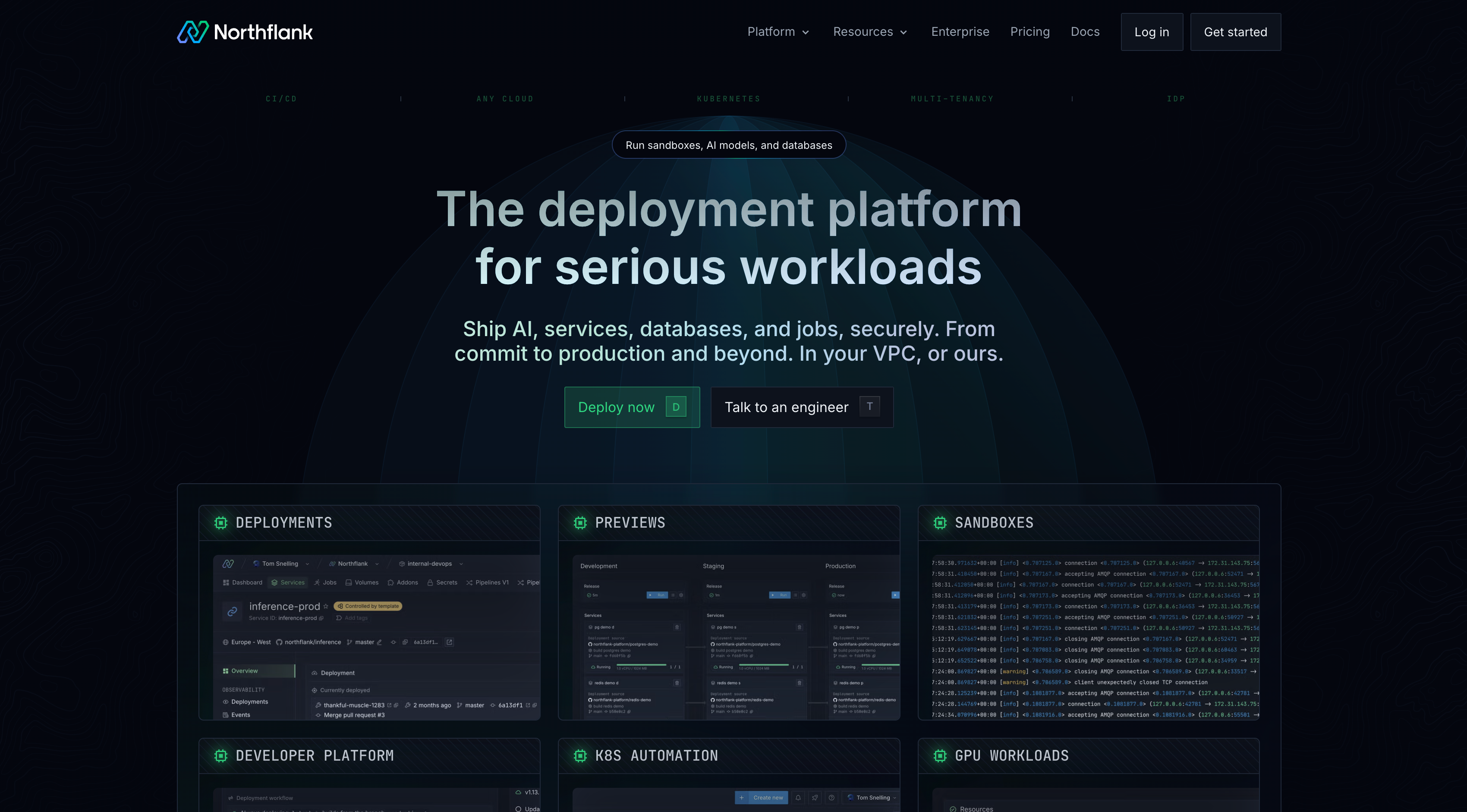
Northflank is an off-the-shelf enterprise container platform built for AI-native software delivery. It combines the governance capabilities enterprises require with the managed platform experience that eliminates the platform engineering overhead of running OpenShift, Rancher, or a self-assembled Kubernetes stack.
- Isolation and sandboxing: AI coding agents and user-submitted code run in microVM-backed sandbox environments using Kata Containers with Cloud Hypervisor, Firecracker, and gVisor. Each workload gets its own dedicated kernel. Network isolation, usage controls, tenancy boundaries across business units, and observability are built in.
- Preview environments at scale: Every pull request gets an isolated environment with forked databases, covering multiple microservices simultaneously. Environments spin up in seconds, run on spot capacity, and tear down on merge automatically. At the PR volumes AI coding tools generate, this is the only reliable way to validate changes before production.
- Full enterprise governance: RBAC at organisation, project, and environment level. SAML and OIDC SSO with Okta, Entra ID, and Google Workspace. Audit logs exported to SIEM. Default-deny network policies. Secrets management via secret groups with no credentials in code. SOC 2 Type 2 certified.
- BYOC for data residency: Self-serve BYOC into AWS, GCP, Azure, Oracle, CoreWeave, Civo, on-premises, and bare-metal. Workloads run inside the enterprise's own VPC. No markup on underlying compute. Available on all plans including free.
- Full deployment lifecycle: CI/CD pipelines from Git, managed databases (PostgreSQL, MySQL, MongoDB, Redis, MinIO, RabbitMQ), GPU workloads (H100, H200, A100, L4, L40S, B200), and background jobs all run from the same control plane.
Weights scaled to millions of users on Northflank without a dedicated DevOps team. Ultralight moved off AWS ECS to Northflank-managed Kubernetes and eliminated infrastructure management overhead entirely.
Get started on Northflank (self-serve) or book a demo to see how it compares for your enterprise container platform requirements.
Kubernetes is the orchestration layer, not a complete enterprise platform. Enterprise container platforms add security controls, CI/CD, observability, secrets management, access controls, and developer workflows on top of Kubernetes.
OpenShift is a self-managed enterprise Kubernetes distribution that enterprises deploy and operate themselves. It requires a dedicated platform engineering team to manage upgrades, configuration, and the operational surface of the full platform. Northflank is a fully managed enterprise container platform that eliminates the need to operate the cluster yourself. The same enterprise governance controls, RBAC, SSO, audit logging, BYOC, and SOC 2 Type 2, with the platform layer managed entirely by Northflank.
Not all of them. OpenShift and Rancher are self-managed, which means the enterprise runs the platform on their own infrastructure. Managed Kubernetes services (EKS, GKE, AKS) run in the cloud provider's infrastructure natively. Northflank provides self-serve BYOC into AWS, GCP, Azure, Oracle, CoreWeave, Civo, on-premises, and bare-metal, where the enterprise connects their cloud account and Northflank manages the platform on their infrastructure.
AI-generated code and autonomous agent execution introduce a stronger isolation requirement than traditional enterprise workloads. MicroVM-based isolation (Kata Containers, Firecracker, gVisor) provides a dedicated kernel per workload, preventing one execution from affecting adjacent workloads or the host system. Standard container isolation shares the host kernel and is not sufficient for multi-tenant AI code execution at enterprise scale.
SOC 2 Type 2 is the baseline for most enterprise environments. HIPAA BAA availability matters for healthcare. FedRAMP authorization matters for US government workloads. ISO 27001 is relevant for European enterprises. Northflank is SOC 2 Type 2 certified across managed cloud and BYOC deployments. Northflank is also HIPAA compliant, meeting the standards required to handle PHI, with BAAs supported under an Enterprise contract.
An enterprise container platform is the infrastructure layer that runs containerized applications in production with the governance, security, and scale requirements that regulated enterprises need. The category spans self-managed Kubernetes distributions like OpenShift, managed Kubernetes services like EKS and GKE, and full-stack managed platforms like Northflank.
Enterprise container platforms span self-managed Kubernetes distributions, managed Kubernetes services, and full-stack managed platforms. This creates a new set of requirements: higher automation, stronger isolation, and self-service workflows designed for a much larger set of builders. Northflank is built for this reality.
Get started on Northflank (self-serve) or book a demo to see how Northflank works as an enterprise container platform for your organization.
- What is OpenShift Container Platform?: OpenShift's architecture, components, deployment options, and how it compares to Kubernetes and Northflank.
- Top managed Kubernetes hosting platforms in 2026: How managed Kubernetes platforms compare on control plane, BYOC, sandbox isolation, and enterprise controls.
- What is an AI internal developer platform?: How AI coding tools are changing what enterprises need from their internal developer platform and why most DIY platforms cannot keep up.
- Best enterprise AI sandbox platforms in 2026: A comparison of enterprise sandbox platforms covering SOC 2, HIPAA, BYOC, and microVM isolation for AI workloads.