
Top enterprise coding agents in 2026
- Claude Code – Best for complex, long-horizon coding tasks with strong reasoning. Terminal-based, MCP-first, API, and CLI integration with enterprise platforms.
- OpenAI Codex – Gartner Magic Quadrant Leader. Best for multi-surface enterprise deployment with strong governance controls and broad IDE support.
- GitHub Copilot – Best for enterprise teams already on GitHub Enterprise. Deepest GitHub ecosystem integration, SSO, audit logs, seat-based licensing.
- Cursor – Best AI-native IDE for developers who prefer a visual editor. $2B ARR in February 2026. Cloud agents, parallel sub-agents, and enterprise audit features.
- Devin – Best for fully autonomous ticket execution. Accepts issues, plans multi-day work, and opens PRs with minimal human direction.
- Windsurf – Best for teams that want a Cascade agent built into the IDE with multi-model support.
The agents above generate the code. Northflank runs it. Preview environments per PR, microVM sandbox isolation for AI-generated code, BYOC into your own cloud, CI/CD pipelines, managed databases, GPU workloads, RBAC, SSO, and audit logging. The only platform equipped to run and deploy apps built by coding agents in the enterprise, at scale, securely. Get started (self-serve) or book a demo.
The tools enterprises use to write software have changed faster in the last two years than in the previous decade. AI coding agents now plan tasks, edit files across repositories, run tests, and submit pull requests with minimal human direction. For enterprise buyers, the question is no longer whether to adopt them but which ones meet the governance, security, and deployment requirements that regulated environments demand.
Many developer-focused coding tools started with individual developers and later expanded into enterprise controls. The enterprise filter for coding agents comes down to four requirements: SOC 2 Type II certification, SAML SSO, granular admin controls, and deployment options that keep code out of vendor training sets.
The enterprise evaluation checklist:
- Identity and access: SAML or OIDC SSO, SCIM provisioning, seat management, and the ability to revoke access on offboarding.
- Data handling: Zero-data-retention mode for sensitive repositories. Code must stay out of vendor model training by default, not as an opt-in setting buried in configuration.
- Audit logging: Every agent run, every file touched, every PR submitted must be logged with a timestamp and user identity.
- Sandboxed execution: Agent execution should happen in isolated environments, not on shared infrastructure where one agent run can affect another.
- Admin controls: Ability to restrict which models, features, and repositories agents can access. Policy enforcement at the team and organization level.
- Deployment flexibility: Cloud-only tools are off the table for some buyers in defense, healthcare, and finance. On-premises or air-gapped options matter.
Claude Code is Anthropic's terminal-based coding agent built around long-horizon, complex coding tasks. It operates via CLI, connects to GitHub repositories, and supports background agent tasks that complete asynchronously. It is the preferred choice for tasks requiring deep repository understanding, careful reasoning about side effects, and multi-file changes that need to hold together coherently. It integrates with Northflank's API and CLI so an agent can build and deploy end-to-end, and supports MCP as a first-class integration.
Best for: Engineering teams that need deep reasoning on complex, long-horizon coding tasks.
Pricing: Usage-based via Anthropic API. Claude Pro and Team plan for individual and team access.
OpenAI Codex was named a Leader in the Gartner Magic Quadrant for Enterprise AI Coding Agents in April 2026. It spans the Codex app, cloud delegation, an open-source CLI, IDE extensions, and connected ChatGPT workflows. With GPT-5.5, it has become the strongest overall choice for teams that need high code quality, multi-agent execution, background work, and human review in one system. Gartner highlighted its enterprise controls, including approval gates, RBAC, customizable policies, OS-level sandboxing, and auditable workspace governance.
Best for: Enterprise teams that need the broadest deployment surface (app, IDE, CLI, API) with strong governance controls.
Pricing: Usage-based on API token consumption. Enterprise pricing via sales.
Copilot is the most mature option in the category, with deep GitHub integration, enterprise compliance, and broad editor support. Copilot Workspace works directly from GitHub issues and pull requests, and the 2026 agent mode brings real multi-file editing and cloud tasks into the same product. For organizations already on GitHub Enterprise, it is the lowest-friction adoption path.
Best for: Enterprise teams already on GitHub Enterprise with established GitHub workflows and a preference for seat-based pricing over usage-based.
Pricing: Usage-based AI credits model as of June 1, 2026. Enterprise pricing via GitHub Enterprise agreement.
Cursor reached $2 billion ARR in February 2026 and is the market-leading AI-native IDE, the benchmark most developers use when evaluating other agents. Cloud Agents run in isolated VMs with parallel sub-agents handling discrete parts of a task simultaneously, and Cursor Blame (Enterprise) extends git blame to distinguish code from tab completions, agent runs, and human edits.
Best for: Engineering teams that want the best AI-native IDE experience and developers who prefer visual editing over terminal-based agents.
Pricing: Pro from $20/month. Enterprise pricing via sales.
Devin pushes furthest on the fully autonomous engineer axis. It accepts tickets, plans multi-day work, browses documentation, and opens PRs with minimal human handholding between assignment and review. The 2026 release added stronger code review behavior and tighter GitHub integration.
Best for: Engineering teams with a steady backlog of well-scoped tickets who want to delegate execution to an agent that runs to completion autonomously.
Pricing: Subscription per engineer-seat. Enterprise pricing via sales.
Windsurf is an AI-native IDE with over 1 million users that pairs local coding sessions with its Cascade agent for multi-step task execution. Cascade proposes a plan before touching code, executes changes across files, and supports multiple model providers including self-hosted models.
Best for: Teams that want a Cascade-style planning-and-execution agent built into the IDE with flexibility over which model backs the agent.
Pricing: Free tier available. Pro and enterprise tiers via sales.
If you built your app with one of these agents and are ready to deploy it to production, these step-by-step guides cover the full deployment workflow on Northflank:
- How to deploy apps built with Claude Code to production
- How to deploy apps built with Cursor to production
- How to deploy apps built with Replit Agent to production
- How to deploy apps built with Lovable to production
- How to deploy apps built with Bolt.new to production
- How to deploy apps built with v0 to production
Deploy directly from your coding agent. Northflank has a Skills package that works with Claude Code, OpenAI Codex, Gemini CLI, and Cursor. Install the skill and your coding agent can deploy services, manage databases, spin up preview environments, and interact with Northflank's API without leaving your agent workflow. See the Northflank skill on GitHub →
| Agent | Type | SOC 2 Type II | SSO | Audit logs | Sandboxed execution | MCP support | Air-gapped |
|---|---|---|---|---|---|---|---|
| Claude Code | Terminal / CLI | Yes | Enterprise | Yes | Yes | Yes | No |
| OpenAI Codex | App / CLI / IDE | Yes | Yes | Yes | Yes (OS-level) | Yes | No |
| GitHub Copilot | IDE / Cloud | Yes | Yes | Yes | Partial | Partial | No |
| Cursor | IDE / Cloud | Yes | Yes | Yes (Enterprise) | Yes (Cloud Agents) | Yes | No |
| Devin | Cloud | Yes | Yes | Yes | Yes | Partial | No |
| Windsurf | IDE / Cloud | Yes | Yes | Yes | Yes | Yes | No |
Most coding agent comparisons focus on the generation layer and spend less time on what happens after the code is written. Coding agents generate pull requests. Something has to run the code. At enterprise scale, that means preview environments per PR, so every agent-generated change can be validated end-to-end before it reaches production. It means microVM sandbox isolation so AI-generated code executes in hardware-isolated environments. It means BYOC so the code runs inside the enterprise's own VPC. It means CI/CD pipelines, managed databases, GPU workloads for model inference, RBAC, and audit logging across every service.
This is the deployment layer that enterprise coding agents assume exists but do not provide.
Northflank is a platform designed to run and deploy apps built by coding agents in enterprise environments, at scale and with security controls. It has been running untrusted code at scale by default since 2019. Claude Code and Codex work with Northflank's API and CLI so an agent can build and deploy end to end.
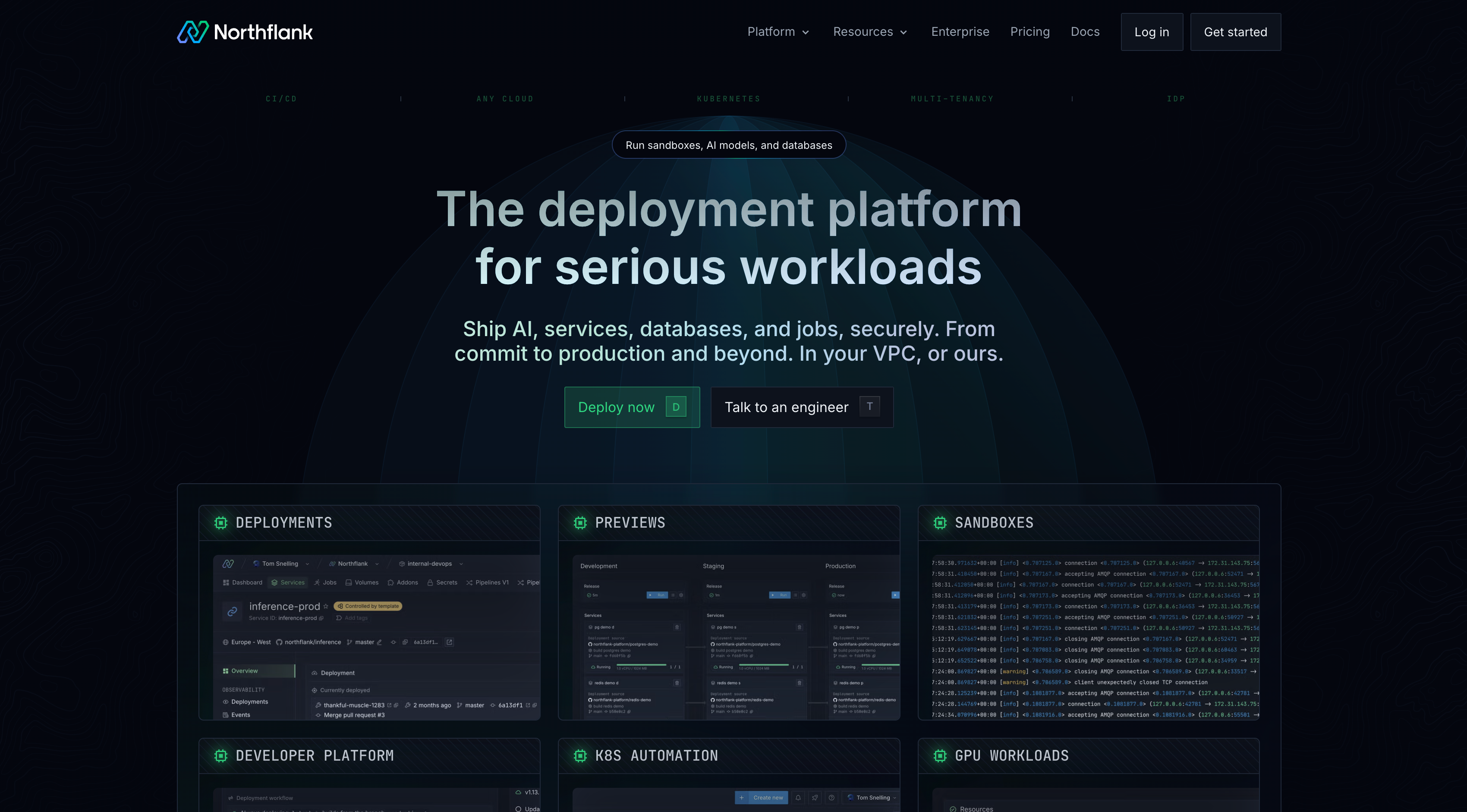
- Preview environments for AI-generated PRs: Every pull request gets an isolated environment with forked databases covering multiple microservices simultaneously. Environments spin up in seconds on spot capacity and tear down on merge. At the PR volume coding agents generate, this must be automated.
- Sandbox isolation for AI-generated code: Agent-generated code runs in microVM-backed environments using Kata Containers with Cloud Hypervisor, Firecracker, and gVisor. Each execution gets its own dedicated kernel. Network isolation, usage controls, tenancy boundaries across business units, and observability are built in.
- BYOC for data residency: Self-serve BYOC into AWS, GCP, Azure, Oracle, CoreWeave, Civo, on-premises, and bare-metal. Agent execution, preview environments, and production deployments all run inside the enterprise's own VPC. No markup on underlying compute.
- Enterprise platform controls: RBAC at organisation, project, and environment level. SAML and OIDC SSO with Okta, Entra ID, and Google Workspace. Audit logs exported to SIEM. Default-deny network policies. Secrets management with no credentials in code. SOC 2 Type 2 certified and HIPAA compliance so agent-generated code touching PHI can run under a signed BAA (Enterprise contract).
- Any scale, any workload, including GPUs: H100, H200, A100, L4, L40S, B200 alongside standard services in the same control plane for teams running local model inference alongside agent execution.
Get started on Northflank (self-serve) or book a demo to see how Northflank handles the deployment layer for your enterprise coding agent workflow.
An enterprise coding agent is an AI system that can autonomously plan, write, test, and submit code across a repository with minimal human direction, while meeting the governance, security, and compliance requirements large organizations need. The enterprise distinction means SOC 2 Type II certification, SAML SSO, audit logging, zero-data-retention options for sensitive repositories, and deployment flexibility for regulated industries.
Most enterprise tiers offer zero-data-retention modes where code is not used for model training. This is typically an enterprise plan feature, not a default. Verify the specific policy with each vendor and confirm it applies to your repository data, not just the prompt content.
Coding agents generate code but do not provide the infrastructure to run it. Enterprise deployments require preview environments per pull request for end-to-end validation, sandbox isolation for AI-generated code execution, CI/CD pipelines, managed databases, and BYOC for data residency. Northflank provides all of these as a managed platform that integrates with Claude Code, Codex, and other coding agents.
All major enterprise coding agents integrate with GitHub, GitLab, or Bitbucket for PR-based workflows. Most support MCP for connecting to external tools and data sources. Claude Code and Codex integrate with Northflank's API and CLI, allowing agents to deploy their output directly to production environments without manual intervention.
Regulated industries should prioritize zero-data-retention guarantees, air-gapped or on-premises deployment options, and compliance certifications beyond SOC 2 Type II (HIPAA, FedRAMP). Tabnine and self-hosted open-source agents like OpenHands offer the most flexible deployment models for organizations that cannot use cloud-only tools.
Enterprise coding agents handle the code generation layer. The deployment layer, where agent PRs get validated, where sandboxes isolate untrusted execution, and where BYOC keeps workloads inside the enterprise's own VPC, is a separate decision. Northflank provides that deployment layer for enterprises running these coding agents in production workflows.
- Enterprise AI coding agent deployment: How enterprises deploy AI coding agents safely in production with the governance controls that take pilots to production.
- Enterprise AI remote coding environments in 2026: The infrastructure layer for running AI coding agents in governed cloud environments rather than on developer machines.
- Best enterprise AI sandbox platforms in 2026: A comparison of enterprise sandbox platforms covering SOC 2, HIPAA, BYOC, and microVM isolation for AI agent execution.