
Top 7 Zeabur alternatives for deployment in 2026
Zeabur alternatives offer more infrastructure control and production-grade features for teams with specific requirements.
Zeabur provides quick, zero-config deployments, while alternatives like Northflank offer Kubernetes-powered infrastructure, multi-cloud flexibility with BYOC (Bring Your Own Cloud), enterprise compliance features, and support for both CPU and GPU workloads.
This guide compares platforms based on infrastructure control, observability, deployment flexibility, and production readiness.
-
Northflank – Production-grade Kubernetes platform with BYOC (Bring Your Own Cloud) support, built-in CI/CD, preview environments, GPU and CPU workload support, and enterprise infrastructure resilience.
Northflank gives you infrastructure control when needed while abstracting complexity through Kubernetes. Deploy to your own AWS, GCP, Azure, Civo, Oracle Cloud, neoclouds like CoreWeave, or bare-metal infrastructure, across 6+ cloud regions and 600 BYOC regions.
-
Railway – Platform with automatic builds (Railpack) and visual service management
-
Render – Managed platform with buildpack deployments and persistent infrastructure
-
Fly.io – Distributed VM platform with global edge deployment and Anycast routing
-
Vercel – Serverless platform for frontend applications with edge functions
-
DigitalOcean App Platform – Managed container platform integrated with DigitalOcean infrastructure
-
Heroku – Buildpack-based platform with dyno containers and add-on integrations
When evaluating deployment platforms, consider these key capabilities:
- Infrastructure control and flexibility - Look for platforms that let you deploy to your own cloud accounts (BYOC) or offer multi-cloud options. This matters when you need data residency control, want to avoid vendor lock-in, or have existing cloud commitments.
- Production-grade observability - Real-time logs, metrics dashboards, health checks, and alerting help you understand application behavior and catch issues before they impact users. Built-in observability reduces the need for additional monitoring tools.
- CI/CD and preview environments - Automated build and deployment pipelines integrated with Git repositories streamline development workflows. Preview environments for pull requests let teams test changes in isolated environments before production.
- Workload diversity support - If you're running or planning to run GPU workloads alongside standard services, choose platforms that support both CPU and GPU compute from a unified interface. This avoids operational complexity from managing separate platforms.
- Backup and recovery capabilities - Automated backups, point-in-time recovery, and disaster recovery features protect your data and reduce downtime when issues occur. These features become critical as your application scales.
- Team collaboration features - Role-based access controls, team management, and audit logs help larger teams work together while maintaining security. Fine-grained permissions control who can deploy, modify, or view resources.
- Infrastructure as Code support - The ability to define infrastructure in code, stored in Git alongside applications, enables reproducible deployments and version-controlled infrastructure changes.
We've evaluated the following platforms based on infrastructure control, production readiness, observability, deployment flexibility, and support for diverse workloads to help you find the right fit for your team's requirements.
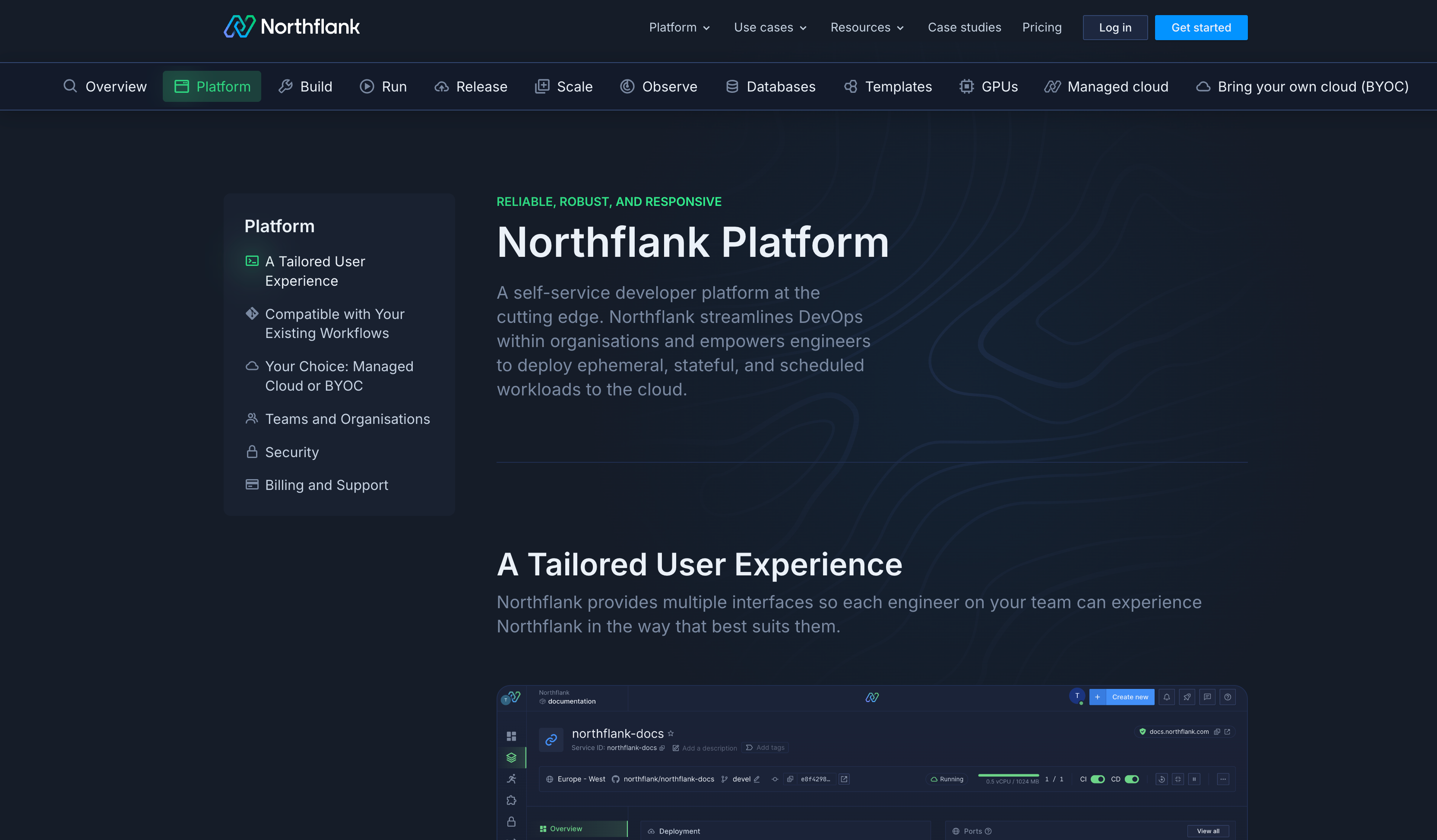
For teams needing production-grade infrastructure with Kubernetes power but without operational complexity, Northflank provides infrastructure control when you need it while abstracting the complexity away. The platform handles workloads from single containers to thousands of services across enterprise and high-scale AI infrastructure.
The key difference from Zeabur: Northflank doesn't hide infrastructure; it abstracts complexity while giving you control for production workloads. The platform supports both CPU and GPU workloads from a single interface, offers BYOC (Bring Your Own Cloud) deployment to your own cloud accounts, and runs on battle-tested Kubernetes foundations without requiring you to manage clusters directly.
Key feature
- Multi-cloud deployment across AWS, GCP, Azure, Civo, Oracle Cloud, or bare-metal with BYOC (Bring Your Own Cloud) support
- CPU and GPU workload support from a unified platform for web services, AI inference, and ML training
- Managed databases (PostgreSQL, MySQL, Redis, MongoDB, MinIO, RabbitMQ) with automated operations
- Built-in CI/CD pipelines with Git-based deployments and automated preview environments for pull requests
- Private networking, health checks, and multi-tenancy support
- Horizontal and vertical autoscaling with scheduled jobs, background workers, and cron tasks
- Real-time observability with logs, metrics dashboards, and configurable alerting
- Automated backups, point-in-time recovery, and disaster recovery capabilities
- Infrastructure as Code with JSON templates and comprehensive API
- Role-based access controls, team management, and audit logs for enterprise compliance
- Deploy in your own VPC with SOC 2 compliance, SSO, and 24/7 support options
Pricing
Sandbox tier
- Free resources to test workloads
- 2 free services, 2 free databases, 2 free cron jobs
- Always-on compute with no sleeping
Pay-as-you-go
- Per-second billing for compute (CPU and GPU), memory, and storage
- No seat-based pricing or commitments
- Deploy on Northflank's managed cloud (6+ regions) or bring your own cloud (600 BYOC regions across AWS, GCP, Azure, Civo)
- GPU pricing: NVIDIA A100 40GB at $1.42/hour, A100 80GB at $1.76/hour, H100 at $2.74/hour, H200 at $3.14/hour, B200 at $5.87/hour
- Bulk discounts available for larger commitments
Enterprise
- Custom requirements with SLAs and dedicated support
- Invoice-based billing with volume discounts
- Hybrid cloud deployment across AWS, GCP, Azure
- Run in your own VPC with managed control plane
- Secure runtime and on-prem deployments
- Audit logs, Global back-ups and HA/DR
- 24/7 support and FDE onboarding
Use the Northflank pricing calculator for exact cost estimates based on your specific requirements, and see the pricing page for more details
For teams wanting quick deployment with visual project management, Railway uses Railpack to automatically analyze source code and generate Docker images across multiple languages without Dockerfiles.

Key features:
- Visual project canvas showing services and relationships
- Automatic image generation from source code (GitHub, Docker images, or direct uploads)
- One-click database provisioning (PostgreSQL, MySQL, Redis, MongoDB) with automatic backups
- Built-in private networking between services
- Environment management with SSL certificates and public URLs
- Logs, metrics, and deployment history
For teams needing managed cloud infrastructure, Render supports web services, static sites, background workers, cron jobs, and databases through unified management.
Key features:
- Git-based deployments with automatic builds
- Managed PostgreSQL with daily backups, point-in-time recovery, and encryption
- Private networking for secure service communication
- Persistent disks for stateful applications
- Health checks with automatic instance restarts
- Metrics dashboards and log aggregation
For applications requiring global edge deployment, Fly.io runs lightweight VMs across worldwide data centers with traffic routing to the nearest location.

Key features:
- Edge deployment across multiple global regions
- CLI-centric workflows with fly.toml configuration files
- Persistent volumes for local storage across deployments
- Anycast networking for automatic traffic routing to closest machines
- Support for background tasks, scheduled jobs, and worker processes
- Machine autoscaling based on traffic patterns
For frontend applications and serverless deployments, Vercel focuses on Next.js projects with deployment to a global edge network.
Key features:
- Framework-defined infrastructure deriving components from application code
- Automatic preview deployments for pull requests with unique URLs
- Serverless functions with on-demand execution and automatic scaling
- Edge Functions running at global edge locations for minimal latency
- Intelligent caching, incremental builds, and Incremental Static Regeneration for Next.js
- Environment variable management across development, preview, and production
For teams within the DigitalOcean ecosystem, App Platform provides managed hosting with GitHub/GitLab integration.

Key features:
- Automatic language and framework detection
- Multiple service types (web services, workers, static sites, scheduled jobs)
- Managed databases with operations and backups handled by DigitalOcean
- Manual scaling configuration with automatic load balancing
- Private networking between services
- Basic metrics and log collection with alerting
For teams needing managed hosting through buildpacks, Heroku provides containerized dyno environments for web processes, workers, and scheduled tasks.

Key features:
- Buildpack system for automatic language and framework detection
- Extensive add-on ecosystem for databases, caching, monitoring, and other services
- Scaling through dashboard or CLI (horizontal and vertical)
- Multi-stage deployment pipelines with review apps for pull requests
- Git-based deployments with slug compilation
- Integration through environment variables
Use this comparison to identify which platform aligns with your infrastructure requirements, workload types, and deployment model preferences.
| Platform | Best for | Multi-cloud/BYOC | GPU support | Key strength |
|---|---|---|---|---|
| Northflank | Production workloads needing infrastructure control, teams running CPU and/or GPU workloads, enterprises requiring compliance | Yes (AWS, GCP, Azure, Civo, Oracle, bare-metal) | Yes | Kubernetes-powered infrastructure with full control, unified CPU/GPU platform |
| Railway | Quick prototyping with visual management | No | No | Visual project canvas |
| Render | Teams needing managed PostgreSQL and persistent storage | No | No | Managed PostgreSQL with point-in-time recovery |
| Fly.io | Global applications requiring edge deployment | No | No | Multi-region VM deployment with Anycast |
| Vercel | Frontend teams using Next.js | No | No | Serverless functions and edge optimization |
| DigitalOcean | Teams already using DigitalOcean services | No | No | DigitalOcean ecosystem integration |
| Heroku | Teams wanting extensive add-on marketplace | No | No | Mature platform with buildpack system |
When evaluating platforms, consider your infrastructure control needs, workload types (CPU vs GPU), production requirements (backups, observability, disaster recovery), and deployment model preferences (managed vs BYOC).
Teams moving from prototypes to production typically need platforms with operational maturity. If you require Kubernetes-level capabilities, multi-cloud deployment, or unified CPU/GPU management, platforms like Northflank provide that infrastructure control without requiring you to manage clusters directly.
Test representative workloads on shortlisted platforms to evaluate documentation, CI/CD integration, and deployment workflows before committing.
Start with Northflank's free Developer Sandbox or book a demo to discuss your infrastructure requirements.