
The best Container Orchestration Platforms in 2026
Container orchestration platforms form the backbone of modern infrastructure, handling container scheduling, networking, storage management, and system resilience as code evolves.
Northflank is a Modern Enterprise Container Platform that delivers enterprise-grade orchestration with simplified operations, focusing on software delivery and developer experience.
Northflank stands out by running on Kubernetes while exposing developer-friendly abstractions that eliminate complexity without sacrificing power. Teams get enterprise capabilities, multi-cloud deployment, BYOC, RBAC and other enterprise features, strong isolation, GitOps workflows, without the operational burden of traditional platforms.
In practice, a container orchestration platform standardizes how teams deploy, scale, and operate applications on Kubernetes.
Container orchestration platforms handle the critical infrastructure work that keeps modern applications running:
- Workload scheduling across infrastructure nodes
- Service discovery and networking between components
- Deployment management including rollouts, restarts, and failure recovery
- Dynamic scaling based on demand
- Configuration and secrets distribution
- Security boundaries and resource isolation
While Kubernetes powers most modern platforms, the differentiation lies in how platforms abstract complexity, enforce safety, and deliver operational efficiency.
When evaluating a Kubernetes orchestration platform or enterprise Kubernetes platform, teams consistently look for the following.
Operational simplicity: Reducing Kubernetes complexity without losing capabilities
Workload versatility: Supporting diverse application types within unified systems
Infrastructure control: Running inside your VPC or on-premises environments
Security enforcement: Implementing strong isolation and compliance boundaries
Developer productivity: Providing intuitive interfaces that accelerate delivery
Building directly on Kubernetes APIs gives flexibility but comes with significant tradeoffs.
Strengths:
- Complete control over Kubernetes primitives
- No vendor abstractions or limitations
Limitations:
- Substantial ongoing operational costs
- Multi-year development timelines for internal platforms
- Fragmented developer workflows across teams
- Low adoption rates due to complexity
Platforms like OpenShift, VMware Tanzu, AKS, and GKE package Kubernetes with governance layers and vendor-supported integrations for centralized operations.
Core capabilities:
- Certified Kubernetes distributions with vendor backing
- Comprehensive RBAC and policy enforcement
- Integrated networking and storage solutions
- Multi-cluster management capabilities
Tradeoffs:
- Complex installation and upgrade procedures
- Heavy operational requirements for day-two management
- Slower iteration cycles for product teams
- Focus on control over delivery speed
Northflank represents a new category: enterprise-grade orchestration designed around software delivery rather than infrastructure control. It represents a modern enterprise Kubernetes platform focused on software delivery rather than cluster administration.
Built on Kubernetes, Northflank abstracts complexity while preserving power. Instead of exposing raw Kubernetes resources, it provides higher-level primitives matching how teams actually deploy software.
Northflank supports all workload types through consistent primitives:
- Long-running services for APIs and web applications
- Background workers for asynchronous processing
- Scheduled jobs for cron-like operations
- Batch jobs for one-time processing
- Databases and stateful services with persistent storage
- GPU workloads for machine learning inference and training
All workloads share the same deployment model, networking configuration, and scaling behaviors. No separate systems to learn or manage.
Northflank handles the complete build-to-production workflow:
Build capabilities:
- Container builds from source code or prebuilt images
- Multi-stage builds with reproducible outputs
- Integrated build caching for faster iterations
Deployment features:
- Zero-downtime rollout strategies with health checks
- Git-based deployments for declarative infrastructure
- CLI and API support for automation
- Automatic rollback on deployment failures

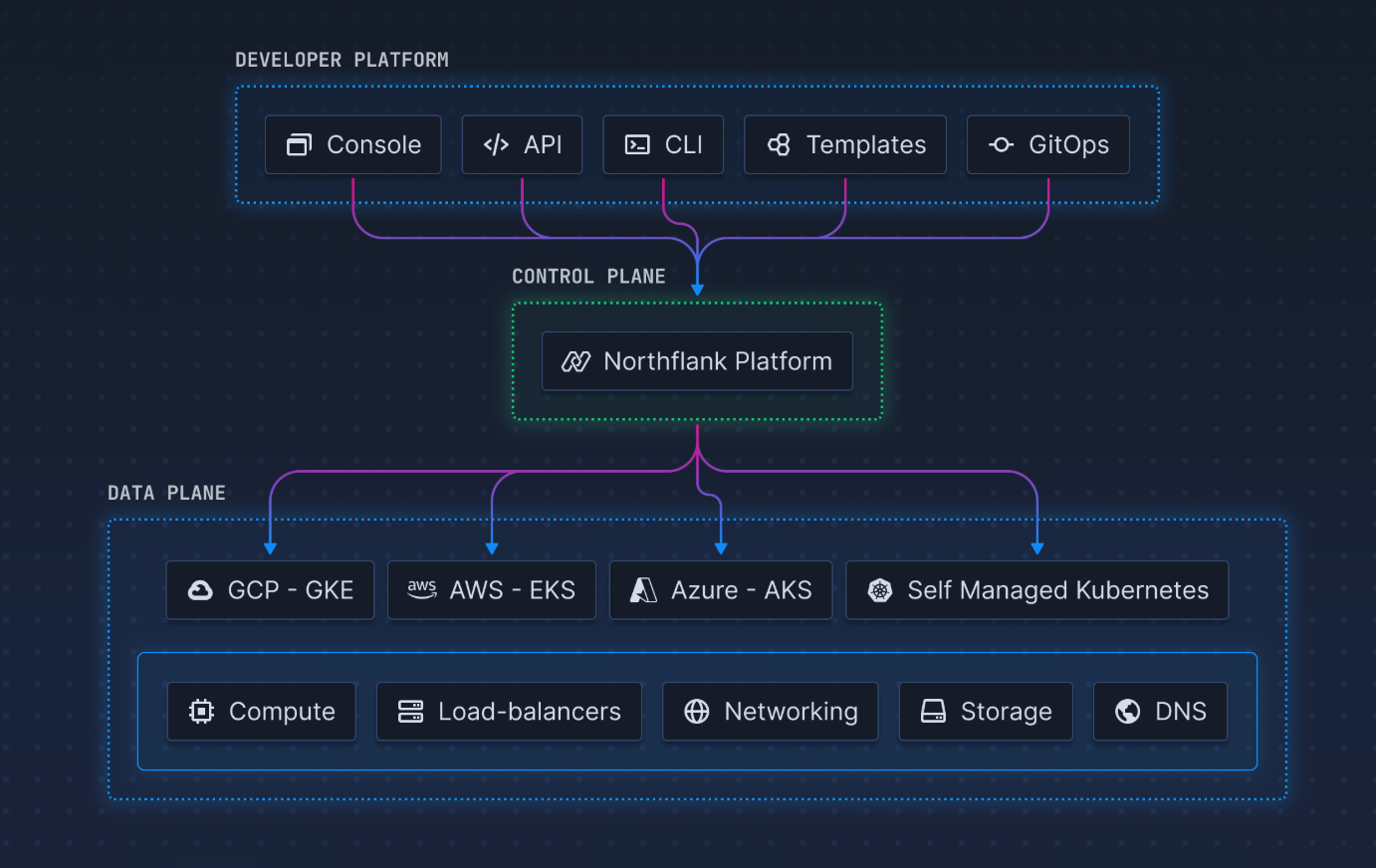
Northflank runs across diverse infrastructure environments:
Managed cloud regions:
- Fully managed platform-as-a-service option
- No infrastructure management required
Bring Your Own Cloud (BYOC):
- Google Cloud Platform: Google Kubernetes Engine (GKE). Docs here.
- Amazon Web Services: Elastic Kubernetes Service (EKS). Docs here.
- Microsoft Azure: Azure Kubernetes Service (AKS). Docs here.
- Civo: Civo Kubernetes. Docs here.
- Oracle Cloud Infrastructure: Oracle Kubernetes Engine (OKE). Docs here.
- CoreWeave: CoreWeave Kubernetes Service (CKS). Docs here.
- On-premises and bare-metal
This flexibility allows enterprises to maintain data boundaries and compliance requirements while adopting modern platform capabilities.
Environment management:
- Multi-cluster deployments across regions
- Environment-level isolation for staging and production
- Separate environments for internal systems
Northflank provides comprehensive networking without per-service YAML configuration:
- Automatic service discovery within clusters
- Internal networking between components
- Public ingress with automated TLS management
- Private networking across clusters
- Traffic routing and load balancing
- Support for high-throughput, low-latency requirements
Northflank includes operational tooling without requiring separate monitoring stacks:
- Centralized logging across all workloads
- Real-time metrics and performance monitoring
- Deployment history and runtime visibility
- Health check monitoring and failure alerts
- Complete audit trails for compliance
Modern workloads often require stronger isolation than standard containers provide.
Northflank delivers:
- Strong workload isolation for multi-tenant architectures
- MicroVM-based isolation for sensitive workloads
- Security boundaries for untrusted code execution
- Network segmentation and access controls
Northflank provides multiple interaction patterns without forcing a single workflow:
GitOps workflows:
- Automatic deployments from Git repositories
- Branch-based environment strategies
- Pull request preview environments
CLI tooling:
- Complete CLI for local development
- Scriptable automation for CI/CD pipelines
- Shell integration for common tasks
API-driven automation:
- Full REST API for programmatic control
- Webhook integrations for event-driven workflows
- Infrastructure-as-code compatibility
Web interface:
- Intuitive dashboard for visual management
- Real-time logs and metrics
- Quick debugging and troubleshooting
These interfaces are bidirectional and equal. A service deployed via Git behaves identically to one deployed via CLI or API. There are no second-class citizens.
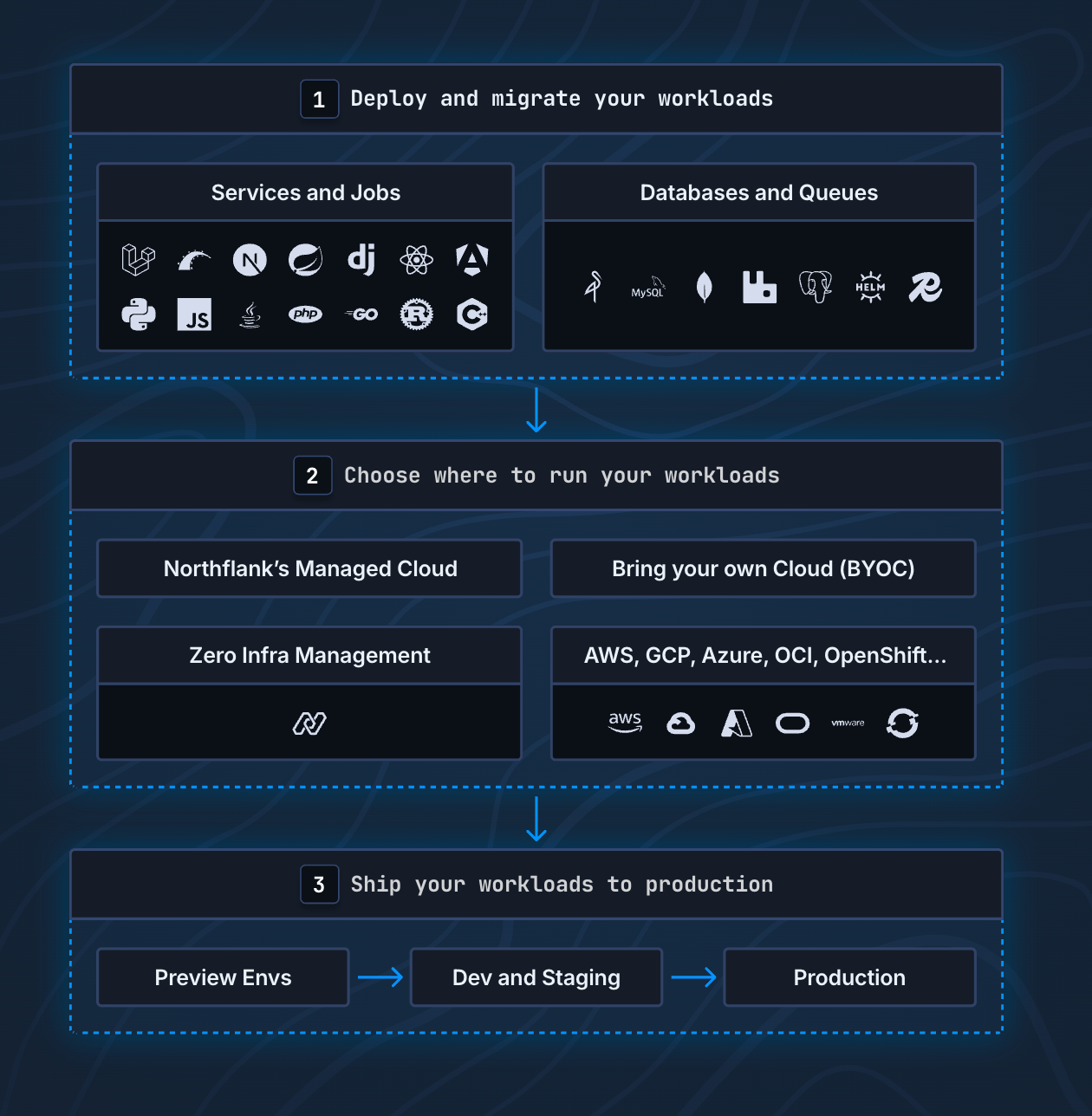
Unlike traditional PaaS platforms that hit scaling limits, Northflank sits directly on Kubernetes infrastructure. Teams avoid artificial constraints, runtime limitations, or forced platform migrations as systems mature.
The following tools are commonly evaluated as enterprise Kubernetes platforms or Kubernetes management platforms alongside Northflank.
VMware Tanzu targets enterprises deeply invested in VMware ecosystems.
Core features:
- Kubernetes distribution with VMware integration
- Centralized operations and governance
- On-premises optimization
- Long-lived cluster management
Considerations:
- Heavy operational requirements
- Developer workflows mediated by platform teams
- Better suited for VMware standardization than delivery optimization
OpenShift provides comprehensive enterprise Kubernetes with strong security emphasis.
Capabilities:
- Opinionated Kubernetes distribution
- Integrated CI/CD pipelines
- Built-in networking and security
- Robust RBAC and policy enforcement
Tradeoffs:
- Complex installation procedures
- Significant upgrade overhead
- Slower iteration for product teams
Rancher focuses on Kubernetes cluster management rather than complete application orchestration.
Strengths:
- Centralized multi-cluster visibility
- Governance across Kubernetes fleets
- Lighter weight than OpenShift
Limitations:
- Limited application-level abstractions
- Requires additional delivery tooling
- More cluster manager than full platform
Platform9 delivers managed Kubernetes with operational simplicity.
Offerings:
- Managed Kubernetes control planes
- Enterprise support and SLAs
- Simplified cluster operations
Considerations:
- Limited application layer opinions
- Developers still interact with raw Kubernetes
- Primarily operations-focused
Portainer provides lightweight management for Docker and Kubernetes environments.
Features:
- Simple UI for container visibility
- Easy adoption for small teams
- Basic cluster management
Limitations:
- Limited orchestration abstractions
- Not designed for complex workloads
- Functions more as visibility tool
Best for: Small teams needing container management UI without full platform requirements.
Porter offers open-source PaaS capabilities on Kubernetes.
Capabilities:
- Kubernetes-native abstractions
- Git-based deployment workflows
- Simple deployment model
Constraints:
- Limited enterprise features
- Self-hosting and maintenance required
- Scalability challenges at larger sizes
Container orchestration is essential at scale, but most platforms force difficult tradeoffs between power and usability. Northflank eliminates this choice.
Run across any infrastructure, managed regions, your own cloud accounts, or on-premises. Support any workload type through unified primitives. Enforce strong security boundaries. All without the operational burden of traditional platforms.
Teams deploy through Git, CLI, API, or UI, whichever fits their workflow. Sensible defaults accelerate initial delivery while override capabilities support sophisticated requirements.
Unlike PaaS platforms that hit scaling limits, Northflank runs on actual Kubernetes infrastructure. Avoid artificial constraints, runtime limitations, and forced platform migrations.
Start simple and add sophistication as needs evolve. No need to rebuild workflows or switch platforms as systems mature.
Organizations choosing Northflank typically seek enterprise-grade orchestration without dedicating teams to Kubernetes operations, or need sophisticated delivery capabilities their current platform can't provide.
Ready to see how Northflank handles your orchestration challenges?
Schedule a demo to discuss your requirements and explore how Northflank fits your infrastructure.
- Documentation: Complete guides for getting started
- Case Studies: How teams use Northflank in production