
Top self-hostable alternatives to Daytona for AI code execution
- Daytona is an open-source infrastructure for running AI-generated code in isolated sandbox environments
- Top self-hostable alternatives: Coder (enterprise Terraform-based CDEs), DevPod (client-only), Microsandbox (hardware isolation)
- Two deployment approaches: DIY open-source (maximum control, high complexity), BYOC platforms (managed orchestration in your infrastructure)
- Key decision factors: Operational capacity, isolation requirements, whether you want client-only tools or full platforms
Note: Northflank Sandboxes lets you run untrusted code at scale with microVMs, either on Northflank's infrastructure or in your VPC. For teams needing self-hosted control, Northflank offers BYOC deployment into your AWS, GCP, Azure, Civo, Oracle, CoreWeave, or on-premise infrastructure, handling orchestration, scaling, and microVM management. Alternatively, Northflank's managed PaaS provides instant deployment without any infrastructure setup.
Self-hostable alternatives to Daytona give you infrastructure control for running AI agent code execution while meeting compliance requirements and managing costs at scale.
This guide compares the top self-hostable options to help you choose based on operational complexity, isolation technology, and deployment model.
When your AI agents execute code, where that code runs determines your compliance posture, cost structure, and operational control. See the following:
- Data sovereignty and compliance requirements: Processing financial transactions, patient health records, or customer PII requires code execution within your own VPC. Third-party APIs introduce additional data processors into your compliance chain, complicating audits and potentially disqualifying you from enterprise contracts that mandate data residency. Northflank is SOC 2 Type 2 compliant and HIPAA compliant, and signs BAAs, so this requirement can be met on Northflank's BYOC without building a self-hosted stack from scratch.
- Cost predictability at scale: Managed services charge per execution or per compute minute. Running millions of code executions monthly makes per-unit costs accumulate quickly. Self-hosting lets you pay for underlying infrastructure directly with more predictable economics.
- Infrastructure control and customization: You need custom network policies, observability stack integration, or specific isolation technologies. Managed services don't offer the configuration flexibility your security policies require. Self-hosting gives you complete control over sandbox configuration.
- Air-gapped environments: Organizations with strict security requirements need to deploy in networks without external internet access. Self-hosted solutions can run in completely isolated environments.
Alternative approach: Platforms like Northflank offer BYOC deployment, which keeps data in your infrastructure while providing managed orchestration. This addresses self-hosting requirements without the operational complexity of managing sandbox infrastructure yourself.
When evaluating self-hostable Daytona alternatives, you're choosing between different tradeoffs in deployment complexity, operational requirements, isolation strength, and whether you need server infrastructure at all. Here are the top self-hostable options.
Coder is an open-source platform for self-hosted cloud development environments, used across industries including automotive, finance, government, and technology sectors.
Key characteristics:
- Terraform infrastructure-as-code for workspace provisioning
- Self-hosted on Docker, Kubernetes, or air-gapped deployments
- Governed workspaces and access controls for AI agents and developers
When to choose Coder: Need enterprise-grade infrastructure-as-code, use Terraform already, want to run both human developers and AI agents in the same platform.
When to consider alternatives: Want simpler deployment without Terraform complexity, prefer client-only tools, or don't need enterprise governance features.
DevPod is a client-only tool that creates reproducible development environments using the DevContainer standard.
Key characteristics:
- Client-only tool using the DevContainer standard
- Works with local Docker, Kubernetes, and major cloud providers
When to choose DevPod: Want client-only development environments, need flexibility to run locally or in multiple clouds, or prefer client-side tools over centralized platforms.
When to consider alternatives: Need centralized workspace management, require enterprise governance, or want managed orchestration.
Microsandbox is an open-source project providing secure execution of untrusted code using libkrun microVMs.
Important: Microsandbox is explicitly marked as experimental software by its developers. Expect breaking changes, missing features, and rough edges.
Key characteristics:
- libkrun microVM isolation with dedicated kernels
- OCI-compatible (runs standard container images)
When to choose Microsandbox: Security is your top priority, you have infrastructure engineering capacity, and you're comfortable working with experimental software.
When to consider alternatives: Need production-proven infrastructure with stability guarantees, enterprise support, or managed operations.
Northflank Sandboxes lets you run untrusted code at scale with microVMs. The platform offers two deployment options: managed PaaS for teams wanting zero infrastructure management, and BYOC for teams requiring self-hosted control with data in their own cloud.
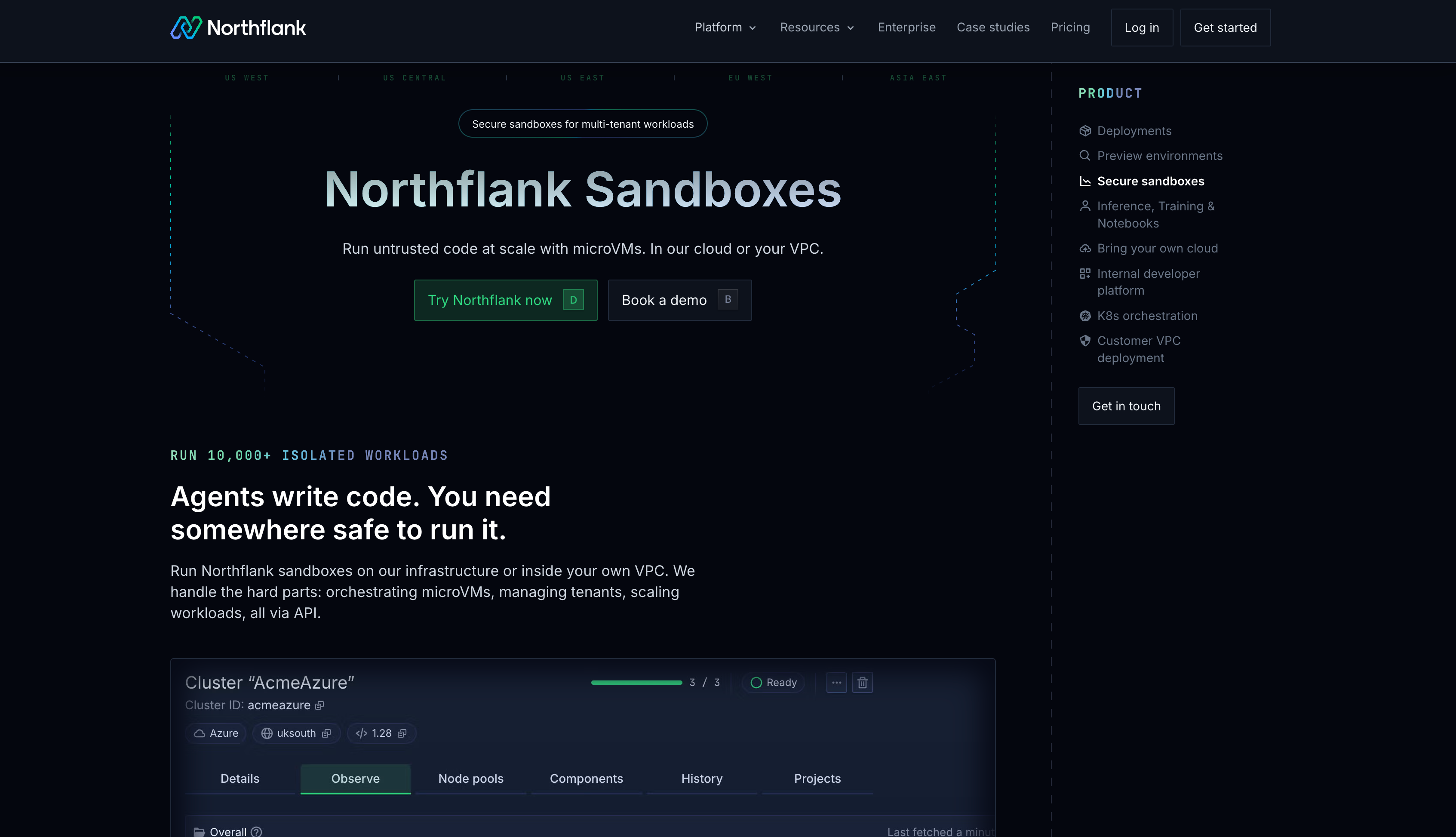
For self-hosting requirements, Northflank's BYOC option provides a different approach than traditional self-hostable alternatives. Rather than downloading software and managing it yourself, Northflank deploys into your infrastructure while handling orchestration, scaling, and operations.
What Northflank's BYOC deployment provides:
- Deployment flexibility: BYOC deployment to AWS, GCP, Azure, Civo, Oracle Cloud, CoreWeave, or on-premise infrastructure. Northflank manages the orchestration layer while workloads run in your cloud account. Most enterprise customers choose BYOC, and unlike many platforms where BYOC is not fully production-ready, Northflank's BYOC is self-serve and production-proven.
- Isolation technology: Kata Containers, Firecracker, or gVisor isolation depending on your workload requirements. All three provide stronger isolation than standard containers.
- Managed Kubernetes orchestration: Northflank handles cluster management, scaling, updates, and Day 2 operations. You get Kubernetes' power without operating it yourself.
- Production track record: Northflank has been in production since 2021 across startups, public companies, and government deployments.
- Enterprise observability: Built-in monitoring, logging, and debugging capabilities without building your own observability stack.
- Ephemeral and persistent environments: Short-lived execution pools or long-running stateful services, depending on your workflow needs.
When Northflank's BYOC fits your requirements:
Choose Northflank when you need self-hosted control (data stays in your infrastructure) but don't want to build and maintain sandbox orchestration yourself. This fits teams where compliance requires data in their VPC, but dedicating engineering resources to infrastructure management doesn't make business sense.
If you need faster deployment than building infrastructure from scratch, want production-grade microVM isolation without the operational burden, or your team focuses on application development rather than platform engineering, Northflank's BYOC model addresses these constraints.
Learn more about Northflank Sandboxes or read our guide on self-hosted AI sandboxes.
| If you need | Choose | Why |
|---|---|---|
| Enterprise CDE with AI agent support | Coder | Terraform-based provisioning, governance features |
| Client-only development environments | DevPod | Works with local Docker, Kubernetes, and major cloud providers |
| Secure execution of untrusted code | Microsandbox | Hardware-isolated microVMs with dedicated kernels (experimental) |
| Infrastructure control without operational burden | Northflank BYOC | Managed orchestration in your cloud account |
| Air-gapped deployment | Coder | Supports offline deployment in air-gapped environments |
| Both ephemeral and persistent environments | Northflank BYOC | Short-lived execution pools or long-running stateful services in one platform |
DevPod offers the simplest deployment as a client-only tool. Microsandbox provides simple installation with a CLI tool, but you'll build monitoring and operational tooling yourself. Coder requires more setup but provides enterprise features out of the box.
Microsandbox provides hardware-level microVM isolation with dedicated kernels per sandbox, preventing kernel-level exploits from affecting other sandboxes or the host. Northflank BYOC offers microVM-level isolation with Kata Containers, Firecracker, or gVisor depending on workload.
Coder supports AI agents with governed workspaces, access controls, and audit logging. Microsandbox is designed for secure AI code execution with its microVM isolation. DevPod provides development environments that can run AI workflows but doesn't have AI-specific features.
Self-hosting keeps data in your infrastructure, which helps meet compliance requirements like HIPAA, SOC2, and GDPR. You control data residency, security policies, and audit logging. With Northflank's BYOC deployment, data stays in your infrastructure while Northflank handles orchestration, helping you meet those requirements without the full operational burden of self-hosting. Northflank holds SOC 2 Type 2 certification, is HIPAA compliant, and signs BAAs for customers processing PHI.
Self-hosting means you deploy and manage the entire platform yourself. BYOC means the platform deploys into your infrastructure but the vendor manages orchestration and operations. Self-hosting gives maximum control but requires operational expertise. BYOC provides infrastructure control with managed complexity.
For more on sandbox security and compliance, see our guide on how to sandbox AI agents.
Self-hostable alternatives to Daytona give you infrastructure control, data sovereignty, and deployment flexibility for running AI agent code execution.
Your choice depends on operational capacity, isolation requirements, and whether you want client-only tools or full platforms.
For teams wanting self-hosted control without infrastructure burden, Northflank offers BYOC deployment into your AWS, GCP, Azure, Civo, Oracle, CoreWeave, or on-premise infrastructure with production-ready microVM isolation and managed orchestration. Get started with Northflank Sandboxes or see more alternatives to Daytona based on your requirements.