
What is an AI internal developer platform (IDP)?
- An internal developer platform gives developers self-service access to deployment, environments, databases, secrets, and observability without depending on a platform engineering team.
- An AI IDP extends this for AI-assisted software creation: more builders (engineers and non-engineers), more deployments (AI-generated PRs at high volume), and stronger isolation requirements (untrusted code executed by agents).
- Most DIY IDPs were built for a different volume and a different threat model. As AI coding tools increase development activity by an order of magnitude, those platforms become the bottleneck.
- Northflank combines the capabilities enterprises typically assemble when building an internal developer platform: deployment workflows, sandboxed execution, environment management, governance, and cloud flexibility, in one off-the-shelf platform built for AI-native software delivery.
Northflank has operated isolated execution environments and multi-tenant infrastructure since 2021, before AI coding agents made this a mainstream requirement. BYOC into your own cloud or on-premises. Preview environments per PR. RBAC, SSO, secrets, and disaster recovery out of the box. Any scale, any workload, including GPUs. Get started (self-serve) or book a demo.
An internal developer platform (IDP) is the infrastructure layer that sits between developers and the cloud: it provides self-service deployment, CI/CD pipelines, environment management, secrets handling, access controls, and observability so developers can ship software without depending on a platform engineering team for every deployment.
Many enterprises have built some form of internal developer platform over time, stitching together Kubernetes, Terraform, ArgoCD, Vault, and internal tooling. It worked when a predictable number of engineers submitted a predictable number of pull requests per day. AI coding tools changed both variables simultaneously.
An AI IDP is not a replacement category for internal developer platforms. It is the next evolution of an IDP designed around AI-assisted software creation, where the number of builders, deployments, and execution environments increases dramatically.
An IDP gives developers a self-service interface to do everything they would otherwise need a platform engineer for:
- Deploy services from a Git repository without writing Kubernetes manifests
- Provision databases with scoped credentials injected automatically
- Manage secrets without credentials in source code or environment files
- Create preview environments per pull request for end-to-end testing before merge
- Promote builds through staging and production with defined pipelines and guardrails
- Monitor services with logs, metrics, and alerting without configuring a separate observability stack
- Enforce access controls so different teams and business units only see and touch what they should
A well-built IDP means developers ship without filing tickets with a platform team. Platform engineers build infrastructure once and expose it as a service. Software delivery is not constrained by a central team.
| Dimension | Traditional IDP | AI IDP |
|---|---|---|
| Primary users | Engineers | Engineers, non-engineers, and agents |
| Workload volume | Predictable | Highly variable, order-of-magnitude increases |
| Code origin | Human-authored | Human and AI-generated |
| Execution model | Human-triggered deploys | Agent-assisted and autonomous |
| Security model | Trusted developers | Untrusted generated code requiring isolation |
| Environments | Team and service based | Per-agent, per-PR, ephemeral |
| Interface | Developer portal | Self-service for technical and non-technical users |
| Scale requirement | Sized for engineering team | Sized for organization-wide contribution |
The IDPs many enterprises built were designed for a specific set of assumptions: a dedicated engineering team, a manageable number of services, and a deployment cadence that a small platform team could govern.
AI coding tools put pressure on all three assumptions at once.
- The volume problem: When engineers ship faster with AI assistance, and when non-engineers across finance, HR, legal, and operations build and ship internal tools with vibe coding tools, the number of pull requests, deployments, and environments increases by an order of magnitude. An IDP built for 20 engineers submitting 50 PRs a day was not sized for 200 people generating 10x to 100x that volume. The platform team becomes a bottleneck. Deployments slow. Engineers route around the platform rather than through it.
- The security problem: AI-generated code is untrusted code. It needs to run in isolated execution environments with defined network controls, not in shared infrastructure where one misconfigured deployment can affect adjacent workloads. Most DIY IDPs were not built with microVM isolation, default-deny networking, or the audit trail that security teams require when agents are generating and committing code autonomously.
- The DX problem: Non-engineers shipping software with AI coding tools need an interface they can use without Kubernetes knowledge. A YAML-heavy IDP with a steep learning curve is not that interface. An AI IDP needs to be self-service for people who have never configured a container.
Four capabilities distinguish an AI IDP from a traditional internal developer platform.
- Scale without platform team involvement: An AI IDP provisions environments in seconds. It handles high volumes of simultaneous deployments without degrading. Preview environments spin up per pull request and tear down on merge, automatically, at the volume AI-generated code creates. The infrastructure absorbs demand without the platform team as a manual control point.
- Isolation for untrusted code execution: AI-generated code and autonomous agents introduce a stronger isolation requirement than many traditional IDPs were designed for. Kata Containers and Firecracker run each workload in a lightweight VM with a dedicated kernel. gVisor intercepts system calls in user space without full hardware virtualization. All three provide a meaningfully stronger boundary than standard container isolation for untrusted code.
- Self-service for non-engineers: An AI IDP exposes deployment, environment management, and observability through interfaces that non-technical users can operate. Non-engineers building internal tools with AI coding tools should be able to deploy their output without opening a ticket or waiting for a platform engineer.
- Enterprise controls at every layer: RBAC at the organisation, project, and environment level. SAML and OIDC SSO. Audit logging for every deployment, secret access, and environment change. Secrets management with no credentials in source code. Disaster recovery. Network policies. These are not optional when AI-generated code is part of the software delivery pipeline and when non-engineers are deploying to production.
Building an IDP capable of handling AI-scale workloads, isolation for untrusted code, and self-service access for non-engineers is a significantly larger project than building a traditional IDP. Most enterprise platform teams are being asked to absorb order-of-magnitude increases in workload volume at the same time they are asked to solve security problems the original platform was not designed for.
For many teams, the build-vs-buy decision has shifted. An off-the-shelf AI IDP that covers the full feature set and is production-ready on day one is faster, lower risk, and often cheaper in total engineering hours than rebuilding the same capabilities internally.
Northflank is the off-the-shelf internal developer platform built for AI-native software delivery. It is what most enterprises would build if they started their IDP project today with AI coding tools as the primary driver.
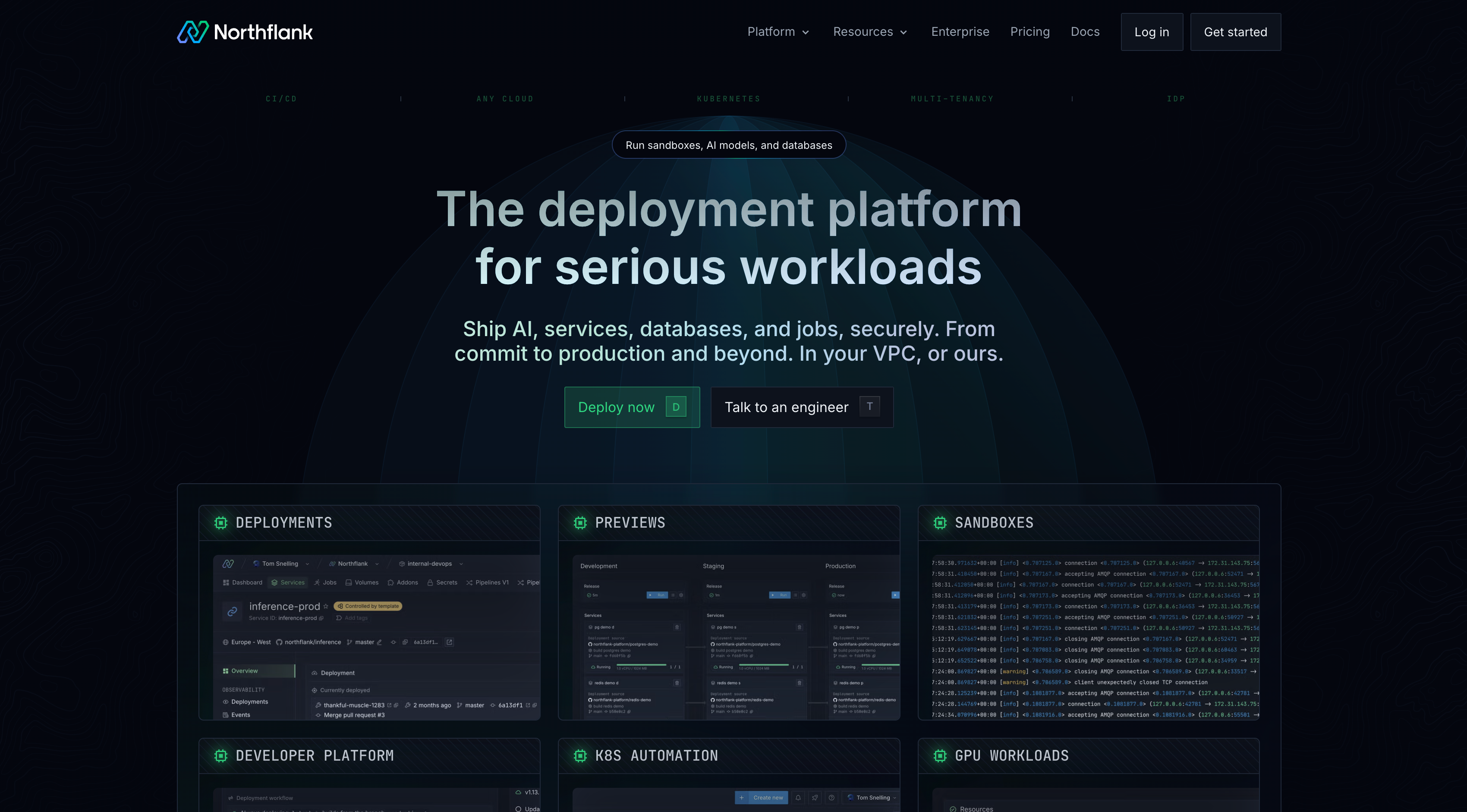
Northflank has been running untrusted code at scale by default since 2021. Many of the capabilities enterprises now look for in AI sandbox environments have existed in Northflank's platform for years. Claude Code and Codex work with Northflank's API and CLI, so an agent can build and deploy end-to-end. Non-developers can use the UI. Platform teams get enterprise controls without building them.
What Northflank provides as an AI IDP:
- Remote coding sandboxes: AI coding agents run in isolated environments using Kata Containers with Cloud Hypervisor, Firecracker, or gVisor, with network isolation, usage controls, tenancy boundaries across business units, and observability built in.
- Preview environments per PR: fast, ephemeral, production-like environments that fork databases, cover multiple microservices simultaneously, and run on spot capacity. One of the most effective ways to validate AI-generated code before it reaches production.
- Staging and production at scale: CI/CD pipelines, environment promotion, secrets management, and deployment guardrails that handle 10x to 100x the workload volume without the platform team as a bottleneck
- Enterprise controls out of the box: RBAC, SSO, secrets, disaster recovery, audit logging, and default-deny networking without configuration
- BYOC: the code runs inside the customer's own cloud account, on-premises, or bare-metal. Self-serve into AWS, GCP, Azure, Oracle, CoreWeave, Civo, and more. No markup on underlying compute
- Any scale, any workload, including GPUs: H100, H200, A100, L4, L40S, B200 alongside standard services in the same control plane
Deploy from your coding agent. The Northflank Skills package lets Claude Code, Codex, Gemini CLI, and Cursor deploy services, manage databases, configure sandboxes, and set up preview environments via Northflank's API and CLI, directly from your agent session.
Weights scaled to millions of users on Northflank without a dedicated DevOps team. Ultralight moved off AWS ECS to Northflank-managed Kubernetes and eliminated infrastructure management overhead entirely.
Get started on Northflank (self-serve) or book a demo to see how it works as an AI IDP for your organization.
A PaaS (Platform as a Service) typically refers to a managed cloud platform where the vendor runs the infrastructure. An IDP is the layer your organization builds or adopts on top of cloud infrastructure to give internal developers a self-service deployment experience. The distinction matters less than it used to as the best modern IDPs combine PaaS-quality developer experience with the control and customization that enterprise platform teams need.
DIY IDPs were built for a predictable number of engineers submitting a predictable number of deployments. AI coding tools change both variables simultaneously: more people across the organization can now build and ship code, and each person generates more code faster. The volume of PRs, deployments, and preview environments multiplies at a rate that manual platform engineering cannot absorb.
Sandbox isolation means each workload runs in its own dedicated execution environment with a separate kernel, preventing one workload from affecting another. For AI-generated code, which is untrusted by definition, standard container isolation that shares the host kernel is not sufficient. MicroVM isolation using Kata Containers, Firecracker, or gVisor provides the hardware boundary that enterprise security teams require when AI agents are generating and executing code.
Not a different platform, but a different interface on top of the same platform. Non-engineers building internal tools with AI coding tools need to deploy their output without Kubernetes knowledge or YAML. An AI IDP exposes the same underlying infrastructure through interfaces that work for both a platform engineer and a finance analyst who built an internal dashboard with Lovable.
No. Northflank is self-serve from a free tier and is used by solo developers, startups, and large enterprises on the same platform. BYOC, advanced RBAC, SSO, and audit logging are available for teams that need them. Teams that do not need enterprise controls can ignore them.
For enterprises that cannot route code through a vendor's shared infrastructure, BYOC deploys the IDP data plane into the enterprise's own cloud account. AI coding agent execution, preview environments, staging, and production all run inside the enterprise's own VPC. The vendor manages the control plane. The enterprise owns the compute, the network, and the data.
An AI internal developer platform is an IDP built for the scale, security requirements, and self-service demands that AI coding tools create. Most enterprise IDPs built over the last decade were not designed for this. They were built for a different volume, a different audience, and a different threat model.
Northflank is the off-the-shelf answer: built for untrusted code at scale since 2021, covering the full lifecycle from remote coding sandboxes to preview environments to staging and production, with enterprise controls and BYOC built in. Teams that adopt it ship faster than teams rebuilding the same capabilities internally.
Get started on Northflank (self-serve) or book a demo to see how Northflank works as an AI IDP for your organization.
- Enterprise AI coding agent deployment: How enterprises deploy AI coding agents safely in production with the governance controls that take pilots to production.
- Top internal developer portals in 2026: How platform teams give developers and non-technical employees self-service access to Kubernetes-powered infrastructure.
- Best enterprise AI sandbox platforms in 2026: A comparison of enterprise sandbox platforms covering SOC 2, HIPAA, BYOC, and microVM isolation.
- Enterprise AI remote coding environments in 2026: The infrastructure layer for running AI coding agents in governed cloud environments rather than on developer machines.