
Railway vs Heroku in 2026: full comparison of pricing, infrastructure, and features
Railway and Heroku are both platforms for deploying applications without managing servers directly. This article compares their infrastructure models, databases, networking, CI/CD, and pricing as they stand in 2026.
- Railway supports deploying apps from a GitHub repo, a Docker image, or a local repo via the Railway CLI. The Hobby and Pro plans require a $5/month and $20/month minimum usage commitment respectively, which also counts as included usage credit, with extra usage billed based on resource consumption.
- Heroku runs apps on dynos across two generations: Cedar (long-standing, used by Common Runtime and Private Spaces) and Fir (newer, built on Kubernetes with Cloud Native Buildpacks). Pricing is fixed per dyno size: Cedar ranges from $5/month (Eco) up to $1,500/month (Performance-2XL), while Fir starts at $25/month (Classic 1CPU-0.5GB).
- As of its March 2026 update, Heroku has moved to what its own team calls a "Sustaining Engineering" model, focused on stability and security over new capabilities.
- Both platforms support Postgres, Redis-compatible databases, Git-based deploys, and preview/review environments, but implementation details differ enough to matter for production workloads.
- Teams hitting Railway's infrastructure limits or Heroku's per-add-on database costs often look at additional evaluation points, including bring-your-own-cloud (BYOC) support, databases running alongside app services under one billing model, uptime guarantees, and other production capabilities. Northflank is one platform built around these points, and the section below shows how it compares to Railway and Heroku on each.
What is Northflank, and how does it compare to Railway and Heroku?
Northflank is a deployment platform that runs application services, databases, workers, cron jobs, preview environments, and more production capabilities including built-in CI/CD, observability, and infrastructure-as-code templates, alongside CPU and GPU workloads on a single platform. It deploys to managed cloud, bring-your-own-cloud, or a customer's VPC. Northflank has been running this class of workload in production since 2021 across startups, public companies, and government deployments.
Compared to Railway, Northflank adds bring-your-own-cloud and customer VPC deployment options alongside its managed cloud. Compared to Heroku, databases run alongside application services in the same project, rather than as separately priced add-ons. Northflank operates at 99.99% historical uptime. For customers on enterprise agreements, this uptime is guaranteed under an SLA with service credits if not met. Northflank is SOC 2 Type 2 compliant.
If you are evaluating Railway or Heroku, Northflank is worth including in your shortlist. Get started (self-serve) or book a demo to walk through your specific setup with the team.
Railway is a cloud platform that deploys web apps, APIs, databases, and background workers from a GitHub repo, a Docker image, or a local repo via the Railway CLI. The platform provides a visual project canvas and private networking between services using encrypted WireGuard tunnels.
Heroku is a cloud application platform that deploys apps as dynos, lightweight, isolated containers that run your code. It runs on two platform generations: Cedar, the long-standing generation, and Fir, a newer generation built on Kubernetes with Cloud Native Buildpacks. Heroku also provides managed data services, including Postgres, a Redis-compatible key-value store, and Apache Kafka.
The two platforms differ in execution model, database options, networking and isolation, and CI/CD workflow.
Railway supports persistent services that run continuously (web applications, APIs, databases) as well as scheduled jobs that run to completion on a defined schedule. The Hobby and Pro plans require a $5/month and $20/month minimum usage commitment respectively, which counts as included usage credit, with additional usage billed based on resource consumption.
Heroku's Cedar generation runs apps as dynos with fixed monthly prices per size, from Eco ($5/month, 0.5 GB RAM, 1x-4x compute) up to Performance-2XL ($1,500/month, 126 GB RAM, 100x compute). Heroku's Fir generation is a newer dyno family built on Kubernetes, organized into Classic, General Purpose, Compute, and Memory families starting at $25/month (Classic 1CPU-0.5GB).
Railway lets you deploy open-source databases such as Postgres, MySQL, and Redis as services inside a project, running alongside your application. Railway describes these as unmanaged services: the platform provides volumes, backups, private networking, and a TCP proxy, but configuring backup schedules, performance tuning, security, and monitoring is the user's responsibility.
Heroku offers managed data services as separate products with their own pricing: Heroku Postgres (from $5/month for Essential-0 up to tens of thousands per month for the largest Premium, Private, and Shield configurations), a Redis-compatible Key-Value Store (from $3/month), and Apache Kafka (from $100/month for shared clusters).
The practical difference: on Railway, a database runs as an unmanaged service within your project, alongside your application. On Heroku, databases are managed services, provisioned as separate products with their own plans and pricing.
Railway provides private networking between services using encrypted WireGuard tunnels.
Heroku's default Common Runtime is multi-tenant. Teams needing network isolation use Private Spaces, available across ten global regions. Cedar dynos can run in the Common Runtime without one, with Private and Shield Cedar tiers available for isolation; Shield tiers are also used for HIPAA and PCI compliance requirements such as BAAs.
Railway supports deploying from a GitHub repo, a Docker image, or a local repo via the Railway CLI, with optional per-pull-request preview environments.
Heroku's CI/CD workflow is built around Heroku Pipelines, which group staging and production apps and support promoting builds between stages. Review Apps create a temporary app per pull request. Heroku CI is a visual test runner that integrates with Pipelines to run tests on every push to GitHub.
| Railway | Heroku | |
|---|---|---|
| Entry paid tier | Hobby: $5/month minimum usage | Eco: $5/month (sleeps after 30 min) or Basic: $7/month (always on) |
| Mid tier | Pro: $20/month minimum usage | Standard-1X: $25/month, Standard-2X: $50/month |
| Compute billing model | Usage-based above the monthly minimum, billed on resource consumption | Fixed monthly price per dyno size |
| Database | Open-source databases run as services inside a project, alongside your app | Heroku Postgres from $5/month, separate product and billing |
Railway's usage-based model means costs scale with actual resource consumption once you're past the monthly minimum. Heroku's dyno pricing is predictable per app but adds up quickly as you move into Standard, Performance, and Private/Shield tiers, and managed data services are billed on top as separate line items.
Teams that want compute, databases, workers, and preview environments under one billing model can compare Northflank's pricing directly.
Northflank’s free Sandbox tier offers always-on compute, two free services, one free database, and two free cron jobs. The Pay-as-you-go tier is self-service, billed only for consumption with compute at $0.01667/vCPU/hour and memory at $0.00833/GB/hour, with 6+ cloud regions, 600 BYOC regions, and CPU/GPU support.
The Enterprise plan supports running in your own VPC, 24/7 support with SLAs, and 100+ enterprise features.
Get started for free (self-serve) or book a demo to walk through your specific infrastructure requirements.
- Railway alternatives: platforms covering persistent services, databases, and workers
- Top Heroku alternatives: options for teams moving off Heroku in 2026
- Is Railway good for production workloads?: a closer look at Railway's reliability track record
- How to migrate from Heroku: a step-by-step guide: a practical migration walkthrough
Northflank provides managed databases, built-in CI/CD, workers, cron jobs, and preview environments within a single control plane. It supports GPU workloads and deployment to managed cloud, bring-your-own-cloud, or a customer's VPC across AWS, GCP, Azure, Oracle Cloud, CoreWeave, and Civo, as well as on-prem and bare-metal clusters. Northflank is SOC 2 Type 2 compliant.
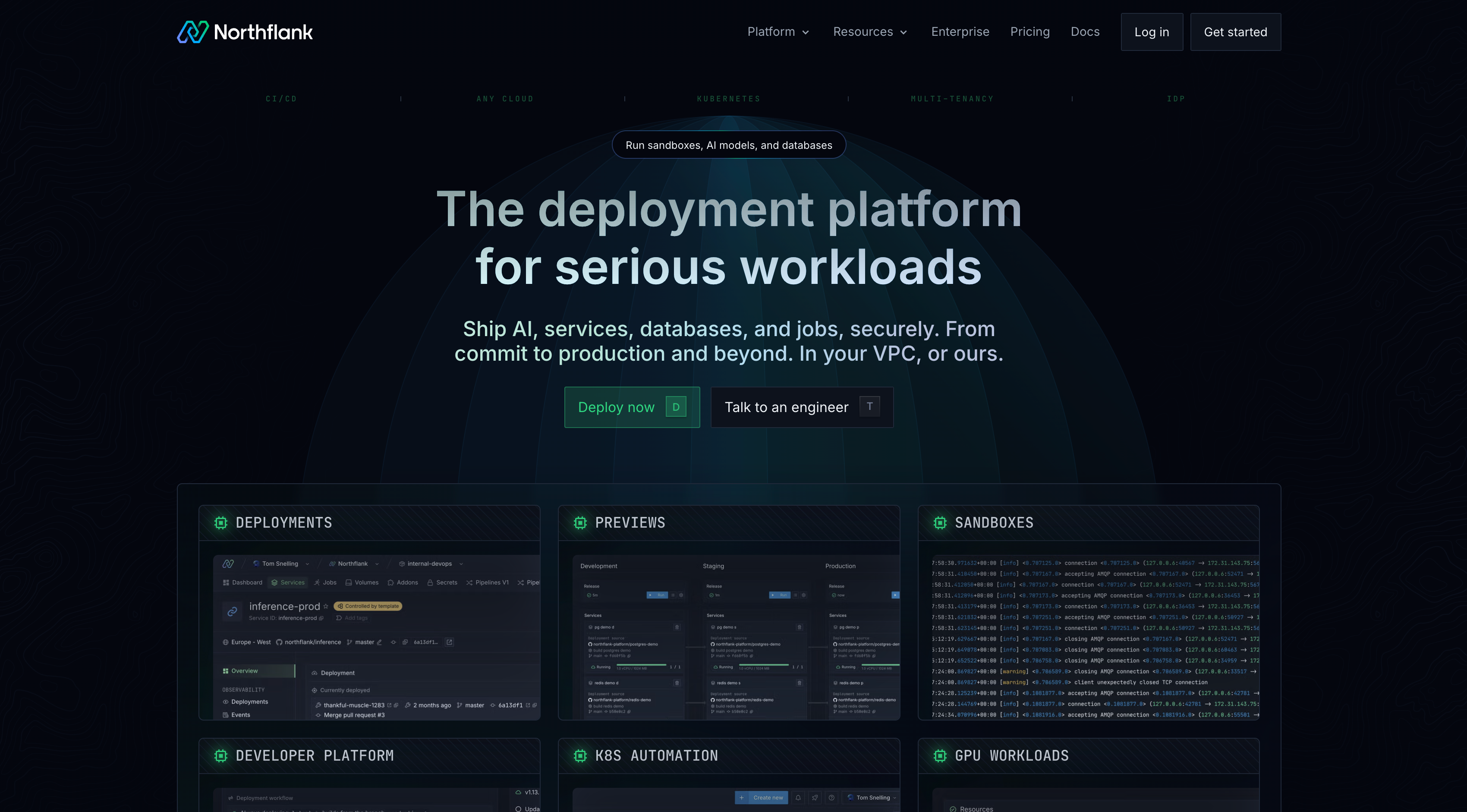
Compared to Railway, Northflank adds bring-your-own-cloud and customer VPC deployment as documented, self-serve options alongside its managed cloud. Compared to Heroku, databases run as services within the same project and billing model as your application, rather than as separately priced add-on products.
Get started with Northflank (self-serve), or book a demo if you have specific infrastructure requirements.
It depends on the workload. Railway's usage-based pricing means a small, low-traffic service can cost less than Heroku's fixed dyno prices, since you pay based on resource consumption above the monthly minimum. For larger workloads, the comparison depends on how Heroku's dyno tier and add-on costs, especially Heroku Postgres at Standard tier and above, compare to Railway's combined usage. Teams comparing usage-based pricing may also want to model Northflank, which bills compute at $0.01667/vCPU/hour and $0.00833/GB/hour to the second, and includes a free Sandbox tier with always-on compute, two services, a database, and two cron jobs.
Yes. Railway's PR Environments provision a preview environment per pull request, copying the services, networking, and variables from the base environment, and remove it once the PR is merged or closed. Heroku Review Apps serve a similar purpose within Heroku Pipelines. For teams whose stack includes GPU workloads or requires deployment into their own cloud, options Railway and Heroku don't support, Northflank's preview environments extend full-stack, per-pull-request previews to that infrastructure.
Migrating a Heroku app generally involves exporting your Postgres database, recreating your add-ons or their equivalents on the new platform, and redeploying your codebase via Git or a Docker image. The exact steps depend on which add-ons your app depends on. See the step-by-step Heroku migration guide for a detailed walkthrough.
Heroku's March 2026 update describes a shift to a "Sustaining Engineering" model, focused on stability, security, and reliability for existing customers, alongside continued releases such as the Fir dyno runtime and Heroku AI Managed Inference and Agents.
Railway lets you deploy open-source databases, including Postgres, MySQL, and Redis, as services within a project. Railway describes these as unmanaged services: the platform provides volumes, backups, private networking, and a TCP proxy, but performance tuning, security, and monitoring are the user's responsibility. This differs from Heroku Postgres, a separate managed add-on product with its own pricing, from $5/month for Essential-0 up to tens of thousands per month for the largest Premium and Shield configurations.