
Sandbox providers: types, categories, and top platforms in 2026
Sandbox providers cover several distinct categories, and the right one depends entirely on what you are building and what your infrastructure requirements are.
- Sandbox providers range from managed cloud services and self-hosted runtimes for AI code execution to browser-based developer tools and malware analysis environments. Knowing which category you need narrows the field immediately.
- For AI code execution, the critical evaluation criteria are isolation model, session lifecycle (ephemeral vs persistent), BYOC (Bring Your Own Cloud) support, compliance coverage, and whether the platform covers your full workload runtime or just code execution.
Northflank provides secure sandbox infrastructure backed by microVM isolation (Kata Containers, Firecracker and gVisor, applied per workload), support for both ephemeral and persistent environments with no forced time limits, self-serve BYOC across AWS, GCP, Azure, Oracle, CoreWeave, and bare-metal, SOC 2 Type 2 compliance, GPU support, and a full workload runtime for APIs, workers, databases, and jobs alongside sandboxes.
Sandbox providers span several distinct categories. Depending on your use case, you could be looking for isolated runtimes for AI-generated code, malware analysis environments, or browser-based developer tools.
This guide maps the main categories, explains what distinguishes each one, and goes deep on AI code execution sandbox providers, the category most relevant to engineering teams building AI products, multi-tenant platforms, and agent infrastructure.
A sandbox provider is a vendor or platform that delivers isolated execution environments, either as managed infrastructure or a self-hosted runtime. The core function of any sandbox is containment: workloads inside the sandbox cannot affect what is outside it.
The isolation technology determines how strong that containment is. At one end, standard Linux containers share the host kernel and rely on namespace separation.
At the other end, microVMs (such as Firecracker and those managed by Kata Containers) give each workload a dedicated kernel, which limits the impact of a kernel-level exploit to that workload.
The type of provider you need depends on which threat model you are protecting against and what your architecture looks like.
For a detailed breakdown of isolation models and lifecycle patterns, see what is a sandbox environment?
The main categories of sandbox providers differ in isolation model, use case, and the type of team evaluating them:
These providers deliver isolated runtimes for executing code generated by LLMs and AI agents. The defining characteristics are fast environment creation, strong workload isolation, and APIs or SDKs that fit into agent orchestration flows.
Use cases include:
- AI coding assistants running generated code
- Multi-tenant SaaS platforms where each customer executes custom logic
- Reinforcement learning pipelines running parallel code evaluations
- Any product where untrusted code executes on shared infrastructure
See what is an AI sandbox? for a deeper look at this category.
These providers deliver isolated environments for detonating and analyzing potentially malicious files, URLs, and executables. The defining characteristics are deep inspection capabilities, behavioral analysis, and integration with threat intelligence workflows. Use cases include malware detonation, URL and file reputation scoring, threat detection, and SOC automation pipelines.
These providers deliver browser-based IDEs, pull request preview environments, and cloud development containers. The use cases are frontend prototyping, collaborative development, and ephemeral environments tied to a code review workflow. For alternatives in this space, see CodeSandbox alternatives.
When you are choosing between sandbox providers for AI workloads, there are a few questions worth working through before you commit to a platform:
- What isolation model does the provider use? Containers, gVisor, and microVMs offer meaningfully different security guarantees. For truly untrusted code, microVM-level isolation is the current standard. See Kata Containers vs Firecracker vs gVisor for a technical breakdown.
- Does it support both ephemeral and persistent environments? Ephemeral sandboxes handle stateless, short-lived execution. Persistent environments are needed when an agent or user session must survive across multiple interactions or days. Many providers support only one or the other.
- What does "cold start" actually measure? Check whether the figure covers only the microVM start step or the full environment readiness, including network attachment, filesystem mount, and process initialization.
- Can the provider deploy inside your own infrastructure? Regulated industries and enterprise AI teams often have requirements that prevent execution workloads from leaving their own infrastructure. The BYOC (Bring Your Own Cloud) deployment model keeps the execution plane inside your VPC. See self-hosted AI sandboxes and top BYOC AI sandboxes for more on deployment models.
- Is the provider compliant? If you are building for regulated industries or selling into enterprises, compliance certifications like SOC 2 Type 2 are often a hard requirement at the procurement stage. Check what the provider is certified for and whether it covers your specific requirements.
- What is the platform scope? Sandbox-only products require you to manage separate infrastructure for databases, APIs, GPU workloads, and background jobs. If sandboxes are core to your product architecture, you will likely need more than just isolated code execution as your requirements grow.
The platforms below are the most commonly evaluated options for AI agent infrastructure and production code execution.
- Northflank: A workload platform with microVM-based sandbox infrastructure (Firecracker, Kata Containers, and gVisor, applied per workload), support for both ephemeral and persistent environments with no forced time limits, self-serve BYOC (Bring Your Own Cloud) across AWS, GCP, Azure, Oracle, CoreWeave, and bare-metal, SOC 2 Type 2 compliance, and GPU support alongside APIs, workers, and databases in the same control plane.
- E2B: An API-driven sandbox platform for AI agent developers, with Python and JavaScript SDKs. Supports sandbox persistence through snapshots and AutoResume.
- Modal: A serverless compute platform with gVisor-based sandbox isolation and Python, JavaScript, and Go SDKs. Sandbox timeouts are configurable up to 24 hours, with snapshot-based state preservation for longer workflows.
- Vercel Sandbox: A Firecracker microVM-based sandbox product for running untrusted code. Supports Node.js and Python runtimes, snapshotting, and a TypeScript SDK.
- Together Code Sandbox: A sandbox product built on CodeSandbox SDK infrastructure, using Firecracker VMs with memory snapshot and restore support.
Pricing as of April 2026. Billing models differ across platforms (some bill based on active CPU usage only, others bill for the entire duration the sandbox is running). Verify current rates on each platform's pricing page before making cost decisions.
| Platform | CPU | Memory | Storage | GPU | Billing model |
|---|---|---|---|---|---|
| Northflank | $0.01667/vCPU-hr | $0.00833/GB-hr | $0.15/GB-month | L4: $0.80/hr, A100 40GB: $1.42/hr, A100 80GB: $1.76/hr, H100: $2.74/hr, H200: $3.14/hr | Per second |
| E2B | $0.0504/vCPU-hr | $0.0162/GiB-hr | 10–20GB included free | Do not provide GPU compute | Per second |
| Modal Sandboxes | $0.1419/physical core-hr (2 vCPU) | $0.0242/GiB-hr | — | L4: $0.80/hr, A100 40GB: $2.10/hr, A100 80GB: $2.50/hr, H100: $3.95/hr, H200: $4.54/hr | Per second |
| Vercel Sandbox | $0.128/vCPU-hr | $0.0212/GB-hr | $0.023/GB-month (snapshots) | Do not provide GPU compute | Active CPU only |
For a full ranked breakdown with pricing, isolation details, and session lifecycle comparisons, see top AI sandbox platforms for code execution.
The table below shows how each platform handles BYOC deployment, which clouds are supported, and whether it requires a sales process.
| Platform | BYOC available | Clouds supported | Access model | Pricing model |
|---|---|---|---|---|
| Northflank | Yes, fully self-serve | AWS, GCP, Azure, Oracle, CoreWeave, any neoclouds, Civo, bare-metal, on-premises | Self-serve, enterprise contracts available for larger commits (with bulk discounts) | Your existing cloud bill, CPU $0.01389/vCPU-hr and Memory $0.00139/GB-hr* |
| E2B | Yes, limited and not self-serve | AWS and GCP only | Not publicly disclosed, need to contact sales | Starts at $50/sandbox/month, on top of your existing cloud bill |
| Modal | No | Managed only | — | — |
| Vercel Sandbox | No | Managed only (iad1 region only) | — | — |
Northflank is a workload platform that includes secure sandbox infrastructure as a first-class product. Sandboxes run on Northflank's managed cloud or inside your own VPC, with BYOC (Bring Your Own Cloud) available self-serve across AWS, GCP, Azure, Oracle Cloud, CoreWeave, Civo, bare-metal, and on-premises infrastructure.
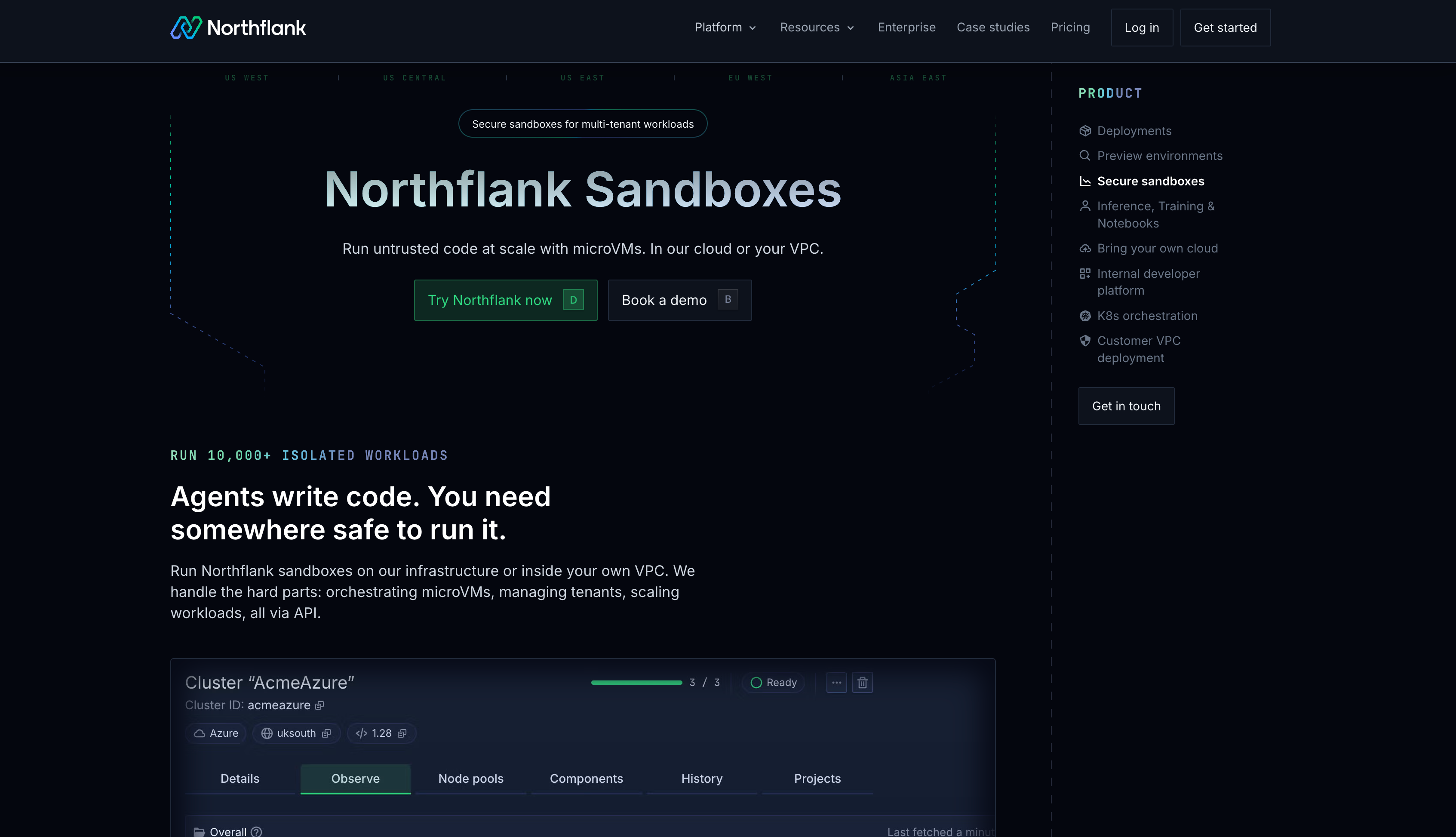
Key capabilities include:
- Isolation: Firecracker, Kata Containers, and gVisor applied per workload at the infrastructure level, with orchestration, multi-tenant isolation, autoscaling, and bin-packing handled by the platform. Sandboxes reach interactive readiness in a median of 97ms (167ms under concurrent burst, 100% success rate), per ComputeSDK benchmarks (July 2026).
- Ephemeral and persistent environments: Run sandboxes ephemerally for stateless jobs or make them persistent with no forced time limits. Persistent volumes, S3-compatible object storage, and stateful databases (Postgres, Redis, MySQL, MongoDB) run alongside sandboxes in the same control plane.
- Full workload runtime: APIs, workers, GPU workloads, and databases run in the same platform as sandboxes, so teams do not need to manage separate vendors as requirements grow.
- GPU support: NVIDIA H100, A100, L4, and others. H100 is priced at $2.74/hour. See full GPU and compute pricing.
- Compliance: SOC 2 Type 2 certified, with BYOC deployment for data residency and regulated industries.
Northflank has been running microVM workloads in production since 2021 across startups, public companies, government deployments, and regulated industries. cto.new runs thousands of daily code executions on Northflank's sandbox infrastructure and scaled to 30,000+ users without infrastructure changes.
CPU is priced at $0.01667/vCPU-hour and memory at $0.00833/GB-hour. See the full GPU and compute pricing.
To make the pricing difference concrete, here is what 200 sandboxes costs across providers under the same conditions.
Based on 200 sandboxes, plan: nf-compute-100-4, infra node: m7i.2xlarge
| Model | Provider | Cloud | Sandbox vendor | Total |
|---|---|---|---|---|
| PaaS | Northflank | — | $7,200.00 | $7,200.00 |
| PaaS | E2B | — | $16,819.20 | $16,819.20 |
| PaaS | Modal | — | $24,491.50 | $24,491.50 |
| PaaS | Vercel Sandbox | — | $31,068.80 | $31,068.80 |
| BYOC (0.2 overcommit)* | Northflank | $1,500.00 | $560.00 | $2,060.00 |
| BYOC | E2B | $1,500.00 | $10,000.00 | $11,500.00 |
*Through Northflank's plans on BYOC, there's a default overcommit, which allows a customer to spawn more services and sandboxes on the same amount of compute. A request modifier of 0.2 means each sandbox only requests 20% of its plan's resources as a guaranteed minimum, but can burst up to the full plan limit if there's available capacity on the node. So instead of fitting 8 sandboxes per node, you could fit 40 on the same hardware, reducing both infrastructure cost and the Northflank management fee.
For a hands-on walkthrough of spinning up a secure sandbox and microVM on Northflank, see this step-by-step guide. Get started on Northflank or book a demo with the engineering team to discuss your requirements.
The questions below cover what engineering teams most commonly ask when evaluating sandbox providers.
The main categories are AI code execution sandbox providers, network and security sandbox providers, and developer environment sandbox providers. Each serves a different use case and a different set of technical requirements.
A managed sandbox provider runs all execution infrastructure in the vendor's cloud. A BYOC (Bring Your Own Cloud) sandbox provider keeps the execution plane inside your own cloud account or VPC while the vendor manages orchestration. BYOC is relevant when workloads must meet data residency requirements, access private services, or stay within a regulated network boundary. Platforms like Northflank support both deployment models, with BYOC available self-serve across multiple cloud providers and on-premises infrastructure.
The most commonly evaluated platforms are Northflank, E2B, Modal, Vercel Sandbox, and Together Code Sandbox. The right choice depends on your isolation requirements, session lifecycle needs, deployment model, and whether you need the sandbox to sit alongside broader workload infrastructure.
In the software infrastructure category, sandbox providers are typically developer infrastructure companies offering compute platforms, serverless runtimes, or application platforms. They range from narrow, sandbox-specific products to full workload platforms where sandboxes are one capability among many.
Some do. Northflank, for instance, supports NVIDIA GPU workloads (H100, A100, L4, and others) within the same platform as sandbox execution. Not all sandbox-focused providers include GPU support, so verify this against your requirements before evaluating.
If you are building for regulated industries or selling into enterprises, compliance certifications are often a hard requirement at the procurement stage. This can include SOC 2 Type 2, ISO 27001, HIPAA, or GDPR depending on your industry and region. For instance, Northflank is SOC 2 Type 2 certified. Northflank is also HIPAA compliant, with BAAs supported under an Enterprise contract. Verify compliance status and which certifications apply to your specific requirements directly with any provider you are evaluating.
The articles below go deeper on specific aspects of sandbox infrastructure covered in this guide.
- What is an AI sandbox?: A detailed explainer on what AI sandboxes are, why they are needed, and how isolation models differ.
- Top AI sandbox platforms for code execution: A full ranked comparison of AI sandbox platforms with pricing, isolation, and session lifecycle breakdowns.
- How to sandbox AI agents: A practical guide to sandboxing agents, covering architecture patterns and isolation requirements.
- Top BYOC AI sandboxes: A comparison of sandbox providers that support deployment inside your own cloud infrastructure.
- Self-hosted AI sandboxes: Covers the three deployment models for self-hosted sandbox infrastructure and how to evaluate them.
- Ephemeral sandbox environments: Explains ephemeral execution patterns and when they are and are not the right fit.
- Persistent sandboxes: Covers when and how to use persistent sandbox environments for stateful workloads.