
What is Alibaba OpenSandbox? Architecture, use cases, and how it works
- Alibaba OpenSandbox is an open-source sandbox platform for AI applications, released under the Apache 2.0 license. It provides multi-language SDKs, standardised sandbox APIs, and Docker and Kubernetes runtimes.
- Its architecture is built on four layers: SDKs, Specs, Runtime, and Sandbox Instances. A Go-based execution daemon (execd) is injected into each container at runtime and handles code execution, file operations, and command execution.
- It supports four sandbox scenarios: Coding Agents, GUI Agents, Code Execution, and RL Training, with integrations for Claude Code, Gemini CLI, OpenAI Codex, LangGraph, Google ADK, Playwright, and Chrome.
- OpenSandbox handles the execution protocol layer. However, running sandbox workloads in production also requires lifecycle orchestration, multi-tenancy, scaling, and persistent storage, which are areas sandbox infrastructure platforms cover.
Northflank Sandboxes runs untrusted code at scale using microVM isolation (Kata Containers, Firecracker, and gVisor), on Northflank's managed cloud or inside your own VPC. Both ephemeral and persistent environments are supported, with sandbox creation taking around 1–2 seconds. BYOC (Bring Your Own Cloud) deployment is available self-serve across AWS, GCP, Azure, Oracle Cloud, Civo, CoreWeave, and on-premises infrastructure. Northflank has been in production since 2021 across startups, public companies, and government deployments.
Alibaba OpenSandbox is an open-source sandbox platform released in March 2026 under the Apache 2.0 license. It sits at the execution layer of the AI agent stack, providing a standardised API for running AI-generated code, browser automation, GUI interactions, and reinforcement learning workloads inside isolated environments.
This article covers what OpenSandbox is, how its architecture works, what it supports, and what production-grade sandbox infrastructure involves.
Alibaba OpenSandbox is a general-purpose sandbox platform for AI applications. It provides multi-language SDKs, sandbox lifecycle and execution APIs, and Docker and Kubernetes runtimes.
It is built on the same internal infrastructure Alibaba uses for large-scale AI workloads and is designed for four primary scenarios:
- Coding Agents: environments for agents that write, test, and debug code
- GUI Agents: environments with full VNC desktop support for agents that interact with graphical interfaces
- Code Execution: runtimes for script and compute execution
- RL Training: isolated environments for reinforcement learning workloads
OpenSandbox is built on a four-layer modular stack where client logic is decoupled from execution environments:
- SDKs Layer: Client libraries for managing sandbox lifecycle and executing code. Exposes four components: Sandbox for provisioning and teardown, Filesystem for file operations, Commands for shell execution, and CodeInterpreter for stateful multi-language code execution
- Specs Layer: Two OpenAPI specifications define the contract between SDKs and runtimes: the Sandbox Lifecycle Spec (sandbox creation, pause, resume, deletion, TTL management) and the Sandbox Execution Spec (code execution, command execution, file operations, and metrics).
- Runtime Layer: A FastAPI-based server manages sandbox orchestration. Supports Docker for local and single-node use, and Kubernetes for distributed deployments. The Kubernetes runtime includes BatchSandbox for sandbox pooling and batch creation, and supports Kata Containers and gVisor as secure container runtimes.
- Sandbox Instances Layer: Each sandbox runs a container with an injected Go-based execution daemon called execd. It is injected at creation time without modifying the base image. execd starts a Jupyter Server inside the container and handles stateful code execution, with output streamed via Server-Sent Events (SSE).
OpenSandbox supports four environment types, each targeting a different agent workload.
| Environment type | What it supports |
|---|---|
| Coding Agents | Code writing, testing, and debugging inside isolated environments |
| GUI Agents | Full VNC desktop environments for graphical interface interaction |
| Code Execution | Script and compute execution across multiple languages |
| RL Training | Isolated environments for reinforcement learning workloads |
It also includes integrations across AI frameworks and developer tools. The table below covers what is currently supported.
| Category | Integrations |
|---|---|
| Coding agent CLIs | Claude Code, Gemini CLI, OpenAI Codex, Kimi CLI |
| Orchestration frameworks | LangGraph, Google ADK |
| Browser automation | Chrome (headless), Playwright |
| Desktop environments | VNC, VS Code Server |
OpenSandbox supports two runtimes for local and production use, and provides SDKs across multiple languages.
OpenSandbox supports two runtimes:
- Docker: for local development and single-node use. Supports host networking and bridge mode with HTTP routing.
- Kubernetes: for distributed deployments. Includes the BatchSandbox runtime with sandbox pooling and batch creation, and is compatible with the Kubernetes SIG agent-sandbox project. Supports Kata Containers and gVisor as secure container runtimes.
OpenSandbox currently provides SDKs in the following languages.
| Language | Status |
|---|---|
| Python | Available |
| JavaScript / TypeScript | Available |
| Java / Kotlin | Available |
| C# / .NET | Available |
| Go | Roadmap |
OpenSandbox defines how sandboxes are created, how code runs inside them, and how output is streamed back. Running that at production scale involves additional considerations beyond the protocol layer itself.
These are the operational areas teams need to account for:
- Lifecycle orchestration: provisioning, monitoring, pausing, resuming, and tearing down sandboxes reliably across concurrent sessions
- Multi-tenancy: enforcing isolation between tenants at the infrastructure level, not just the application level
- Scaling: handling demand spikes, pre-warmed pool sizing, and bin-packing workloads across nodes
- Cold start latency: end-to-end sandbox creation involves image pulling, execd injection, container start, and runtime initialisation. This is longer than VMM boot time alone
- Persistent storage: stateful agent sessions need volumes or databases that survive restarts; this is on OpenSandbox's roadmap but not yet available
- Observability: monitoring sandbox health and resource consumption across concurrent environments
- BYOC (Bring Your Own Cloud) deployment: teams with data sovereignty or compliance requirements need execution inside their own cloud account or VPC
Teams building on OpenSandbox take on responsibility for these layers.
For a deeper look at how self-hosted and managed sandbox approaches compare, see Self-hosted AI sandboxes.
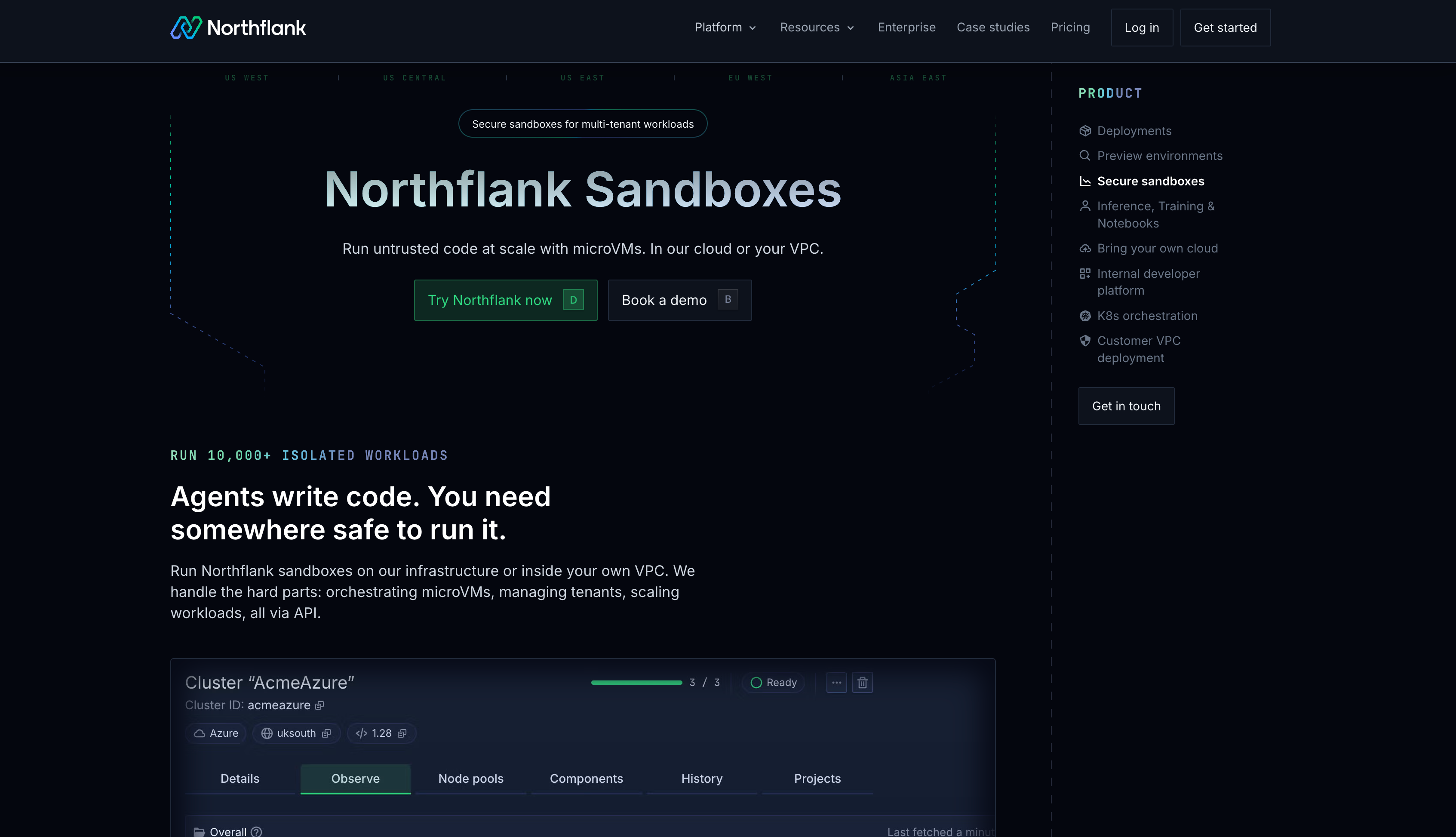
Northflank provides sandbox infrastructure for running untrusted code at scale. It handles microVM orchestration, multi-tenancy, scaling, and lifecycle management. Workloads run on Northflank's managed cloud or inside your own VPC.
Northflank Sandboxes runs every workload in its own microVM using Kata Containers, Firecracker, or gVisor depending on workload requirements. BYOC (Bring Your Own Cloud) deployment is self-serve across AWS, GCP, Azure, Oracle Cloud, Civo, CoreWeave, and on-premises infrastructure. Both ephemeral and persistent environments are supported. Sandbox creation takes around 1–2 seconds end-to-end. GPU support is available on-demand without quota requests. Northflank has been in production since 2021.
Here is how OpenSandbox and Northflank compare across the main infrastructure dimensions:
| OpenSandbox | Northflank | |
|---|---|---|
| Deployment model | Self-managed (Docker or Kubernetes) | Managed cloud or BYOC (Bring Your Own Cloud) self-serve |
| Isolation | Container-level, with Kata / gVisor on Kubernetes | MicroVM per workload (Kata, Firecracker, gVisor) |
| Persistent environments | Roadmap | Available |
| BYOC (Bring Your Own Cloud) | Self-managed | Self-serve across AWS, GCP, Azure, Oracle Cloud, Civo, CoreWeave, and on-premises |
| Scaling and orchestration | Self-managed | Platform-managed |
| GPU support | Runtime-dependent | Available on-demand |
| Pricing | Open source (infrastructure costs apply) | CPU $0.01667/vCPU/hour, Memory $0.00833/GB/hour (Full GPU and compute pricing) |
| License | Apache 2.0 | Commercial |
For a broader comparison of sandbox platforms, see Best code execution sandbox for AI agents, Top BYOC AI sandboxes, and Self-hosted AI sandboxes.
OpenSandbox provides a standardised execution layer for AI agent workloads, giving developers a single API for running code, managing files, and executing commands inside isolated environments across Docker and Kubernetes runtimes.
Yes, OpenSandbox is released under the Apache 2.0 license. The source code, including SDKs, server, specs, and examples, is available on GitHub at github.com/alibaba/OpenSandbox.
OpenSandbox supports Docker for local and single-node deployments and Kubernetes for distributed deployments. The Kubernetes runtime supports Kata Containers and gVisor as secure container runtimes. Teams running sandbox workloads in production can use Northflank Sandboxes, which provides Kata Containers, Firecracker, and gVisor isolation with a managed control plane.
OpenSandbox currently provides SDKs for Python, JavaScript/TypeScript, Java/Kotlin, and C#/.NET. A Go SDK is listed on the project roadmap.
OpenSandbox is designed for platform engineers and AI agent developers who want an open-source, self-managed execution layer they can run on Docker locally or on Kubernetes in production.
OpenSandbox's Kubernetes runtime supports distributed sandbox deployments. It includes a BatchSandbox implementation for high-throughput batch creation and is compatible with the Kubernetes SIG agent-sandbox project. It also supports Kata Containers and gVisor as secure container runtimes. For background on multi-tenancy considerations on Kubernetes, see Kubernetes multi-tenancy.
The articles below cover isolation models, sandbox platforms, and infrastructure options for running untrusted code at scale:
- How to sandbox AI agents: Covers isolation strategies for AI agent workloads, including microVMs, gVisor, and how to match an isolation model to your threat profile.
- Kata Containers vs Firecracker vs gVisor: A detailed comparison of the three major isolation technologies used in production sandbox infrastructure, including how they handle kernel boundaries and which workloads each fits.
- Self-hosted AI sandboxes: Breaks down the difference between DIY, self-hosted, and BYOC sandbox approaches and what changes operationally with each.
- Best code execution sandbox for AI agents: Compares leading sandbox platforms across isolation models, lifecycle design, session limits, and operational responsibility.
- Top BYOC AI sandboxes: Compares sandbox platforms that support bring-your-own-cloud deployment across isolation, lifecycle design, and operational overhead.
- Self-hostable alternatives to E2B for AI agents: Covers the top self-hostable options for AI agent code execution, including how they compare on isolation strength and deployment complexity.
- Kubernetes multi-tenancy: Explains how multi-tenancy works on Kubernetes and the isolation considerations relevant to running sandbox workloads across tenants.
- Ephemeral sandbox environments: Covers how ephemeral sandbox environments work, when to use them, and how they differ from persistent execution environments.