
7 best Upsun alternatives for flexible cloud deployment
Upsun offers Git-driven deployments with production-like preview environments across AWS, Azure, and GCP for teams managing complex web applications with multi-cloud requirements.
If you're looking for alternatives to Upsun, it might be because of cost scaling concerns, a need for Kubernetes-native architecture, a desire to run infrastructure in your own cloud account, or the need for GPU support for AI workloads.
We'll cover some of the top Upsun alternatives in this article.
For a quick overview of the 7 best Upsun alternatives, here's the list based on their architectural approach and deployment flexibility:
- Northflank – Kubernetes-native platform with BYOC support (deploy in Northflank's cloud or bring your own infrastructure: AWS, GCP, Azure, Civo, Oracle, or bare-metal), managed databases (PostgreSQL, MySQL, Redis, MongoDB), GPU workloads, zero-downtime deployments, and autoscaling for teams needing infrastructure control without operational overhead
- Render – Git-based deployments with managed Postgres, zero-downtime releases, and background workers for structured production workloads
- Railway – Usage-based platform with visual service canvas and fast iteration for prototyping and small teams
- Fly.io – Global edge deployment with VM-level control and Anycast networking for latency-sensitive applications
- DigitalOcean App Platform – Managed PaaS with predictable pricing and DigitalOcean ecosystem integration
- Heroku – PaaS with extensive add-on marketplace and buildpack support
- Vercel – Frontend-optimized platform with serverless functions and edge network for Jamstack applications
When evaluating Upsun alternatives, look out for the following capabilities:
Key evaluation criteria:
- Architecture flexibility – Native container and Kubernetes support vs proprietary deployment models
- Infrastructure control – Ability to run in your own cloud account (BYOC) or bring your own Kubernetes clusters
- Pricing transparency – Usage-based models that scale predictably vs per-user licensing
- Modern workload support – GPU capabilities, microservices orchestration, and stateful applications
- DevOps integration – Native CI/CD, GitOps support, and external tool compatibility
- Escape velocity – Migration paths and avoidance of vendor lock-in through standard technologies
We're evaluating these platforms based on their architectural approach, deployment flexibility, pricing models, and support for modern cloud-native workflows.
Northflank provides a Kubernetes abstraction layer that delivers PaaS simplicity while maintaining the power and portability of container orchestration.
You can either deploy to Northflank's managed Kubernetes cloud or connect your existing infrastructure (AWS, GCP, Azure, Civo, Oracle, or bare-metal).
You can run containerized applications, managed databases, GPU workloads, scheduled jobs, and background workers on a single unified platform without requiring Kubernetes expertise.
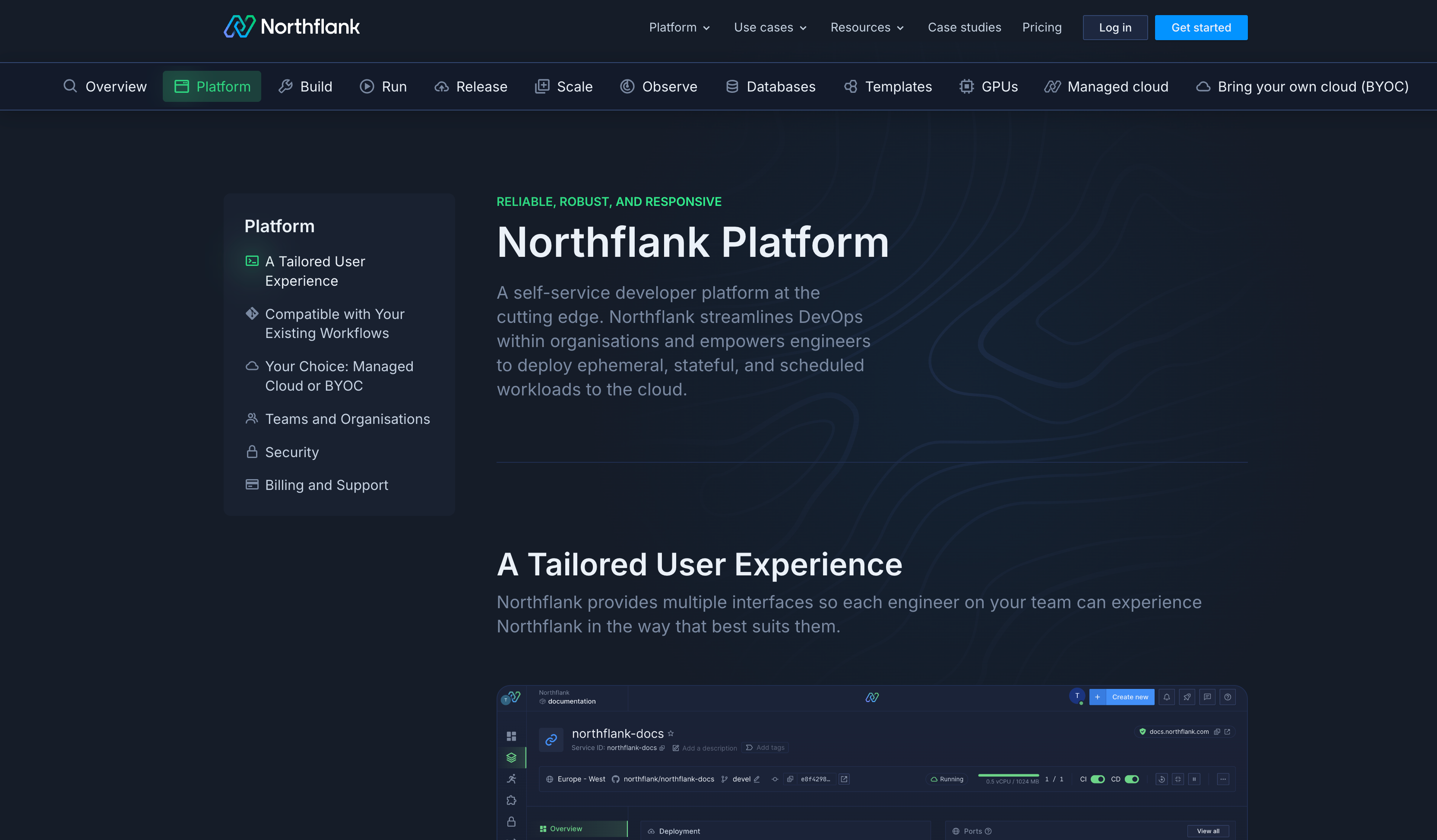
Key capabilities:
- Kubernetes-native architecture with no vendor lock-in – Built on K8s from the ground up with standard APIs and Dockerfiles, giving you container portability across any cluster or cloud provider without vendor-specific configuration formats
- Bring Your Own Cloud (BYOC) – Deploy to your AWS, GCP, Azure, Civo, Oracle, or bare-metal infrastructure while maintaining the same developer experience, addressing compliance and cost control requirements
- Managed databases and persistent storage – Provision PostgreSQL, MySQL, MongoDB, Redis with automated backups, monitoring, and production-grade persistent storage
- GPU support – Run AI inference, training, and LLM workloads with fractional GPU allocation and spot instance orchestration
- Zero-downtime deployments with autoscaling – Deploy production releases with automatic health checks, rollback capabilities, and horizontal/vertical scaling based on metrics
- MicroVM isolation – Secure code execution using Kata Containers for multi-tenant environments or untrusted code
- Unified workflow management – Deploy applications, databases, scheduled jobs, background workers, and release pipelines through consistent UI, CLI, API, or GitOps interfaces with external CI/CD integration (GitHub Actions, GitLab CI)
- Flexible networking – Private and public networking configuration for services, databases, and add-ons with built-in service discovery
- Infrastructure as Code and preview environments – Template systems for standardizing deployments and Git branch deployments that create isolated environments with configurable data sharing
- Usage-based pricing – Pay by the second for CPU, memory, GPU, networking, and storage
Best for: Platform engineering teams building internal developer platforms, SaaS companies requiring multi-tenancy and GPU workloads, enterprises needing BYOC (Bring Your Own Cloud) for compliance or cost optimization, teams running microservices architectures, organizations with AI/ML workloads requiring GPU support, development teams wanting Kubernetes benefits without YAML complexity, and companies needing infrastructure control with data residency requirements.
Start with Northflank's free sandbox to deploy your first application, or book a demo with our engineering team to discuss your specific infrastructure requirements and migration path. See full pricing details
Render provides managed application hosting with Git-based deployments and integrated services.
Key capabilities:
- Automatic deployments from Git with preview environments for pull requests
- Managed PostgreSQL with point-in-time recovery and automatic failover
- Native support for background workers and scheduled tasks
- Zero-downtime deployments with health checks
- Private networking between services
Best for: Teams migrating from Heroku who need managed databases and background job processing without infrastructure management.
See more:
Railway offers project-based deployments with visual service management and integrated provisioning.

Key capabilities:
- Visual project canvas showing service relationships and connections
- Template marketplace for common application stacks
- Volume support for persistent data
- Database provisioning (Postgres, MySQL, Redis, MongoDB)
- Usage-based pricing with monitoring and spend controls
Best for: Solo developers and small teams prioritizing deployment speed over infrastructure customization.
See more:
Fly.io runs applications on lightweight VMs distributed globally across edge locations. The platform provides VM-level control with Anycast networking for routing traffic to the nearest instance.

Key capabilities:
- Global deployment across 30+ regions with automatic request routing
- Fly Machines (lightweight VMs) with customizable CPU and memory
- WireGuard-based private networking between instances
- Volume support for persistent storage
- Metrics-based autoscaling using fly-autoscaler application that polls metrics and scales via the Machines API
Best for: Applications requiring global edge deployment and low-latency access for distributed user bases.
See more:
DigitalOcean App Platform provides managed deployments integrated with DigitalOcean's infrastructure services. The platform handles builds, deployments, and scaling while connecting to managed databases and other DigitalOcean products.

Key capabilities:
- Automatic deployments from GitHub, GitLab, or container registries
- Integration with DigitalOcean Managed Databases and Spaces
- Auto-scaling based on traffic patterns
- Built-in CDN for static assets
- Alerts and monitoring dashboards
Best for: Teams already using DigitalOcean infrastructure who want managed application deployments within the same ecosystem.
See more:
Heroku provides buildpack-based deployments with an extensive add-on marketplace. The platform abstracts infrastructure management through dynos (containerized processes) and managed services.

Key capabilities:
- Buildpack support for automatic language detection and dependency installation
- Add-on marketplace with 200+ integrations for databases, monitoring, and caching
- Heroku Postgres with automated backups and rollback capabilities
- Review apps for automated preview environments
Best for: Organizations with existing Heroku deployments seeking minimal migration friction.
See more:
Vercel specializes in frontend frameworks with serverless function support and global edge network distribution. The platform integrates deeply with Next.js and other modern JavaScript frameworks.
Key capabilities:
- Automatic preview deployments for every Git push
- Edge network with 100+ global locations
- Serverless Functions for API endpoints
- Image optimization and caching
- Built-in analytics and Web Vitals monitoring
Best for: Frontend applications and Next.js projects requiring global CDN distribution and serverless backend capabilities.
See more:
- Can you use Vercel for backend? What works and when to use something else
- Best Vercel Alternatives for Scalable Deployments
- Vercel vs Netlify: Choosing the right one in 2026 (and what comes next)
- Vercel vs Heroku: Which platform fits your workflow best?
- Top Vercel Sandbox alternatives for secure AI code execution and sandbox environments
Match the platform architecture to your application requirements and team capabilities rather than defaulting to the most feature-rich option.
| Your priority | Best fit | Why |
|---|---|---|
| Infrastructure control & compliance | Northflank | BYOC option (Bring your own cloud) lets you run in your own cloud account with full control over networking, security, and data residency |
| Kubernetes without complexity | Northflank | K8s-native architecture with abstraction layer removes YAML management while preserving portability |
| GPU and AI workloads | Northflank | Native GPU support with spot instances and fractional allocation for cost optimization |
| Managed databases & workers | Render, Northflank | Managed database provisioning with background workers and scheduled jobs, plus monitoring and automated backups |
| Internal tools and side projects | Railway | Visual service canvas with template-based deployment and monitoring |
| Global edge performance | Fly.io | Anycast routing and edge deployment minimize latency for distributed users |
| DigitalOcean ecosystem | DigitalOcean App Platform | Native integration with DO databases, storage, and services |
| Existing Heroku apps | Heroku | Minimal migration complexity if already using Heroku buildpacks and add-ons |
| Next.js & frontend focus | Vercel | Deep Next.js integration with global CDN and serverless functions |
Northflank addresses the core limitations teams encounter with traditional PaaS platforms through Kubernetes-native architecture, infrastructure control via BYOC (Bring Your Own Cloud), and modern workload support, including GPU capabilities. The platform maintains developer experience simplicity while providing the flexibility required for complex production environments.
Start with Northflank's free sandbox to deploy your first application, or book a demo with our engineering team to discuss your specific infrastructure requirements and migration path.